

FuturPulse analysis · 13 October 2026
jialinyyzz/humanizer’s 12-billion-parameter weights change the rewrite engine itself, not merely its wording prompt: they make a local model prefer reorganised, less formulaic prose while trying to retain numbers, names, dates and quotations. The current release supplies files from 3.9 GB to 23.8 GB.
At a glance
- The published Humanizer model is a 12B text-rewriting model that runs locally in English and Chinese.
- The full bf16 weights occupy 23.8 GB as a GGUF file, while the smallest published two-bit file is 3.9 GB.
- The project’s October evaluation recorded 11 AI-detector flags in 210 English rewrites using full bf16 weights.
- The Q8_0 download recorded 44 factual flags across 420 English rewrites in the project’s strict judge test.
What do the Humanizer AI weights actually change?
The weights change which next words the model is inclined to produce after reading a draft and instruction. In this case, the model card defines the job narrowly: rewrite AI-written emails, essays, reports and posts so they read less like language-model output, while preserving factual material. That is a different mechanism from a generic website rule that swaps phrases after text arrives at a server.
The project’s instruction tells the model to reorganise prose, vary sentence length, cut hedging and empty introductions, and use concrete wording. It also tells the model that every fact, number, unit, date, name and quotation must survive. The published prompt format matters because it steers each request, but the weights are what make that instruction produce a particular distribution of rewrites.
The model is a fine-tune of Google Gemma 4 12B, according to its model card. Its configuration identifies the architecture as Gemma4UnifiedForConditionalGeneration, uses bfloat16 values, and lists a 3,840-wide text representation. That configuration file describes the machinery that holds the learned values; it does not disclose a simple list of “human phrases” added to the model.
That distinction is the useful answer to “what changed?” The release does not claim to install a grammar checker, a plagiarism filter, or an AI-detector bypass switch inside an otherwise unchanged chatbot. It publishes a specialised set of learned values plus a fixed rewriting instruction. The result can still be wrong, because learned preferences are not a guarantee that every detail will survive.
How is this different from an online humanizer?
Most humanizer landing pages describe the visible result rather than the model underneath. Evernote says its AI Humanize varies sentence structure, improves flow, adds transitions and may use colloquialisms while retaining meaning. Evernote also says submitted material is deleted within 30 days and supports more than 50 languages.
Prepostseo says its free tool analyses context and rewrites wording and sentence structure, with a 700-word free-request limit. Its page also advertises paid plans, document uploads and detector-passing claims. Those features may be convenient, but they do not tell a reader which base model, training examples, weight files, sampling settings, or factual-error measurements produced a rewrite.
Humanizer’s open release changes that level of visibility. A user can select the weight file, inspect the prompt, run the model offline and choose an execution tool. The practical gain is control: a private draft need not be pasted into a browser service. The trade-off is a large download, local memory needs and responsibility for checking the result.
What was promised, and what shipped?
The published record shows a sequence from repository creation to a revised release and runnable local files. It also shows that some reliability claims are measurements on defined tests, not universal promises.
Repository created. The model page lists this as the creation date for jialinyyzz/humanizer. The eventual repository was labelled for text generation, rewriting, paraphrase and style transfer, rather than as a general assistant.
Detector result measured. The project recorded 11 flags among 210 English bf16 rewrites in Originality.ai’s strictest setting, or 95% judged human in that one test. The same evaluation lists 26 flags for the prior release.
Prompt settings shipped inside GGUF metadata. The model card says files uploaded from this date include the intended sampling settings and a chat template. That reduces one source of accidental variation for compatible local applications.
The public release offers six size choices. The project lists full bf16 weights, Q8_0, Q6_K, Q4_K_M, Q3 and IQ2_XS files. It also lists local use through llama.cpp, LM Studio, vLLM, Docker and related tools.
The key promise is factual preservation. The shipped evidence is weaker and more useful: on the project’s 420 English-rewrite test, the strict judge found no factual issue in 376 Q8_0 outputs. The same release notes say more than nine in 10 identified issues were a word or phrase, but even a one-word error can change a contract, grade, date or price.
Which weight file fits a local computer?
The files differ mainly in precision. Quantisation stores learned values with fewer bits, shrinking the download and memory load. The publisher says its smallest files used tensor-specific bit allocation and quantisation-aware training, meaning lower-precision files were trained to imitate the full bf16 model rather than simply rounded once.
The project’s published table gives measured or estimated peak memory for its Mac setup. Our calculation below uses the file sizes and adds a modest context-cache allowance; it is not a hardware test. Your system also needs memory for its operating system and the app running the model.
| Humanizer weight file | Download size | Publisher peak memory | Our planning estimate | What changes for the user |
|---|---|---|---|---|
| IQ2_XS | 3.9 GB | 6.2 GB | 4.5 GB | Smallest download; more factual slips in the project’s test. |
| Q3-QAT | 5.6 GB | 8.0 GB | 6.4 GB | Fits smaller machines with a stated quality trade-off. |
| Q4_K_M | 7.6 GB | 10.0 GB | 8.8 GB | A middle option when disk space is limited. |
| Q6_K | 10.0 GB | About 11.0 GB | 11.5 GB | The publisher reports no measurable quality loss. |
| Q8_0 | 12.7 GB | 13.7 GB | 14.6 GB | The project’s recommended local-quality file. |
| bf16 | 23.8 GB | About 24.8 GB | 27.4 GB | Full-precision reference, with the largest memory demand. |
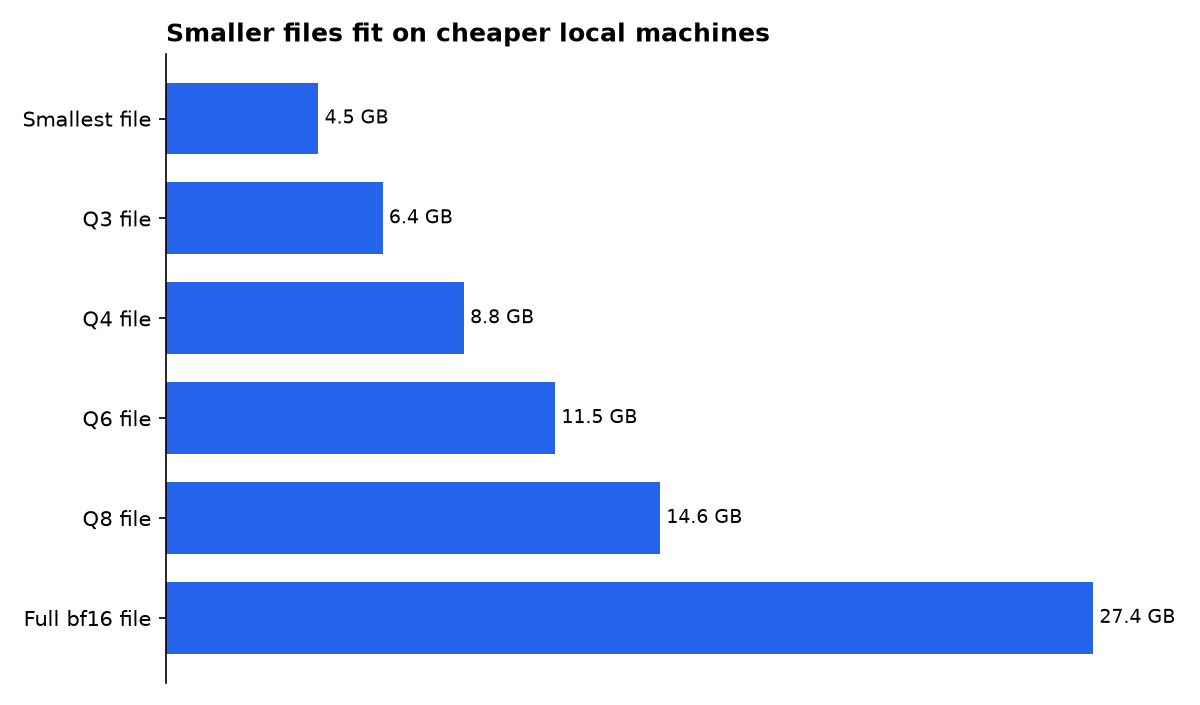
The apparent mismatch between our planning figures and the publisher’s peak-memory figures is expected. File size is storage, while peak memory includes runtime overhead and context. The publisher’s Mac figures are therefore the safer operational guide; our calculation from the published files is a rough minimum-planning view for someone deciding whether a model might fit at all.
Do smaller weights alter the writing itself?
Yes. Lower precision changes the numeric representation of the learned values, so it can change individual token choices and therefore the rewrite. The project measures agreement with the bf16 model by asking how often a smaller file chooses the same most-likely next token.
The full bf16 file is the reference at 100%.
The project’s factual test shows the same direction, though not a straight line. Q8_0 had 44 flagged rewrites out of 420, while the two-bit file had 70. The bf16 reference had 52, illustrating an important point: greater numerical fidelity to bf16 does not automatically produce the fewest judge flags on every sample.
For a reader, the sensible choice is not “smallest always wins” or “full precision is flawless.” Use Q8_0 or Q6_K where memory permits, then proofread names, dates, quantities and quotations. Use Q3 or IQ2_XS only when local capacity is the deciding constraint and the draft can receive closer review.
Can a humanizer guarantee detector results?
No. Humanizer’s result is a dated measurement against one detector configuration, not a promise that every rewrite will be classified as human. The project itself says detector results change over time and guarantees no outcome. It also says the tool should be used for a person’s own drafts and subject to school, employer or publication rules.
That caution separates the open model from much of the category’s marketing. Humanizer Pro says it can achieve 90% or higher human scores across detectors, while its own page also presents “100% effectiveness” language. EssayDone advertises three rewritten options and a 5,000-word session limit while positioning its product around bypassing detectors.
EssayDone’s page makes broad claims about Turnitin and other detection systems. Those are vendor claims, not a substitute for understanding an institution’s policy or checking factual accuracy. A detector score also says nothing reliable about whether a rewritten sentence still conveys the original evidence.
What should writers check after humanizing text?
Check the items the model is specifically asked to preserve: figures, units, dates, names, quotations, citations and qualifications. Humanizer’s own limitations say formatting changed in 28 of 420 outputs, and it warns that headings, lists and paragraph breaks can merge or disappear.
Then check whether the rewrite still sounds like the writer. Wordtune’s approach is more explicitly editor-led: it asks users to choose among suggestions and set tone or length. That workflow treats humanisation as revision, not a pass-fail test against a detector.
A useful review sequence is short:
- Compare every number, date and name with the original.
- Restore citations, headings, tables and list structure.
- Remove slang, invented certainty or casual wording that does not fit the audience.
- Read the final version for meaning, not for a detector score.
That human check is not optional. As a 11 October essay on AI use argues, the useful line is between skilled use with feedback and delegation without understanding or oversight. The open weights give a writer more control over where the model runs and which version runs; they do not transfer editorial judgment into the file.
What we could not verify?
No public claim establishes that Humanizer’s weights make every output factually identical to its input, safe for academic submission, or consistently undetectable by every present and future classifier. The released evaluation covers defined English and Chinese sets, named configurations and specified dates. A broader independent audit could settle how those results hold across other domains, languages, detectors and longer documents.
The public release does not identify every individual training example in a way that lets an outside reader infer why a specific sentence changed. The project links training data and describes its process, but only the publisher can fully explain a particular learned preference, retrain the model, or publish additional independent evaluations. Schools, employers and publishers can settle whether a given use complies with their rules.

