

FuturPulse analysis
Google launched Gemini 4 Argon to developers on 13 October 2026 at $2 per million input tokens and $10 per million output tokens. Google also says cached input receives a 95% discount from the input-token price.
The useful pricing question is not simply whether Argon is cheap. It is whether its higher output rate, long context and reasoning capability cost less than the extra work a smaller model would create.
At a glance
- Google’s published launch price is $2 per million input tokens and $10 per million output tokens.
- OpenRouter lists a batch route at $1 per million input tokens and $5 per million output tokens.
- Argon has a one-million-token context limit, according to Google.
- Cached input is priced at a 95% discount from the normal input rate in Google’s announcement.
- For a short chat workload, output tokens account for most of the estimated Argon bill.
What does Gemini 4 Argon cost today?
Gemini 4 Argon’s announced API price is $2 per million input tokens and $10 per million output tokens. Google published those introductory rates when it first announced Argon, before broad developer availability.
Input tokens are the material a model reads. They can represent words, code, document contents or other prompt data. Output tokens are the material the model generates in response.
The difference matters because Argon’s output rate is five times its input rate. A team that concentrates on prompt length can miss the larger cost driver: lengthy generated code, detailed analysis, agent plans and other answers that keep expanding before the task is complete.
That does not mean every answer will be expensive. A brief classification result or a compact extraction response can contain little output. The billing risk appears when an application gives the model room to reason at length, revise a response, produce many files or write a report rather than a short field value.
Google presents Argon for complex professional work, including software engineering, legal and finance tasks, cybersecurity defence and science. That positioning matters for procurement because the model’s advertised use cases are not routine chat alone. The buyer is paying for a model intended to work through longer, multi-step assignments.
A sensible estimate therefore starts with real traffic. Measure how many tokens reach the model, how many it returns, and how often users ask it to retry. Then separate work that needs complex reasoning from work that merely needs a correctly formatted answer.
Why is output pricing the budget risk?
Argon’s listed output price creates a simple planning rule: control the answer before trying to minimise every prompt. A long prompt can be necessary when it includes a contract, repository or research file. A needlessly long answer is often an application-design problem.
Set a response length appropriate to the job. An extraction workflow may need a small JSON object. A code-review system may need a concise set of findings. A research assistant may need a fuller explanation, but it should still have a defined scope and a clear stopping point.
Teams should also distinguish useful output from model activity that creates no customer value. Repeated retries, duplicated agent messages and broad follow-up prompts can turn a successful task into a costly one. Logging token use by feature is more useful than treating the API bill as a single platform expense.
Reasoning models make this especially important. A request that looks short to a user may require substantial internal work before the visible answer arrives. The visible response is still the practical place for product teams to control length, structure and the number of follow-up steps.
For finance teams, the consequence is straightforward. Use a blended cost model rather than an input-only rate card. The blended model should reflect the typical ratio between prompt tokens and generated tokens for each feature.
How do Argon and cheaper Gemini routes compare?
For a short chat workload, OpenRouter’s listed prices put Argon Standard at $7 per 1,000 requests and Argon Batch at $3.50. OpenRouter’s model listings and published workload calculations assume each request has 1,000 input tokens and 500 output tokens.
| Concrete option | Input / output rate | Cost per 1,000 requests | Context limit | Best fit |
|---|---|---|---|---|
| Gemini 4 Argon | $2.00 / $10.00 per 1M | $7.00 | 1,048,576 tokens | Complex live work |
| Gemini 4 Argon Batch | $1.00 / $5.00 per 1M | $3.50 | 1,048,576 tokens | Deferred complex work |
| Gemini 2.5 Flash | $0.30 / $2.50 per 1M | $1.55 | 1,048,576 tokens | Lower-cost general tasks |
| Gemini 2.5 Flash Lite | $0.10 / $0.40 per 1M | $0.30 | 1,048,576 tokens | High-volume simple tasks |
| Gemini 2.5 Flash Lite Batch | $0.05 / $0.20 per 1M | $0.15 | 1,048,576 tokens | Deferred simple tasks |
| Gemini 2.5 Flash Image | $0.30 / $2.50 per 1M | $1.55 | 32,768 tokens | Image-focused requests |
The table compares the same request pattern across listed routes. It shows that Argon Batch cuts the estimated short-chat cost in half, while Flash Lite is far cheaper for a task that does not need Argon’s capabilities.
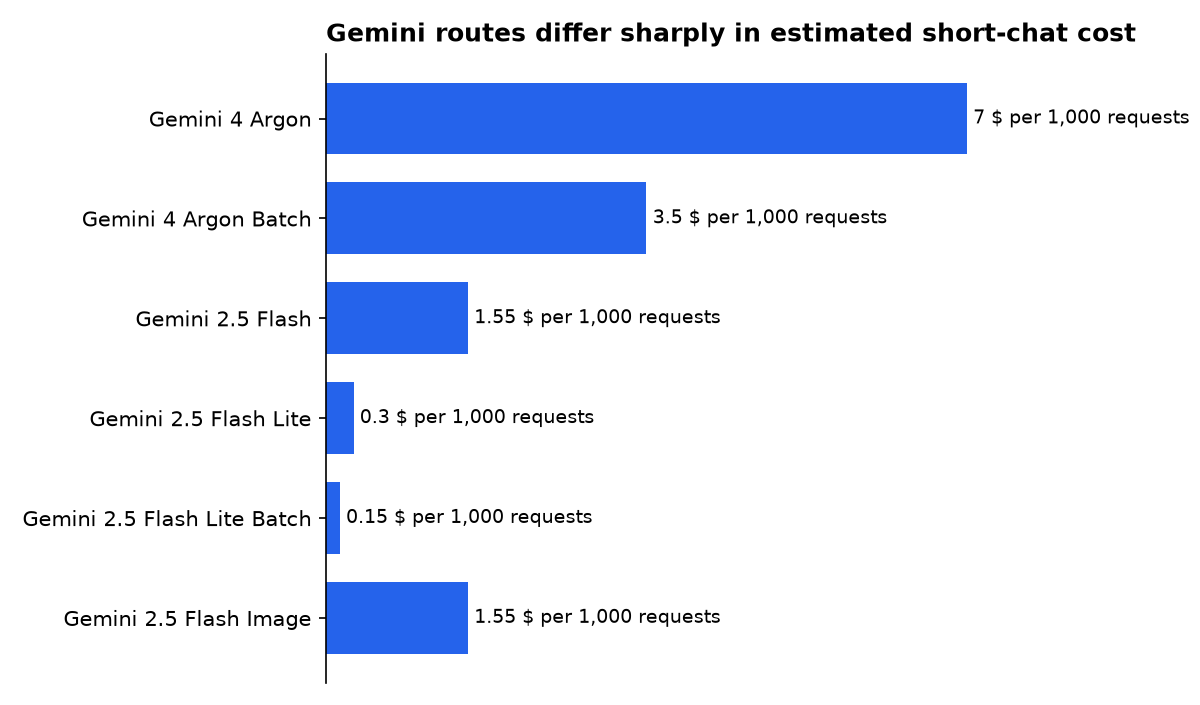
The calculation is a comparison aid, not a performance benchmark. A product with longer prompts or more generated text will have a different bill. The point is to make the decision visible: Argon costs more because its list rate is higher, so the feature must earn that difference through better outcomes or less downstream work.
The same source also models other request shapes. A retrieval-augmented answer, where the application supplies more source material, costs more because it sends more input. An agent step costs still more when both the working context and the generated response become larger.
That pattern is useful for routing. A company can send routine tagging, short summaries and basic extraction to a cheaper route. It can reserve Argon for cases where a larger context, harder reasoning or a stronger coding response materially changes the result.
When does batch pricing make sense?
Batch pricing is most useful when a task can wait. Examples include a backlog of document classifications, an overnight review of support conversations, a first pass over a code archive or the creation of draft metadata for a content library.
The main economic advantage is not that batch makes every task cheap. It reduces the listed token rate for the Argon batch route. That can be attractive when the workload genuinely needs Argon but does not need an immediate answer.
Do not make the opposite mistake and send every background job to Argon. A deferred task can still be simple. If it only assigns a known category, extracts a few fields or identifies duplicates, a cheaper model remains the better place to begin testing.
Routing should be based on observed failure cost. If a lower-priced model creates manual review, broken automation or repeated retries, its apparent saving can disappear. If it succeeds reliably, paying Argon rates merely because a task is important may be wasteful.
Batch also changes operational design. The application needs a queue, a way to collect results later and a process for handling failed jobs. These are ordinary engineering concerns, but they matter because a lower token rate does not help if the product assumes an instant response.
How much can cached input change the bill?
Google says cached input tokens are priced at 95% off the input-token price. That makes repeated context potentially important for an application that sends the same stable material with many requests.
The clearest candidates are a long policy manual, a fixed codebase guide, a stable product catalogue or a reusable research the public record. In each case, the application should measure whether the same material actually recurs. A cache discount helps only when repeat use is real.
It does not change the cost of generated answers. A system can reduce the cost of repeated context while still producing expensive long outputs. That is why cache planning belongs alongside output controls rather than replacing them.
Prompt stability also matters. If a product continually rewrites its base instructions, adds different retrieved passages or changes the document bundle for every request, it should not forecast savings as though every token were cached. Finance teams should model ordinary input and discounted input separately.
There is a product-design benefit too. Reusable context encourages teams to identify what is genuinely stable: instructions, source material, schemas and policy text. That can improve consistency. But stable prompts should not become a reason to send irrelevant material on every request.
Does one million tokens mean one million tokens of output?
No. Google describes Argon as having a one-million-token limit for deep, multi-step work. That limit is a capacity figure, not a promise that every request should produce a one-million-token answer.
Large context is useful when a job requires the model to consider a substantial body of related material. A repository migration, a long collection of legal documents or a large research record may benefit when the application can present more of the relevant evidence together.
It does not remove the need for selection. More material can mean more input spending, and irrelevant material can make a task harder to evaluate. The best use of a large context window is to include the evidence that changes the answer, not every file that happens to be available.
Google has described Argon’s work on large-scale engineering tasks, including codebase migrations and performance work. Those examples show why buyers may consider the model for complex assignments. They do not prove that every organisation will receive the same result.
Run a controlled test before moving a production workflow. Compare task completion, reviewer time, retry rates and token use against a cheaper model. The winning route is the one that reduces the total cost of completing the job, not necessarily the one with the lowest price per million tokens.
Can structured output reduce expensive retries?
Gemini 4 Argon supports structured output on Vertex AI. Google’s documentation says a response schema can make generated output follow a defined structure, such as valid JSON.
That is useful for extraction, classification and workflow automation. Instead of asking a model for a free-form response and then trying to parse it, an application can specify the fields and data types it expects. Downstream software then receives a more predictable result.
Structured output is not a direct discount. The schema itself counts toward the input limit, and an overly complicated schema can fail. Its value is operational: fewer malformed responses can mean fewer retries, less cleanup code and fewer manual interventions.
Keep schemas narrow. Use short property names where possible, request only the fields the application needs and test real examples that include missing data. A schema should make a workflow dependable, not recreate an entire database design inside a model prompt.
For a high-volume service, this can be more valuable than shaving a small amount from input text. A correct compact response can avoid a second model call. It can also avoid a human reviewing output that software could have consumed directly.
What should API buyers test before choosing Argon?
Start with a representative workload, not a demonstration prompt. Include the documents, tools, response limits and error handling that the production feature will use. A model choice made on a short isolated question is unlikely to predict the cost of an agent that takes several steps.
- Record input and output tokens for each feature.
- Measure retries, parsing failures and human-review time.
- Set response-length limits that match the task.
- Compare Argon with a lower-cost route on the same cases.
- Queue work when an immediate result has no business value.
- Test reusable context separately from fresh user material.
Then decide what Argon is buying. It may be a higher-quality code change, stronger handling of a long document set, fewer failed tool calls or a better first draft for a specialist. If the evaluation cannot identify that benefit, the expensive route has not yet earned its place.
There is also a governance question. Long-context systems can include more sensitive source material in each request. Teams should know what data they send, who can access the resulting output, how long it is retained and how a reviewer can check a consequential answer.
Google’s public examples include coding, legal, finance, scientific and cybersecurity work. Those are areas where an answer can carry real consequences. The pricing decision should therefore include the cost of review and accountability, not only token charges.
What we could not verify?
Google’s launch material in this article states the introductory Argon rate, but it does not provide a complete public schedule for every delivery tier. Simon Willison reported on 13 October 2026 that Argon’s price was set to double on 1 December; buyers should confirm any current rate directly with Google before committing a budget.
We could not verify a public service commitment for Argon batch processing. A lower batch rate does not by itself establish a delivery deadline, a queue priority or a latency target. Teams with a time-sensitive workload should test the route against their own operational requirements.
We also could not verify a universal public rate-limit table for every Argon customer tier from the material reviewed here. Sustained production traffic depends on the limits attached to the relevant account, region and access arrangement.
The next practical step is a like-for-like trial: run a real workload through Argon and a cheaper Gemini route, then compare completion quality, review time and token use before setting a production default.

