
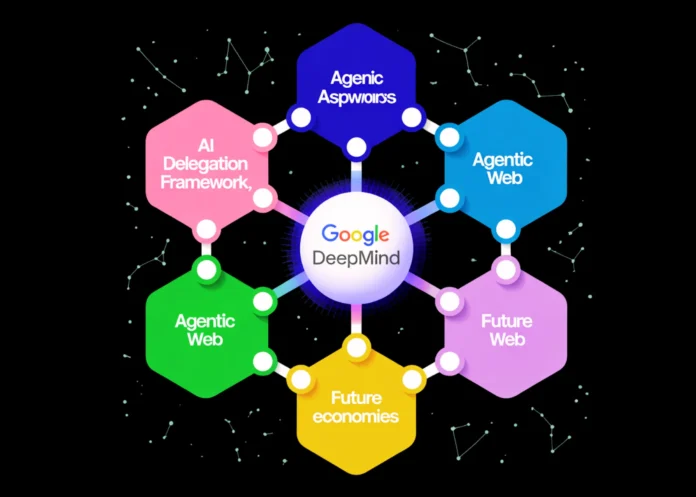
intelligent AI delegation — Key Takeaways
- Google DeepMind suggests implementing human-like organizational principles in AI agents.
- The intelligent delegation framework includes risk assessment and capability matching to enhance safety.
- Essential to this framework is the contract-first decomposition, allowing task verification post-assignment.
- Delegation Capability Tokens (DCTs) are introduced to improve security in AI delegation.
- The framework aims to enhance the scalability of AI agents within the emerging agentic web.
What We Know So Far
Introduction to the Framework
Google DeepMind has recently proposed a robust framework for intelligent AI delegation aimed at ensuring safety in the rapidly evolving Agentic Web. This strategic initiative supports the integration of AI into daily operations, seeking to instill human-like organizational principles into AI agents. This step is crucial for enabling more effective, safe, and meaningful collaborations with human users.

Related image — Source: marktechpost.com — Original
Through this framework, Google DeepMind is addressing the complex challenges surrounding AI interactions. By instilling principles that are akin to human organizational behavior, AI can better understand and navigate the tasks assigned to it. This is particularly important as the need for AI systems that effectively communicate and coordinate with humans increases.
Key to this proposal is the incorporation of risk assessments and capability matching, which are meant to enhance the overall safety and operational efficacy of AI delegations. Ensuring that AI systems comprehend their limitations and strengths is paramount for creating a trustworthy environment.
Analyzing AI performance in varied contexts allows for more prudent decision-making, which ultimately contributes to enhanced safety standards in AI interactions. By updating traditional approaches, Google DeepMind is positioned to lead in formulating responsible AI practices.
Key Details and Context
More Details from the Release
The integration of AI with structured website interactions is a significant step in improving AI agent functionality. Understanding the environment in which an AI operates helps contextualize its decisions, which is essential in creating systems that collaborate with humans seamlessly.

Related image — Source: marktechpost.com — Original
The framework suggests that accountability in delegation is transitive across delegation chains. This means that the responsibility for outcomes does not fall solely on one AI component but is shared across the entire process, fostering a culture of accountability.
Current protocols are insufficient for high-stakes delegation according to DeepMind’s analysis. As tasks increase in complexity, the limitations of existing frameworks become more apparent, indicating a vital need for novel solutions.
The new framework aims to expand the scalability of AI agents in the agentic web, allowing for a diverse range of interactions that improve both efficiency and efficacy. The goal is to accommodate the evolving demands placed on AI systems in various sectors.
DeepMind introduces Delegation Capability Tokens (DCTs) to mitigate security risks in delegation. These tokens serve as a safeguard, ensuring that tasks assigned to AI agents are closely monitored and appropriate. By employing these tokens, DeepMind intends to foster a more secure environment for both AI and users alike.
Essential to the framework is contract-first decomposition, where tasks are assigned only if outcomes can be verified. This approach emphasizes the importance of monitoring and validating AI performance, thereby deepening trust in AI systems.
The new intelligent delegation framework emphasizes risk assessment and capability matching. This ensures that AI agents have the necessary skill sets for the tasks they undertake, significantly reducing potential errors.
Principles and Techniques
DeepMind’s framework emphasizes contract-first decomposition, allowing tasks to be assigned to AI only when outcomes can be verified post-assignment. This method is crucial for maintaining accountability across delegation chains, boosting trust in AI operations.
Moreover, the proposal introduces Delegation Capability Tokens (DCTs) designed to mitigate security risks associated with delegation, thereby fortifying the interaction landscape between AI agents and users. Such innovations serve to create a more resilient framework for AI collaboration.
The practice of grounding AI decisions in clear principles is vital for creating systems that are adaptable yet accountable. This is particularly essential in a rapidly changing technological landscape, where AI’s role continues to evolve.
What Happens Next
Implementation Strategies
The implementation of this framework is expected to likely require a concerted effort to refine existing AI protocols. Current methods have been deemed insufficient for high-stakes delegation, making this framework a potentially transformative approach for future AI applications. Establishing best practices is expected to play a significant role in how this framework takes shape.
Related image — Source: marktechpost.com — Original
As AI agents become more prevalent in various sectors, enhancing their scalability within the agentic web is expected to facilitate more complex, autonomous interactions. This initiative showcases a forward-thinking approach to address challenges in AI development by building on existing knowledge and practices.
Furthermore, stakeholder engagement and collaborative efforts across the industry is expected to likely be crucial for the successful rollout of this framework. By inviting multiple perspectives, the implementation of these ideas can be enriched and tailored to meet diverse needs.
Why This Matters
Significance of AI Safety
The implications of Google DeepMind’s proposed framework extend beyond mere technical advancements. By embedding risk assessments and human-like organizational principles into AI agents, the framework promises to create a safer and more reliable interaction environment.
This ensures not only compliance but also enhances the overall quality of AI outputs. The focus on accountability and verification may pave the way for more extensive adoption of AI technologies in high-stakes environments, fostering a new era of trust between humans and AI systems.
“The focus on accountability and verification may pave the way for more extensive adoption of AI technologies in high-stakes environments.”
FAQ
Frequently Asked Questions
What is intelligent AI delegation?
Intelligent AI delegation refers to assigning tasks to AI agents based on their capabilities and risk assessments.
How does Google DeepMind propose to secure AI delegations?
By introducing Delegation Capability Tokens and employing contract-first decomposition methods.
Why is risk assessment important in AI delegation?
It ensures that the tasks assigned to AI agents are suitable for their capabilities, enhancing safety and effectiveness.
Sources
- Primary source
- Google DeepMind Proposes New Framework for Intelligent AI Delegation to Secure the Emerging Agentic Web for Future Economies
- Google AI Introduces the WebMCP to Enable Direct and Structured Website Interactions for New AI Agents
- Google DeepMind Introduces Aletheia: The AI Agent Moving from Math Competitions to Fully Autonomous Professional Research Discoveries

