

Talorys is a single-user personal AI agent that deploys into your own Cloudflare account. It combines chat with editable memory, tasks, notes, projects, reminders and scheduled routines. The trade-off is clear: Talorys does not operate the service for you, so you remain responsible for the Cloudflare account, access controls, updates and provider limits.
At a glance
- Talorys runs its application and stored state in the owner’s Cloudflare account rather than in an account run by the project’s developers.
- Its chat uses Workers AI, while tasks, notes, memories and ordinary reminders can continue when AI chat is unavailable.
- The browser reaches a Pages site, which sends API requests through a service binding to a private Worker without a public Worker URL.
- It is a useful fit for one person who wants a personal workspace and accepts responsibility for maintenance, backups and Cloudflare usage controls.
Is Talorys actually free?
Talorys is designed for Cloudflare’s free plan and does not enable paid features on its own. Its installer deploys a Pages frontend, a private Worker, a SQLite-backed Durable Object and Workers AI access. That means an owner can begin without subscribing to Talorys or handing the project operator a hosting account.
“Free” does not mean unlimited. The project says Cloudflare applies account-level quotas for requests, Durable Object usage and Workers AI. Cloudflare can change those limits, and an owner who exceeds them can lose access to a function even though the Talorys code itself has not changed.
The important distinction is between the AI feature and the personal workspace. Talorys says that tasks, notes, memories and reminders keep working when Workers AI is unavailable or its allocation has been used. Chat resumes after Cloudflare’s daily allocation resets, but the project does not promise that every cloud limit will be invisible to the owner.
That makes Talorys closer to software you operate than a hosted assistant you rent. The project does not run a Talorys database, account system or server for the user. Cloudflare still supplies the computing, storage, authentication path and model inference, so the practical question is not whether a provider is involved. It is which provider receives the data and which account holder controls the deployment.
Cloudflare describes Workers AI as a serverless service for invoking models from Workers, Pages or its API. Its documentation says the product is available on Free and Paid plans, but the available documentation here does not establish the current paid minimum, per-use price or included allowance. Treat those figures as something to check in Cloudflare’s current dashboard before relying on Talorys for daily work.
What does Talorys do when the AI quota runs out?
Talorys separates its workspace functions from model inference. The project says chat displays a clear message when the Workers AI allocation is exhausted and resumes after the daily reset. It also says tasks, notes, memories and reminders remain available, because they do not require an AI response to exist or be edited.
This matters for expectations. A task created through the interface remains a task even when chat is unavailable. A reminder scheduled through the application can still rely on Durable Object alarms, which Cloudflare describes as a way to trigger future work without keeping a process permanently running.
Some features can create more model activity than a short chat exchange suggests. Talorys documents adjustable limits for output length, context length, tool calls, reasoning steps, AI requests and scheduled AI routines. It counts model calls made for reasoning or history summaries, not only the message an owner typed into the chat box.
Those controls are useful only if the owner sets them deliberately. A shorter answer limit reduces the chance of an unexpectedly large reply. A context limit restricts how much earlier conversation is sent with a new request. A daily request cap provides a simpler stop rule when someone wants predictable use rather than the broadest possible assistant behaviour.
The project’s approach is practical for routine life administration. Use the AI for drafting, sorting an idea, creating a task or finding a relevant saved memory. Keep essential information accessible through the normal task, notes and memory screens, rather than making a critical workflow depend on an AI response arriving at a particular moment.
Which personal-agent option fits your budget?
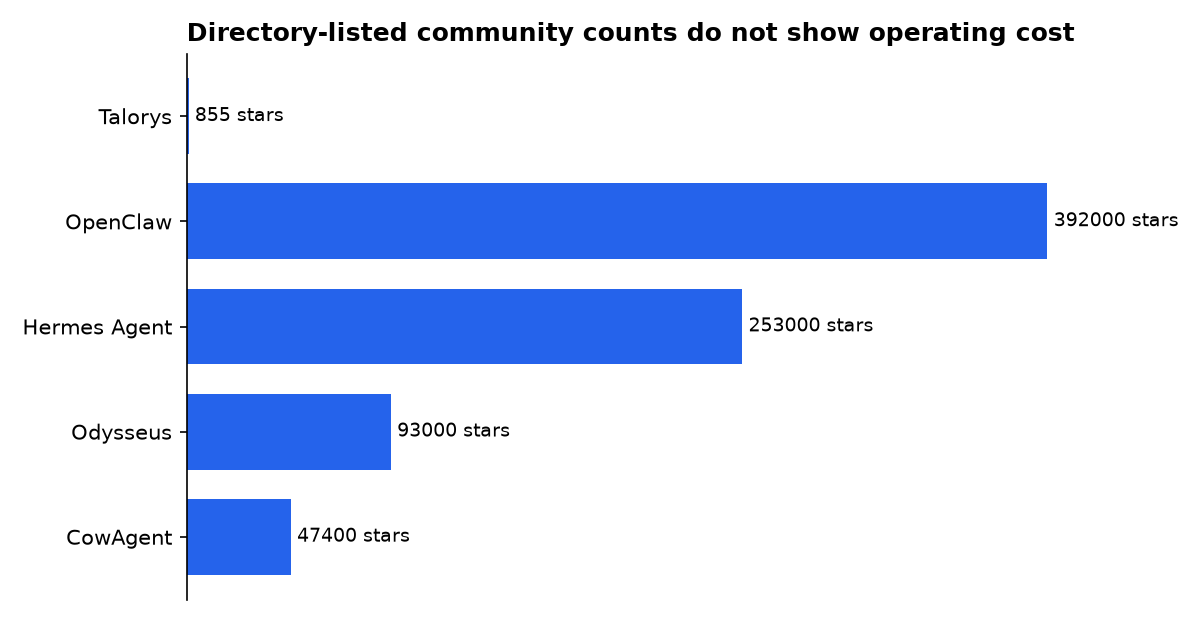
Talorys is easier to inspect than the alternatives in this table because its code and deployment description are public. The other products appear here because AI/TLDR lists them beside Talorys. That directory’s descriptions and star counts are useful starting points, but they do not establish operating cost, model billing, retention policy, security posture or support commitments.
The table is therefore a choice of operating model, not a ranking of quality. Talorys puts a personal workspace on Cloudflare. Some alternatives emphasise messaging channels, local hosting, a Docker-based workspace or tools that can act through a terminal and browser. More capability can also mean more credentials, more permissions and more systems to administer.
| Concrete option | Exact figure | Cost position | Data and operations trade-off | Evidence tier |
|---|---|---|---|---|
| Talorys on Cloudflare | 855 directory-listed stars | Designed for Cloudflare’s free plan, subject to provider quotas | Your Cloudflare account holds the application state. You must manage account access, backups, updates and provider limits. | Tier A: project documentation |
| Cloudflare Agents starter | 3 setup commands | No all-in personal-agent cost is established here | It provides a starting point with chat, scheduling and approvals. You still choose storage, memory, interface and access rules. | Tier A: Cloudflare documentation |
| OpenClaw | 392,000 directory-listed stars | No verified operating price in the directory listing | AI/TLDR describes a self-hosted assistant that works across messaging channels. Hosting and model choices need separate review. | Tier C: directory claim only |
| Hermes Agent | 253,000 directory-listed stars | No verified operating price in the directory listing | AI/TLDR describes persistent memory and several messaging channels. The listing does not establish where personal data is processed. | Tier C: directory claim only |
| Odysseus | 93,000 directory-listed stars | No verified operating price in the directory listing | AI/TLDR describes a Docker Compose workspace using local or API models. That can offer control, but requires server administration. | Tier C: directory claim only |
| CowAgent | 47,400 directory-listed stars | No verified operating price in the directory listing | AI/TLDR lists file, terminal, browser and search tools. Such tools increase the importance of permission boundaries and credential review. | Tier C: directory claim only |
Directory-listed stars measure visible repository attention, not response quality, reliability, privacy or security. The figures also do not share a verified measurement date. They should not decide a purchase or deployment on their own.
Where does Talorys send your data?
Talorys says it stores all application data in a single SQLite-backed Durable Object in the owner’s Cloudflare account. That includes conversations, memories, tasks, notes, projects, automations, sessions, settings and usage information. The project also says its code has no telemetry, analytics, tracking or advertising code and sends nothing to its developers.
That claim does not mean every prompt stays on a personal device. Talorys states that Cloudflare processes data to provide its services, including Workers AI inference on chat messages and the relevant memories included in a prompt. An owner considering sensitive use should understand this as a Cloudflare-hosted deployment, not an offline model running on a laptop.
The memory design offers a useful degree of control. The project describes saved facts and preferences as viewable, editable and deletable. It says only the memories relevant to a conversation are sent to the model on a turn, rather than blindly submitting the entire memory store with every message.
Relevant does not mean harmless. A memory that seems mundane in isolation can become sensitive when combined with a user’s task list, calendar-style reminders or conversation history. The safest practice is to avoid putting passwords, recovery codes, financial account details, government identifiers or confidential work material into any personal-agent system unless the owner has assessed the provider’s terms and their organisation’s rules.
Talorys also provides an export feature under its privacy settings. The project says a backup includes conversations, memories, tasks, notes, projects, settings and automations, but excludes sessions and credentials. A backup is valuable for recovery, yet it is another copy of sensitive personal data. Store it with the same care as any other private archive.
How is the application exposed to the internet?
Talorys places its browser-facing application on Cloudflare Pages. Requests to its API run through a Pages Function, which forwards them over a service binding to the agent Worker. The project says the Worker is deployed without a public URL, and that authentication and authorisation happen in the Worker rather than in the frontend.
This is a meaningful boundary, but not a guarantee against every mistake. A private Worker reduces the chance that an outsider can call the worker directly through a public address. It does not protect an account whose password has been reused, an owner’s device that is compromised, or a future deployment that changes the configuration.
The installer asks the owner to set a password and says it stores a password hash as a Cloudflare secret. It also generates a session secret and lets the same owner sign in from multiple devices. If the owner loses the password, the project documents a reset command that replaces the password secret and signs out existing devices.
That recovery path is useful, but it makes the installation directory important. Talorys says the directory contains deployment details and deployable artefacts, while excluding secrets. Keep it somewhere controlled, because it is needed for updates and password recovery. Do not mistake the absence of a plaintext secret in that directory for an absence of operational risk.
What operations must the owner handle?
Talorys removes much of the work associated with a virtual private server. Cloudflare says Durable Objects combine stateful code with attached durable storage, while Cloudflare provisions the underlying infrastructure. An owner does not need to patch a server operating system or separately run a database process for the standard Talorys deployment.
That is not the same as having no operations. The owner must protect the Cloudflare account, understand the permissions granted during installation, monitor quota messages and decide when to apply updates. The project says its browser-based login uses Wrangler’s standard OAuth flow rather than requiring a Global API Key.
An API-token installation needs permissions to edit Workers and Pages, read Workers AI and read account settings, according to Talorys. Those permissions are connected to deployment work, but they are still meaningful privileges. Review a token’s scope before using it, avoid sharing it in shell history or screenshots, and revoke it when it is no longer needed.
Updates also deserve a routine. Talorys says its update command redeploys the Worker and frontend to the same resources, retains the Durable Object namespace, and applies schema migrations transactionally on the first request. Before updating, download a backup and retain the installation directory. After updating, sign in, inspect core data and test a reminder rather than assuming a successful command output proves every workflow is intact.
Cloudflare offers an Agents framework for developers who need durable sessions, local SQL storage, scheduling, recovery and observability. Talorys uses that broader platform to create a narrower personal application. That focus is useful for one owner, but it should not be confused with a general business automation system with mature role controls and enterprise governance.
Should Talorys receive business credentials?
Not by default. Talorys is best understood as a personal workspace with chat, memories, tasks, notes and reminders. The project describes a private application path and an owner password, but the public record does not establish support for delegated business access, granular external permissions or a formal audit trail for transactions.
Sierra’s proposed Personal Agent Protocol describes an approach where a consumer chooses read-only or write access, while businesses set parameters for what an agent can do. It uses an OAuth-based session model for interactions with participating companies.
Talorys does not claim support for that protocol. Do not give it purchasing, payroll, customer-service or production-system credentials on the assumption that a private note store solves external authorisation. If an agent will take action in another system, start with a separate account, the least privilege available and a reviewable approval step.
What should you actually do?
Choose Talorys if you want a personal task, note, memory and reminder workspace in your own Cloudflare account. It is especially suitable for someone who wants a readable memory list, scheduled reminders and an application they can inspect and back up.
Use it first with low-risk information. Add generic tasks, non-sensitive notes and reminders before deciding whether the data boundary fits your needs. Test what remains available when chat is unavailable, because the answer matters more than an abstract promise of free AI.
Create a recovery routine. Download a backup, protect it, retain the installation directory and test the password-reset process before an emergency. Review sessions in the security settings and remove access from devices you no longer control.
Set AI guardrails before building a habit around chat. Choose conservative context, output and request limits. Treat the Cloudflare dashboard as the authority on provider usage, since Talorys describes its own usage panel as a local estimate.
Review updates as an owner, not as a passive subscriber. Read the project’s release material, back up data, deploy the update and test the functions you rely on. The next useful step is not a broad rollout; it is a controlled trial that shows how your own account behaves under normal use and quota pressure.
What could we not verify?
The available Cloudflare documentation confirms that Workers AI is available on Free and Paid plans, while Durable Objects and Agents are available as platform products. It does not provide a current all-in cost for a Talorys owner. We could not verify a current free AI allowance, a paid-plan minimum, a per-use inference rate or a typical monthly bill for Talorys.
Check Cloudflare’s live pricing and account dashboard before treating the deployment as cost-free. Cloudflare describes Workers AI as using a pay-for-what-you-use model, but the documentation available here does not establish the price of an individual Talorys deployment. The exact bill depends on the account plan and the resources that account uses.
We could not verify independent measures of Talorys response quality, uptime, security-audit results, average model usage or the project’s long-term maintenance policy. The project documents its architecture and safeguards, but those are not substitutes for an independent security assessment or a service-level commitment.
We also could not verify comparable operating costs, model providers, data-retention terms or maintenance burdens for OpenClaw, Hermes Agent, Odysseus or CowAgent from the directory listing alone. Their directory-listed star counts should not be read as a security review, privacy assessment or endorsement.

