

FuturPulse analysis · 8 October 2026
As of 8 October 2026, Udemy’s LangGraph class is the only reviewed catalogue course that publishes both a full project curriculum and a learner score: 4.7 out of 5 from five ratings. For learning by building, VibeWise is the stronger alternative.
At a glance
- Udemy’s LangGraph course lists 60 lectures across 7 hours and 10 minutes, plus three agent-building projects.
- Zendesk’s free sales trial schedules 282 minutes for administrators already using its AI agents add-on.
- Pluralsight’s Microsoft Foundry course runs 1 hour and 8 minutes and targets intermediate enterprise builders.
- VibeWise has no published lesson length, because its teaching appears during a real Claude Code project through build, design and implementation checkpoints.
Which AI agents course is best?
The best conventional course is Udemy’s Build AI Agents Automation Projects with LangGraph if you want a guided Python portfolio project. Its listing names a research agent, a multi-agent workflow and an agentic retrieval system. Agentic retrieval means the software searches a document collection, judges the result, and can revise its search before answering.
The published syllabus gives this option the clearest measurable scope: 60 lectures, two named early projects, then a longer production-style retrieval project. Its 4.7 rating is real platform data, but five ratings is too small a sample to treat as a broad verdict on teaching quality.
The best learn-while-building option is VibeWise for a person already working in Claude Code. Rather than putting a learner through recorded lessons, the plugin asks for an approach, presents trade-offs, then requires a decision before coding. That makes the work itself the exercise.
What can each option prove it teaches?
Course labels blur four different activities: using an agent, configuring one, coding one, and operating one in a company. The published outlines separate them more clearly than search snippets do. A learner should choose the activity first, then the provider.
| Option | Published teaching focus | Best fit | Public rating evidence |
|---|---|---|---|
| Udemy LangGraph | Python, LangGraph, tools, memory, Streamlit interfaces and retrieval workflows | New developer building an agent application | 4.7/5 from 5 ratings |
| Zendesk AI agents | Messaging configuration, conversation design, actions, escalation and testing | Zendesk administrator | No course score shown |
| Pluralsight Microsoft Foundry | Architecture, orchestration, Model Context Protocol and governance | Intermediate enterprise builder | No course score shown |
| Microsoft Learn | Microsoft 365 Copilot and SharePoint agents for workplace tasks | Microsoft 365 user | No course score shown |
| VibeWise | Reasoning through design and reviewing generated code during a project | Claude Code learner | Not a rated catalogue course |
The table compares what each provider explicitly publishes. It does not turn missing ratings into poor ratings, or assume that a short enterprise module has less value than a longer coding course.
Zendesk is unusually specific about its target role: administrators with its advanced add-on enabled. Microsoft Learn instead frames its three-hour offering around agents embedded in SharePoint and Microsoft 365 Copilot Chat, which is useful training but not a course in building an independent Python agent.
How much guided time do the courses offer?
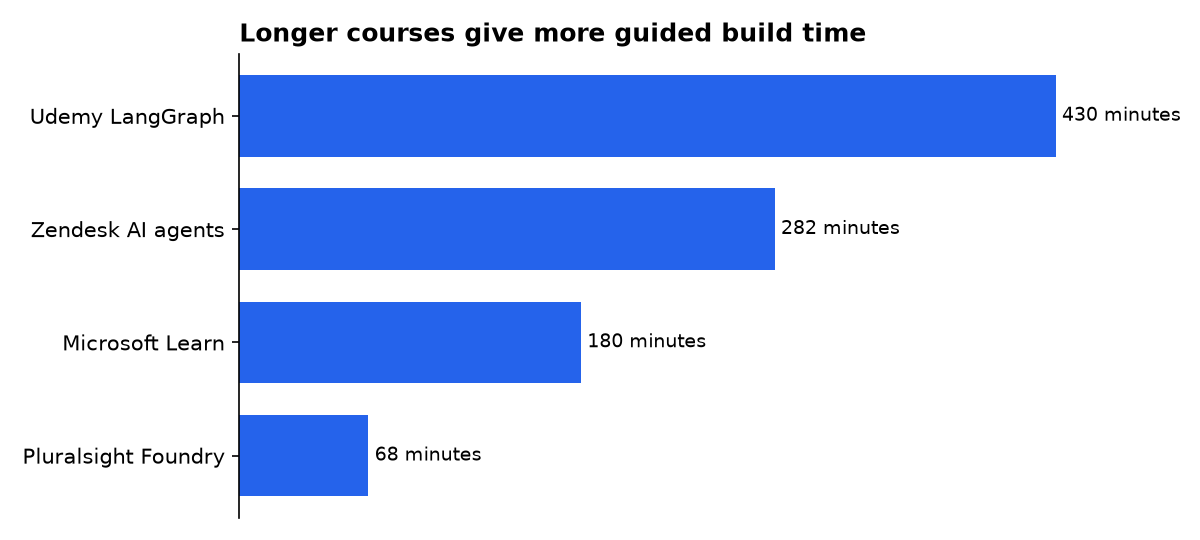
The longest published guided programme here is Udemy’s 430-minute LangGraph course, while Pluralsight’s Microsoft Foundry class is 68 minutes. Time is not a quality score. It is a useful proxy for how much instruction a buyer can inspect before enrolling.
OUR CALCULATION: We converted each provider’s stated running time into minutes, assuming the listed duration represents instructional video or module time and excludes a learner’s own setup, debugging and project work.
| Course | Provider’s stated duration | Our calculation in minutes | What that time covers |
|---|---|---|---|
| Build AI Agents Automation Projects with LangGraph | 7 hours 10 minutes | 430 | Fundamentals, setup, projects, memory and retrieval |
| AI agents – Advanced sales trial | 282 minutes | 282 | Setup, conversation design, dynamic configuration and testing |
| Unlock the power of Microsoft agents | 3 hours | 180 | Agents in SharePoint and Microsoft 365 Copilot Chat |
| Building Production AI Agents with Microsoft Foundry | 1 hour 8 minutes | 68 | Architecture, orchestration, integration and operations |
The 282-minute Zendesk curriculum divides time among preparation, conversation design, dynamic configuration, testing and launch. The 68-minute Pluralsight class spends its published outline on production concerns that beginner projects often omit, including governance, monitoring and tool connections.
What is the best AI agent course?
Choose Udemy’s LangGraph course if your definition of “best” is a structured first build with visible lessons and a public learner rating. It starts with single-agent and multi-agent concepts, then asks learners to connect tools, internet search, memory and a user interface. Basic Python is helpful, although the instructor says advanced mathematics and prior agent experience are not required.
Choose Pluralsight’s Building Production AI Agents with Microsoft Foundry if you already understand the basics and need enterprise architecture. Its outline includes Microsoft Agent Framework workflows, Model Context Protocol connectors and Agent-to-Agent communication. Model Context Protocol, or MCP, is a standard way for a model or agent to use outside tools and data services.
Do not pick either course solely because it uses the word “production.” Udemy teaches a production-ready retrieval project, while Pluralsight teaches the operating controls around enterprise deployment. Those are adjacent skills, not interchangeable outcomes.
How can I learn AI agents?
Learn AI agents by building one narrow workflow, reviewing each decision, then adding tools and tests one at a time. Start with a task that has a clear input and output, such as turning a small set of documents into cited answers. Avoid beginning with a vague “autonomous assistant” brief.
- Use a conventional course when you need terms, setup instructions and a repeatable first project.
- Use a workplace course when the tool is already chosen by your employer.
- Use an agent-guided coding workflow when your priority is making decisions while code is generated.
- Keep a record of failures, tool calls and tests. An agent that works once is not yet a reliable system.
VibeWise’s published workflow makes that third route concrete. It separates a build checkpoint, where the learner reasons about the approach, from a design review and an implementation approval. It also says generated code is followed by an explanation of changes and test results, which is closer to supervised practice than passive video viewing.
That approach has limits. VibeWise requires Claude Code and Python 3, and it does not claim to teach a portable framework such as LangGraph. It is best treated as a learning layer around your own project, not as a certificate or a complete curriculum.
Which alternatives fit business users?
Business users should start with the provider already tied to their daily work, not with a general coding course. Zendesk’s course teaches how to configure and test messaging experiences in a trial environment. Its prerequisites make the boundary clear: the advanced add-on must be enabled and the learner needs administrator access.
SmarterX’s AI Apps Agents Series is a different proposition again. It targets beginner-to-intermediate members through weekly, on-demand tool walkthroughs, with sessions described as roughly 30 minutes. That is useful for deciding whether an AI app fits a workflow, but it is not a published promise of a complete agent-engineering sequence.
Global Skill Development Council’s Autonomous AI Agents page sells certification access, expert-led videos, live sessions, a capstone and job support. The page displays 4.4/5 and 4.8/5 figures without clearly identifying the rating subject or sample size. They should not be compared with Udemy’s five-review course rating.
Can building with an agent replace a course?
It can replace introductory practice for a motivated coder, but not every kind of instruction. A build-first workflow puts the learner into real trade-offs earlier: data design, permissions, failure cases and tests. That is valuable because agents can write code before a learner has formed a clear model of the system.
Replica skill shows the far end of that build-first model. It packages 11 Claude skills covering reconnaissance, architecture, design, implementation, testing, comparison, branding and deployment. Its example claims an app clone can be assessed against feature and layout targets, but it also warns that complex products take longer and results vary.
The learning value is in the artefacts: a requirements map, test plan, missing-feature list and deployment checks. The risk is that a learner runs the sequence as a button-pushing exercise. Pause after each output and explain why the next action follows, or the agent has learned more than you have.
Who is making each claim, and why?
Every provider has a commercial or product interest that shapes its claims. That does not make the curriculum wrong. It does mean readers should distinguish a measurable course fact from a marketing outcome.
- Udemy and instructor Pratham Uday Chandratre: sell access to a marketplace course. The rating, student count and lesson list are platform conversion signals.
- Zendesk: trains administrators to evaluate and configure its advanced messaging product, which requires a Zendesk add-on.
- Pluralsight: sells individual and business learning plans, while its course centres Microsoft Foundry and related Microsoft tooling.
- Microsoft: teaches agents inside its Microsoft 365 and SharePoint products, where adoption can support wider platform use.
- SmarterX: includes its series with AI Mastery membership, so recurring relevance supports membership value.
- Global Skill Development Council: markets a certification package and related learner services.
- VibeWise and Replica skill maintainers: distribute MIT-licensed Claude tools. Their repositories have no stated course fee, but their claims promote use of their workflows and Claude-compatible environments.
What we could not verify?
Public pages do not establish course completion rates, job outcomes, refund use, or whether graduates can build and maintain a reliable agent alone. They also do not show comparable learner-review samples across the catalogue options. Providers could settle those questions by publishing rating counts, completion data, independently assessed projects and clear prices where access is bundled.
VibeWise and Replica skill do not publish controlled studies comparing learning outcomes against videos, tutorials or unassisted coding. Their maintainers could settle that with preregistered studies that measure design understanding, debugging performance and later independent work. Until then, “learn while the agent builds” is a credible workflow choice, not a proven education result.
Sources
- Udemy: Build AI Agents Automation Projects with LangGraph
- VibeWise GitHub repository
- Zendesk Academy: AI agents – Advanced sales trial
- Pluralsight: Building Production AI Agents with Microsoft Foundry
- Microsoft Learn: Unlock the power of Microsoft agents
- SmarterX: AI Apps Agents Series
- Global Skill Development Council: Autonomous AI Agents
- Replica skill GitHub repository

