

iCode, Replica Skill and Open Dot are the strongest genuinely free starting points for self-hosting on 6 October 2026; OpenDots is open-source, but its durable conversation layer requires CopilotKit Intelligence and a self-hosted license. The important distinction is simple: free code does not mean free models, cloud computers, integrations or production operations. (github.com)
At a glance
- iCode requires only uv, which provisions Python 3.14, but users must add their own model profile.
- Replica Skill contains 11 Claude skills and requires Python 3.8 or newer for its local helper tools.
- Open Dot supports 1,500 connected apps through Composio, but its Mac app needs a model-provider key for useful agent work.
- OpenDots starts with Node.js 24, while chat requires CopilotKit Intelligence plus a model connection.
- Parallel Search MCP is free without an API key for exploration and light use, making it a useful add-on rather than a complete agent.
Which free AI agents are worth self-hosting?
The short answer is to choose by job, not by the word “agent.” An agent is software that can plan steps, use tools and keep working across several actions. That covers a terminal developer workspace, a Mac personal assistant, a Claude workflow pack and an agent-workspace template, but those are very different products.
iCode is the best zero-cost first choice for developers who want local control and a visible record of work. It is a terminal application where an agent’s instructions, tools, sub-agents, skills, memory and MCP servers can be edited in one place. MCP, or Model Context Protocol, is a standard way for an agent to call outside tools and data sources. (github.com)
Replica Skill is the best narrow workflow choice if the job is studying a public product and building a clean-room alternative. Its 11 steps include research, architecture, testing, brand work and deployment. That is not a general personal assistant, and buyers should not mistake it for one. (github.com)
Open Dot is the most approachable personal-agent option for a Mac owner who wants browser work, routines and approvals. It gives each dot a browser profile, lets the user take over for logins or CAPTCHAs, and asks before sending, posting, paying or changing something. (github.com)
OpenDots is for a team building its own agent product, not for someone seeking an instant free assistant. It is a template for persistent coworkers with distinct computers, document spaces and review cards. The repository calls it early development, which is a useful warning before anyone promises a production deadline. (github.com)
Which option is actually free?
Replica Skill is the clearest free-software offer in this group. Its repository says the package is free and MIT-licensed, with no signup or API key required for the skills themselves. That does not make the Claude model service free, because the project runs as Claude skills or a Claude Code plugin. (github.com)
iCode is Apache License 2.0 software and says it includes no AI model. You supply model providers, MCP servers and any outbound services. This makes the application cost predictable at zero, while leaving the expensive part, model inference, under your control. (github.com)
Open Dot is open source, but its published setup asks for an OpenAI key, an OpenRouter key, or both. Cloud computers, triggers and app connections have separate keys when you choose those features. Treat it as free software with variable service costs, not as a free unlimited agent. (github.com)
OpenDots is the exception that matters most. The template is MIT-licensed, but its conversations require CopilotKit Intelligence through the hosted service, a local Docker evaluation or a licensed self-hosted deployment. A repository license does not erase that platform dependency. (github.com)
How hard is each agent to run?
The setup floor tells a clearer story than a feature list. Replica Skill needs Python 3.8 or later for its helper tools. Open Dot needs Node 22 or later, pnpm and Google Chrome or Playwright Chromium. iCode uses uv, which installs its Python 3.14 runtime. OpenDots starts with Node.js 24. (github.com)
| Concrete option | Exact published setup figure | Best use | Free-status reality | Evidence tier |
|---|---|---|---|---|
| Replica Skill | 11 skills; Python 3.8+ | Clean-room product research and rebuild planning | Free, MIT package; model access is separate | Primary source: repository |
| Open Dot | Node 22+; 1,500 app connections | Mac personal agent with browser work and approvals | Open-source app; model, trigger and cloud-computer services can cost money | Primary source: repository |
| iCode | Python 3.14 via uv | Terminal-based coding and workflow orchestration | Apache-2.0 software; bring your own models | Primary source: repository |
| OpenDots | Node.js 24 | Custom web, mobile and Slack agent workspace | MIT template, but durable conversations need Intelligence | Primary source: conditional license requirement |
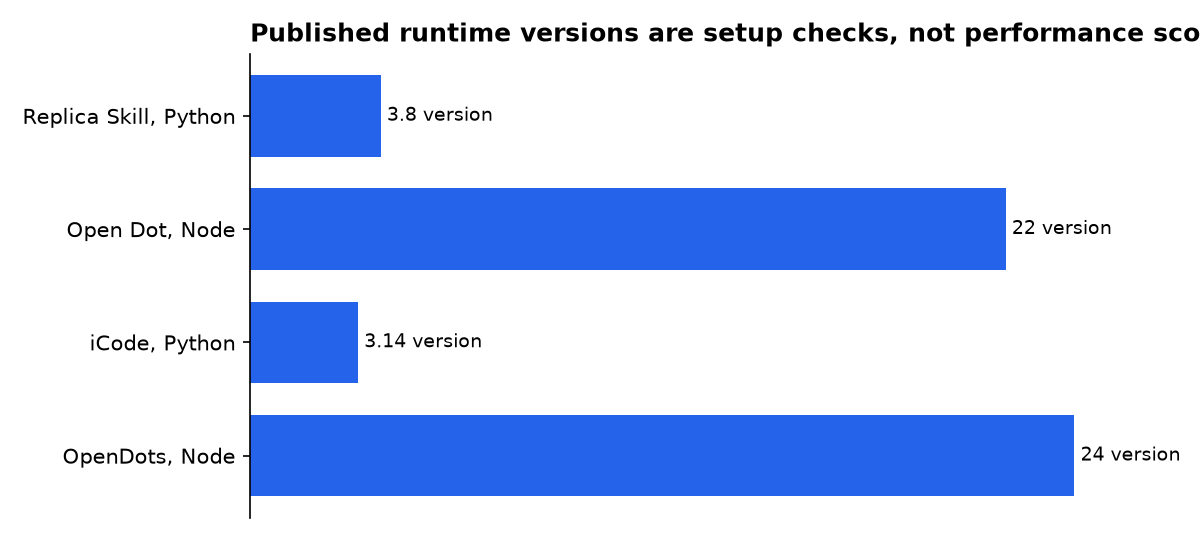
The chart is deliberately not a performance ranking. A higher runtime version does not mean a better agent. It only shows that these tools solve different problems and start from different developer environments.
Is Open Dot safe enough for personal tasks?
Open Dot has a better control model than many “autonomous” agent demos because it separates reading from consequential actions. Its documentation says passwords are encrypted with a macOS Keychain key and typed into pages without being shown to the model. The software also presents approval cards for actions that match a user’s risky-action rules. (github.com)
That is still not permission to give it broad access. Browser sessions, connected mail and saved payment methods are powerful capabilities. Start with one low-risk task, such as collecting an inbox brief, and require approval for every send, purchase and account change.
The practical limitation is availability. Routines and triggers run only while the app remains open, and a task due while the Mac sleeps is skipped. Add a cloud computer only after deciding that the convenience is worth the third-party service and its cost. (github.com)
Can iCode run private local workflows?
Yes, with an important qualification: iCode keeps its own telemetry, analytics and crash reporting off, but your chosen providers and tools still receive what you send them. Its privacy statement says web tools are off by default, and that enabled searches go to the configured provider or to Exa’s public search service when no provider is configured. (github.com)
That makes iCode a strong choice for a developer who wants a local cockpit rather than an agent SaaS. Its trajectory screen breaks a run into model time, tool time and waiting time. Its rollback screen lets a user inspect the file changes associated with a prior turn before discarding the conversation after it. (github.com)
The trade-off is that iCode supplies no model profile. That is a feature for buyers who need control, but it adds work for anyone who wants a one-click chatbot. Choose it when you can configure providers and want the software’s own data collection minimized. (github.com)
Should builders choose OpenDots instead?
Choose OpenDots only if the product you are building needs persistent, user-facing agents across several surfaces. Each Dot can have its own isolated browser and workspace, with browser, file and shell permissions assigned per Dot. The application stores service credentials on the server and derives separate computer credentials for each agent. (github.com)
Its technical advantage is that it is built around AG-UI, an open event-based protocol that connects an agent backend to a user-facing application. AG-UI supports streamed events, frontend tool calls and human interrupts, which are the mechanics behind visible work, approvals and mid-task changes. (docs.ag-ui.com)
But OpenDots also makes its architecture more demanding. A self-hosted CopilotKit Intelligence deployment needs Kubernetes, Postgres, Redis and an OIDC identity provider. It also requires a valid Intelligence license for production self-hosting. That is platform engineering, not a weekend install. (docs.copilotkit.ai)
For a local evaluation, CopilotKit says its Docker Desktop path does not require a cluster. The fully self-hosted path is different: the chart deploys backend, web-interface and optional realtime services on ports 4201, 8080 and 4401 respectively. (docs.copilotkit.ai)
What should you add for web research?
A local agent without current information will often produce stale work. Parallel Search MCP provides two tools, web_search and web_fetch, for searching current sources and extracting pages after a search narrows the target. Its anonymous free tier uses fast mode and needs no API key for exploration or light use. (docs.parallel.ai)
This is an add-on, not a competing agent. It is most useful with iCode, OpenDots or another MCP-aware runtime that already has an agent loop. Search results are inputs, so keep human review for decisions involving money, health, legal matters or account changes.
Parallel caps excerpts at roughly 25,000 characters per tool call, according to its MCP documentation. That limit is useful for keeping an agent’s context manageable, but it also means a research workflow should fetch the most relevant pages rather than indiscriminately loading everything. (docs.parallel.ai)
What should you actually do?
Pick iCode if you are a developer who wants a private-feeling terminal workspace, configurable models and a visible audit trail of agent work.
Pick Replica Skill if you already work in Claude and need a disciplined sequence for researching and rebuilding public product functionality.
Pick Open Dot if you use a Mac and want a personal browser agent, but begin with read-only tasks and approval gates.
Pick OpenDots only when you are building a customer-facing agent product and can operate its infrastructure or accept the hosted Intelligence dependency.
Do not choose based on a claim of “free unlimited AI.” The software layer can be free, while tokens, browser computers, API calls and connected services remain metered. For a first project, install iCode or Replica Skill locally, connect the smallest practical model account, and test one bounded workflow before adding autonomy.
What we could not verify?
No public vendor price in this shortlist establishes the full monthly cost of running Open Dot with a chosen model, cloud computer and Composio triggers. OpenAI, OpenRouter, E2B and Composio would need to publish the applicable usage terms for a precise estimate.
OpenDots’ repository confirms that production self-hosting requires a licensed CopilotKit Intelligence deployment, but it does not state a public license price. CopilotKit could settle that with a published self-hosted price card. Its telemetry policy also says open-source packages send metadata-only telemetry and excludes prompts, messages, agent state and tool content, but a deployment owner must still assess every configured provider and integration. CopilotKit’s telemetry documentation identifies the opt-out environment variable as COPILOTKIT_TELEMETRY_DISABLED=true. (docs.copilotkit.ai)

