

FuturPulse analysis · 23 October 2026
There is no verified public “Builder’s Curriculum” to enrol in on 23 October 2026. Existing AI coding classes already include deployment in some cases, notably Coursera’s eight-hour beginner course; the useful gap is a curriculum where every project must pass a live deployment, test and recovery check before a learner moves on.
At a glance
- Coursera’s Learn to code with AI lists nine modules, eight hours of study and web-app deployment for beginners.
- DataCamp’s AI-Assisted Coding for Developers lists one hour and 30 minutes, 10 videos and 28 exercises.
- AI Roadmap 2026 sets out five layers over about 25 weeks, ending with a production stage called “Ship it.”
- AIHero’s AI Coding Crash Course advertises nearly 60 lessons in six sections for $299.
Which AI coding classes end in a live project?
Coursera’s Learn to code with AI is the clearest beginner option that explicitly says learners will deploy web apps. Its published outline moves from HTML, CSS and JavaScript basics to GitHub, Netlify automation and Firebase-backed projects. That is a meaningful finish line: a deployed app has a public address, runs outside the lesson environment and exposes problems that a local prototype can hide.
Other classes serve different needs. DataCamp concentrates on prompting an assistant to write, test and document Python code. AIHero focuses on controlling an AI coding agent over longer work. Codecademy offers a much wider AI catalogue, including short introductions and longer engineer paths, rather than one clearly defined deployment sequence.
| Curriculum | Published length | What the provider says learners build or practise | Deployment evidence in the outline | Best fit |
|---|---|---|---|---|
| Coursera / Scrimba: Learn to code with AI | Eight hours | Front-end projects, games, an extension and database-backed apps | Explicit: deploy web apps, then automate deployment with GitHub and Netlify | New coders who need a first public app |
| DataCamp: AI-Assisted Coding for Developers | One hour 30 minutes | Prompting for debugging, tests, documentation and security | Not specified on the course page | Developers adding AI to an existing workflow |
| AIHero: AI Coding Crash Course | About three days or a longer self-paced schedule | Agent harnesses, requirements, handoffs, skills and codebase exploration | It promises end-to-end feature practice, but no named hosting target | People managing coding agents on larger work |
| Codecademy AI catalogue | Mixed course lengths | AI Builder prototypes, coding-tool introductions and AI-engineer material | Varies by course; the catalogue does not present one deployment gate | People choosing individual topics |
| AI Roadmap 2026 | About 25 weeks | RAG, agents, evaluation and production mini-projects | Explicit final production layer, with “Ship it” as the mini-project | Self-directed learners planning a broad path |
Comparison based on each provider’s current public course or roadmap description. “Not specified” means the cited outline does not name a deployment outcome, not that deployment is impossible.
The missing comparison is not simply “does this course mention deployment?” It is whether deployment is a required assessment after every build. A learner can complete a polished demo without learning environment variables, error logs, version control or rollback. Those are the ordinary details that turn generated code into software another person can use.
What should a Builder’s Curriculum add?
Proposal, not a released course: a Builder’s Curriculum should make deployment the grading system. Every module would begin with a small product brief, use an AI coding assistant to implement it, then end only after the learner publishes it, tests a user journey and records one failure or limitation.
This changes the role of AI. The model becomes a drafting and debugging partner, not a substitute for judgement. “Deployment” means putting an application on a service where other people can open it. For simple machine-learning demos, Hugging Face Spaces offers hosted apps using Gradio, Docker or static HTML, making it a plausible classroom destination for a public portfolio project.
A practical sequence would use five deployable artefacts:
- Personal utility: publish a small HTML and JavaScript tool, then fix one bug reported after launch.
- Data-backed app: add a database or API, explain which data is public and which must stay private.
- Question-answering app: build retrieval-augmented generation, or RAG, which retrieves relevant source text before a model answers.
- Agent workflow: give an AI agent a narrow task, a test suite and a human approval point.
- Production handoff: write setup instructions, add basic monitoring and show how to roll back a faulty release.
The differentiated feature would be the evidence packet attached to each project. It should contain a public link, repository link, short test record, known limitations and a one-page explanation of what the AI wrote versus what the learner checked. That is more useful to an employer than a certificate alone, and more honest than claiming a generated prototype is production-ready.
What was promised and what has shipped?
Public course pages show a split between promises to teach AI-assisted building and published lesson structures that vary sharply in depth. The timeline below separates the stated outcome from the visible curriculum or research result. Dates are publication or submission dates where the source provides them.
-
22 October 2026
Raw-RAG research reported that a simpler retrieval approach ranked first in six of seven evaluated benchmark-model settings. The lesson for an AI coding class is restrained: students should start with a plain, inspectable retrieval baseline before adding elaborate memory systems. -
22 October 2026
Adaptive Skill Granularity for Coding Agents described coding agents switching from broad reusable skills to smaller recovery actions when a macro step fails. That supports teaching recovery as a project requirement, rather than treating an agent’s first output as a finished answer. -
23 October 2026
Coursera’s current outline promises web-app deployment and lists modules for GitHub, Netlify automation and Firebase projects. This is shipped curriculum detail, not merely a broad claim that AI can help people code. -
23 October 2026
DataCamp’s current course page promises practice in code generation, tests, documentation and security across 28 exercises. The visible outline does not name a hosting or release task, so learners should add one themselves if a public project is their goal. -
23 October 2026
AI Roadmap 2026 promises a five-layer route from foundations to production, with “Ship it” as its final mini-project. It is a roadmap rather than a hosted class, which leaves the learner responsible for deadlines and review.
How long is a project-first AI coding path?
A project-first path can be short for a first deployment, but it cannot cover reliable software work in one sitting. Coursera lists eight hours for its beginner course. DataCamp lists one hour and 30 minutes for an intermediate prompting course. Those durations describe different goals, so they should not be read as competing routes to the same capability.
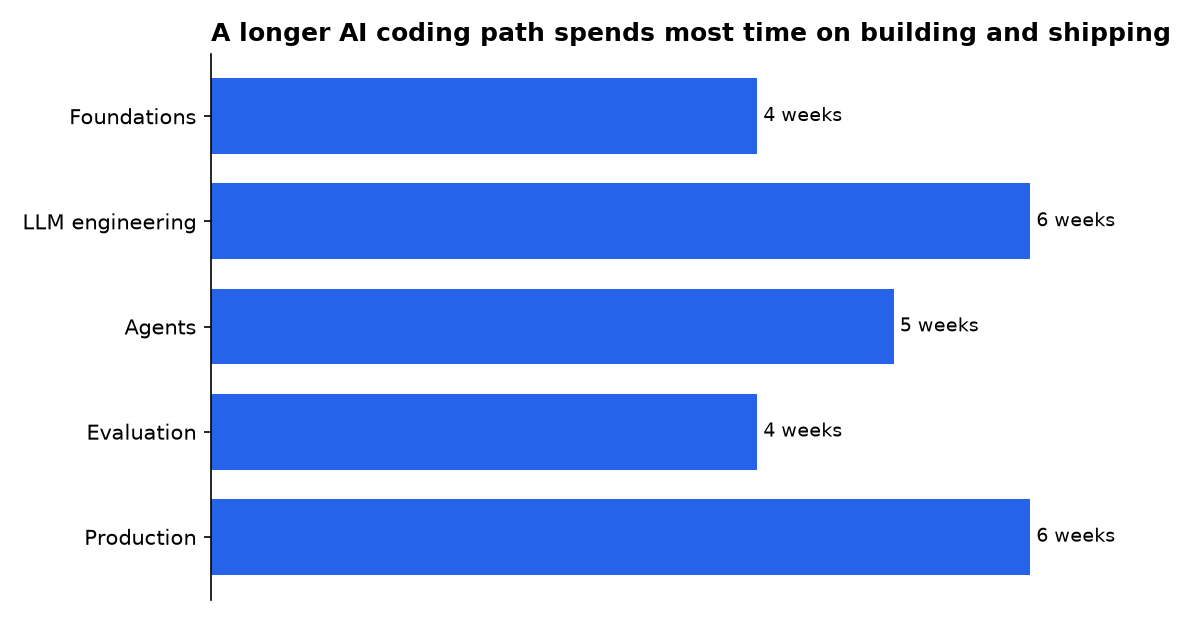
AI Roadmap 2026 provides the clearest longer structure. It divides its suggested path into five layers: foundations, LLM engineering, agents, evaluation and production. The roadmap assigns about 25 weeks at roughly 10 hours weekly, which gives learners time to revisit earlier work after they discover what breaks in a later stage.
| AI Roadmap 2026 stage | Published study time | Mini-project outcome |
|---|---|---|
| Foundations | About four weeks | LLM proxy API |
| LLM Engineering | About six weeks | Document Q&A with citations |
| Agents | About five weeks | Research agent with a sandbox |
| Evaluation | About four weeks | Evaluate the document Q&A project |
| Production | About six weeks | Ship it |
The roadmap’s own sequence makes an important point: deployment belongs after evaluation, not before it. Evaluation means checking whether the system meets defined expectations. In an AI app, that can include factual answers, safe failures, speed, cost and whether the app cites the material it relies on.
How do I become an AI coder?
You become an AI coder by learning enough programming to inspect the output, then shipping small applications that solve clear problems. Start with one web language, one version-control tool and one deployment destination. Coursera’s beginner course is designed for people with no prior experience and introduces HTML, CSS, JavaScript, GitHub and deployment in one sequence.
Use AI to explain code in plain language, suggest tests and identify missing cases. Do not accept a change until you can state what it does and how you checked it. A useful first portfolio item is a small tool with a public link, a readme file and a written list of limits.
Then move from apps that call a model to apps that manage evidence. The DeepLearning.AI catalogue presents AI engineering as building agents, apps and LLM-powered features, while offering a software-developer learning path. That is the right direction after the first deployment: learn systems work, not just prompt wording.
How can I learn AI coding?
Learn AI coding in a loop: choose a tiny feature, ask an assistant for a plan, implement it, test it and publish the result. Keep the project small enough that you can read every changed file. AIHero’s course stresses requirements, codebase exploration, agent handoffs and reusable instructions, which are useful habits once projects become too large for one prompt.
Use a curriculum that matches your starting point:
- Complete beginner: start with a browser-based web app and learn basic HTML, CSS and JavaScript.
- Working developer: use an AI assistant for tests, documentation, bug fixes and security review.
- AI-app builder: learn retrieval, evaluation, agent limits and deployment.
- Student or teacher: use a structured foundation before chasing tools. Code.org’s AI Foundations is a free high-school curriculum that moves from understanding AI to building web apps with AI as a creative partner.
The hard part is not producing code quickly. It is deciding what must be true before users rely on that code. The coding-agent study submitted on 22 October argues that fixed high-level procedures can fail under mismatch, while explicit recovery can improve robustness. In class terms, learners should practise falling back to small, verifiable steps when an agent’s broad plan goes wrong.
Can I learn AI in 3 months?
Yes, you can learn enough AI coding in three months to publish useful projects, but not enough to claim mastery of every model, framework or production risk. A sensible target is three deployed applications: one simple interface, one data-backed app and one AI feature with written evaluation cases. The target is evidence of judgement, not a large collection of generated repositories.
Three months also gives time to learn the difference between a model answer and a reliable product answer. The Raw-RAG paper submitted on 22 October found that preserving and retrieving raw evidence could outperform more complicated memory designs in most of its benchmark settings. For learners, that is a warning against adding complexity before they can inspect the sources behind an answer.
Codecademy’s catalogue illustrates the scale of the field. It lists 164 AI results across free and paid courses, from short introductions to a 30-hour AI Engineer path. That breadth is useful for choosing a topic, but it also means learners need a project plan. Pick one outcome and finish it before switching tools.
What should you publish after each class?
Publish a small proof that the project works, plus a clear account of where it does not. This is the Builder’s Curriculum idea that existing catalogues do not consistently make into a module-by-module gate. It is not a claim that other providers never teach deployment: Coursera and AI Roadmap 2026 plainly do.
For each project, publish:
- a live link or a reproducible local run command;
- a repository with installation instructions;
- three test cases, including one expected failure;
- a short note on data, privacy and model limits; and
- one change made after a user or tester found a problem.
That final item matters most. It proves the learner can operate a project after the first demo. It also creates the feedback loop that AI coding assistants need. A model can offer a patch; only a builder can decide whether the patch solves the right problem without creating another one.
What we could not verify?
No public course page verifies a shared industry standard for “AI coder,” a common deployment assessment, or a job guarantee after completion. Providers can settle those questions by publishing grading rubrics, required project repositories, deployment checks and the terms behind any certificate or career claim.
There is also no verified public programme called Builder’s Curriculum in the material reviewed here. A course operator could settle that point by publishing its syllabus, price, instructors, project requirements and named deployment platform. Until then, Builder’s Curriculum is best understood as a proposed design for AI coding classes, not a product comparison winner.
Sources
- Coursera — Learn to code with AI
- DataCamp — AI-Assisted Coding for Developers
- AIHero — AI Coding Crash Course
- GitHub — AI Roadmap 2026
- Hugging Face — Spaces documentation
- Code.org — AI curriculum
- DeepLearning.AI — AI engineering courses
- arXiv — Is Complex Agentic Memory Always Needed
- arXiv — Adaptive Skill Granularity for Coding Agents

