

FuturPulse analysis · 22 October 2026
As of 22 October 2026, Anatomy is an MIT-licensed agent skill for Claude Code and four other coding agents that creates interactive SVG, SVG-plus-WebGL and beta 3D explainers. Version 1.1, released 12 October, added a community-gallery publishing workflow, while the current skill still requires Chrome or Chromium checks and human approval for factual or engineering claims.
At a glance
- Anatomy’s public collection lists 52 live figures: 22 SVG, 10 WebGL, one 3D and 19 early examples.
- The current skill defines a standard “Figure” as 40 to 80 parts, with SVG and at most one shader layer.
- The public site budgets a “Hero” at two to four hours, making Anatomy unsuitable for instant, low-review diagram generation.
- The MIT licence permits reuse and modification, but it provides the software without warranty.
- Version 1.1 sends only figure source to the gallery after the user has approved a pull-request plan.
What does Anatomy actually make?
Anatomy turns an abstract technical idea into a physical machine that demonstrates the idea through motion. Its central design rule is that the object itself must perform the explanation: a cache key becomes a lock, while a shared GPU context becomes a plotter with one moving head. That makes Anatomy closer to an interactive editorial illustration system than a conventional diagram generator. The current skill instructions direct the agent to produce dense isometric objects with live readouts driven by the same model as their moving parts.
The usable outputs are broader than a static SVG. Anatomy can write standalone HTML and SVG, work in React or Next.js, add WebGL effects inside the isometric scene, and print an A4 PDF. WebGL is the browser graphics layer used here for effects such as fire, water, exhaust and glow. The practical benefit is that a documentation page can keep its labelled machine readable even if a visual effect does not run.
The approach is intentionally restrictive. Anatomy does not ask the model to make a generic visual metaphor or a box-and-arrow architecture chart. It asks for a recognisable object with parts, depth, visible connections and a constrained interaction model. That can make a hard process easier to explain, but it also means a simple request can become a substantial front-end asset rather than a quick illustration.
How much work does an Anatomy figure require?
Public guidance divides work into three production sizes. A Figure has 40 to 80 parts and is budgeted at 30 to 90 minutes; a Hero has 80 to 150 parts and is budgeted at two to four hours. An Epic covers a vehicle, building or plant and starts at six hours, according to the project’s production guide.
| Published size | Part range or scope | Published time | Practical decision |
|---|---|---|---|
| Figure | 40–80 parts | 30–90 minutes | Use for one mechanism in a product page or technical article. |
| Hero | 80–150 parts | 2–4 hours | Use when the reader must explore several linked systems. |
| Epic | Vehicle, building or plant | 6 hours or more | Treat as a commissioned visual, not an automatic diagram. |
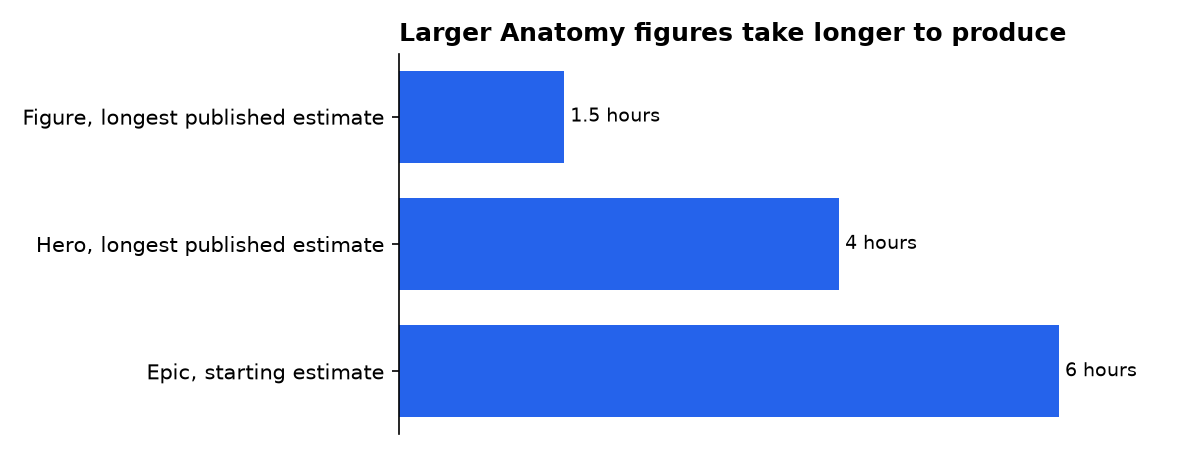
Those are publisher planning estimates, not independent speed tests. They matter because they change procurement and editorial expectations. Anatomy may reduce hand-coded visual work, but it does not turn a complex technical explainer into a one-minute output that can safely bypass design or subject review.
What was promised, and what shipped?
Anatomy’s development story is clearer when separated into dated commitments and delivered features. The most important change is not a new rendering mode. It is the new publication path, which turns a local figure into a proposed gallery contribution with recorded provenance.
The public Anatomy site presented the original promise: enter a one-line idea and receive an interactive isometric machine, rather than a traditional process diagram. The site counted 33 live figures at that point and described a watch example built in one pass over one hour and 54 minutes. The launch page framed this as a skill for Claude Code, with the object’s motion carrying the explanatory burden.
Version 1.1 shipped community-gallery publication. The release says the agent asks for a title, identifier and GitHub name, shows what will be sent, and opens a pull request only after approval. It also shipped browser-check fixes, geometry-audit fixes and reduced-motion fixes, according to the version 1.1 release notes.
The public collection now lists 52 figures: 22 SVG entries, 10 WebGL entries, one 3D entry and 19 earlier experiments. That is a larger public demonstration set than the 33 figures stated on 9 October, although it is not a controlled quality benchmark. The collection page provides live examples across algorithms, web concepts and machine-like systems.
The current main branch lists printable sheets, Antigravity support and MiniMax Code support under “Unreleased.” Those features are present in the public codebase but are not tagged as a later numbered release. The current changelog therefore supports treating them as available branch features, not as a stable release promise.
How does Anatomy check its own work?
Anatomy has more built-in visual checking than most prompt-only skills. Its kit records shapes and routes, ray-casts overlapping parts for depth order, and can fail a build when it finds clearance, terminal, loose-end, support, fold or self-overlap problems. In plain English, the audit checks whether pipes, cables and solid parts look physically connected and properly layered in the generated figure.
That is a useful delivery safeguard, not factual validation. A geometry audit can catch a cable passing through a clamp or a line ending in empty space. It cannot establish that an engine’s stated thrust, a medical workflow or a rate-limiter rule is correct. The audit specification is explicit that it proves generated geometry, depth and visual clearances.
The WebGL rules are similarly demanding. The project requires a back SVG, a canvas for the effect and a front SVG so that visual effects sit inside the drawing rather than over it. It also requires fades rather than abrupt visual changes. That gives Anatomy a credible process for polished front-end output, but no automated check can decide whether an invented physical metaphor teaches the right lesson to a non-specialist reader.
Can Anatomy produce production-ready assets?
Yes, for web production with review; no, as an unattended approval system. Anatomy can produce an asset that a front-end team can ship: standalone HTML, an embedded SVG, or React and Next.js components. The project also defines explicit visual checks, reduced-motion behaviour and a source-based publication workflow. Those are stronger operational details than a skill that only returns image prompts.
Its weaker point is the boundary between visual correctness and domain correctness. A technical illustrator, engineer or product owner should verify source facts, labels, units and causal logic. This is particularly important when a machine metaphor simplifies an algorithm. A vivid lock may explain cache reuse, for example, while still hiding an important cache invalidation edge case.
Beta 3D deserves a separate warning. The project says its 3D mode re-projects, re-shades and re-orders moving parts every frame, while keeping other art static. That can make a dial or rotating mechanism clearer, but beta status means it should be treated as a feature requiring device testing, performance checks and accessibility review before a public launch.
How does it compare with other Claude skills?
Anatomy occupies a different category from Code Wiki and Video Understanding. Code Wiki produces reference documentation and Mermaid diagrams for software repositories. Video Understanding guides users through captioning, action recognition and clip-generation workflows. Neither is a direct visual-design substitute for Anatomy’s animated physical metaphors.
| Skill | Primary output | Operational emphasis | Best use |
|---|---|---|---|
| Anatomy | Interactive isometric web figure | SVG craft, motion and geometry checks | Explaining a mechanism or abstract system to readers |
| Code Wiki | Markdown wiki and Mermaid diagrams | Repository inspection and structured documentation | Onboarding engineers to an unfamiliar codebase |
| Video Understanding | Video-analysis or clip workflow plan | Tool prerequisites and runtime guards | Captioning, action recognition or video processing |
Code Wiki’s published listing says it uses terminal, file-reading, file-search and file-writing tools to create durable repository documentation. Its directory scan assigned it a B score of 85 out of 100 and flagged destructive filesystem operations. That comparison matters because it shows a different production risk: Code Wiki modifies documentation files, while Anatomy’s primary risk is a persuasive but inaccurate visual explanation. The Code Wiki listing describes a documentation workflow rather than a visual authoring system.
Video Understanding has a narrower and more guarded remit. Its published skill instructions require checkpoints, codecs and external tools to be available before claiming results, while its directory scan assigned an A score of 100 out of 100. Anatomy has no equivalent public third-party security grade in the material reviewed here, so its browser automation, local scripts and gallery submission path should be assessed by each team before use. The Video Understanding listing shows how a specialised skill can explicitly refuse work when dependencies are missing.
What does the MIT licence allow?
Anatomy declares the MIT licence in its current skill metadata. MIT generally permits use, copying, modification, publication, distribution, sublicensing and sale, provided that copyright and permission notices remain with substantial copies. That is commercially flexible for teams adapting the kit into product documentation, but it does not transfer responsibility for the final explanatory claims.
The more practical limit is the gallery policy. Gallery submissions must be plain HTML figures with a build script; React and Next.js figures cannot be submitted. The workflow requires explicit user confirmation, supports MIT or CC-BY-4.0 for gallery entries, and copies source rather than a finished binary asset. The current repository’s project page describes Anatomy as open-source, while its release workflow places reviewable source at the centre of sharing.
What should a team do before installing it?
Start with a narrow editorial task. Ask Anatomy to explain one mechanism, such as a queue, lock, cache or rate limiter. Choose SVG first when broad browser compatibility matters. Use WebGL only when the lesson depends on effects such as flow, heat, flame or light.
- Confirm that Node.js, Chrome or Chromium are acceptable local dependencies.
- Review generated source before committing it to a product repository.
- Test keyboard use, reduced motion and narrow-screen layout.
- Have a subject specialist check every real-world number and causal claim.
- Use the gallery only when the figure’s prompt and source can be publicly shared.
The project’s strongest fit is a team that needs one memorable interactive explanation and is willing to review it as a designed asset. It is a poorer fit for high-volume diagrams, regulated claims or situations where the generated metaphor must be treated as authoritative without an expert checking it.
What we could not verify?
No public third-party security scan or independent benchmark was found for Anatomy itself. A security assessor could settle whether its install path, browser automation and publishing scripts meet a particular organisation’s controls. The maintainer could settle which current-main features will receive the next tagged release.
No public evidence establishes that Anatomy-generated explainers improve comprehension against static diagrams. A controlled reader study could answer that question. No public policy was found that certifies generated figures as engineering drawings, medical instruction or compliance material; the relevant engineer, clinician or regulator would need to approve those uses.
Sources
- Anatomy repository
- Anatomy version 1.1 release notes
- Anatomy SKILL.md
- Anatomy changelog
- Anatomy public guide
- Anatomy public collection
- Code Wiki listing
- Video Understanding listing

