

FuturPulse analysis · 7 October 2026
On 7 October 2026, Mistral Large 4 costs $0.68 per million input tokens and $2.09 per million output tokens, while DeepSeek Flash Latest has no fixed price because it redirects requests to the family’s current model.
At a glance
- Mistral Large 4 supports a 524,288-token context window, which can fit a large codebase, logs and documentation in one request.
- By our calculation from Mistral Large 4’s listed token prices, 1,000 agent steps using 30,000 input and 2,000 output tokens cost $24.58.
- DeepSeek Flash Latest can route to a model with up to 1,048,576 tokens of context, but OpenRouter says each request is billed at the serving model’s price.
- Agent Smith’s six-task pilot reported $0.1621807 in reference cost for its local router, but it was a one-shot synthetic experiment rather than a general coding benchmark.
What changed in AI coding software?
The new issue is not simply choosing the best coding model. It is choosing the system that decides which model gets each job. A router is software that sends routine work to a cheaper model and escalates difficult work to a more expensive one.
That distinction matters because a model name can conceal moving commercial terms. DeepSeek Flash Latest redirects to the latest DeepSeek Flash-family model, released on 14 September 2026. OpenRouter explicitly says the alias has no price of its own.
Mistral Large 4 is different. OpenRouter lists a named Mistral Large 4 release dated 6 October 2026, with separate prices for tokens read and tokens generated. Tokens are the chunks of text an AI model reads and bills by.
This makes a simple savings claim inadequate. A router can be cheaper because it selects a lower-priced model, because it sends less text, or because cached input receives a different price. Those are not the same achievement.
How much does Mistral Large 4 cost?
Mistral Large 4’s listed rate is $0.68 per million input tokens and $2.09 per million output tokens. Input is the prompt, repository excerpts and tool results sent to the model. Output is the plan, explanation, patch or command sequence it returns.
Our calculations below apply those list prices to three repeatable coding patterns. They are not usage forecasts. They exclude cache-read discounts, provider fees outside the listed rate, failed requests and any subscription bundle.
Which model choice is cheapest for coding?
An agent step costs more because it carries far more repository context and asks for a longer answer.
| Concrete option | Exact usage assumption | Cost per 1,000 requests | What it buys | Evidence tier |
|---|---|---|---|---|
| Mistral Large 4: chat turn | 1,000 input + 500 output tokens | $1.72 | A short code question, review comment or small patch request. | Vendor-listed price; FuturPulse calculation |
| Mistral Large 4: RAG answer | 8,000 input + 500 output tokens | $6.48 | A retrieval-augmented answer using selected repository or documentation passages. | Vendor-listed price; FuturPulse calculation |
| Mistral Large 4: agent step | 30,000 input + 2,000 output tokens | $24.58 | A larger planning or repair step with substantial context. | Vendor-listed price; FuturPulse calculation |
| DeepSeek Flash Latest | Serving model can offer up to 1,048,576 tokens of context | No fixed figure | A moving alias when the team accepts model and price changes. | Provider says price varies by serving model |
| Agent Smith local router pilot | Six synthetic tasks, one attempt each | $0.1621807 reference cost | A reproducible routing demonstration inside an existing Codex login. | Independent project self-report |
Our calculation uses OpenRouter’s listed Mistral Large 4 rates: input tokens × $0.68 per million, plus output tokens × $2.09 per million. The model page also lists a 524K context window, tool calling and structured outputs.
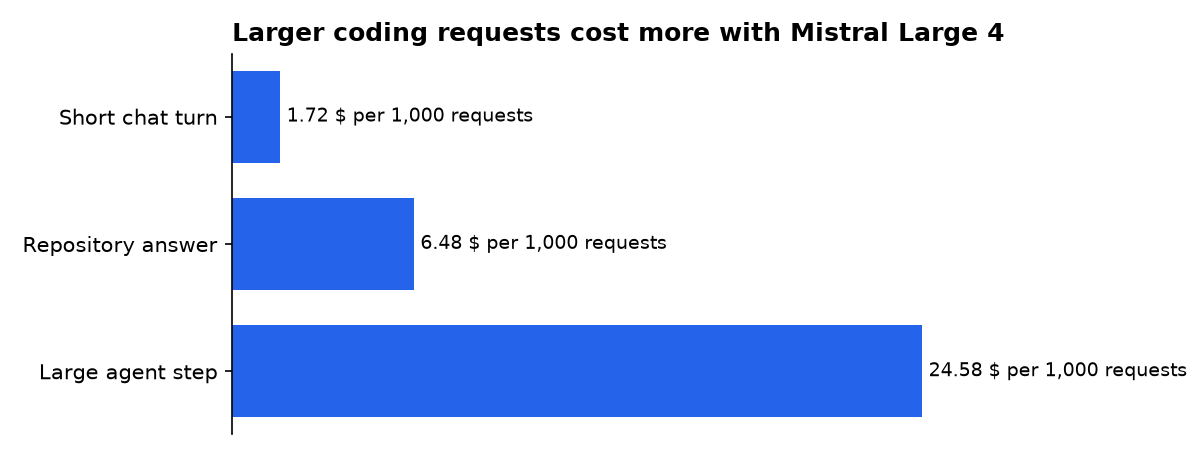
The table is a decision aid, not a quality ranking. It shows the cost of using the same named model at three request sizes. It does not establish that a smaller model will solve the task correctly, or that a larger prompt is needed.
Does Agent Smith prove router savings?
No. Agent Smith reports that its local router passed 18 of 18 deterministic grading results across six public synthetic tasks. That is useful because the project publishes its protocol and distinguishes accepted, rejected and unknown outcomes.
But the comparison is narrow. It also reports that the fixed 6.1 Sol group had 24,832 cached input tokens while the other groups had none.
Cache exposure changes the bill. Cached input is reused prompt material that some providers price below ordinary input. The project therefore warns readers not to treat its reference dollars as Codex subscription bills, and says broader quality equivalence needs separate experiments.
Agent Smith is software, not a competing foundation model. Its Adaptive Router 0.3.0 uses a local difficulty heuristic scored from 1.0 to 10.0. It currently executes through Codex, while other providers are catalog metadata rather than execution targets.
What should a model router measure?
A reliable router should record the task, selected model, tokens, cache status, price snapshot and outcome. Without all six, a claim of “savings” cannot show whether the saving came from better routing or from a changed workload.
Agent Smith’s design provides a useful baseline: it stores its own numeric SQLite ledger, keeps price snapshots for metered requests and leaves conversation bodies and reasoning text out of that ledger. It also treats missing usage or prices as unknown rather than zero.
For a production team, add code-quality checks. Record whether the patch built, tests passed, a reviewer accepted it and a later change reverted it. A cheap answer that creates a defect is not a cheaper software-development outcome.
- Pin the exact model identifier for any workflow where cost predictability matters.
- Log input, output and cached-input tokens separately.
- Compare acceptance rates before comparing token bills.
- Run the same task set against each routing policy.
- Set a budget limit per task, not only per month.
Can AI coding tools handle regulated work?
AI coding tools can assist regulated projects, but they do not remove the need for accountable review. Government Technology Insider’s April 2026 interview describes enterprise work as requiring scalability, durability, supportability and security, rather than a quick generated prototype.
The risk grows when an agent gets broad repository access. A coding system can duplicate logic, choose an unsuitable design or generate code that looks plausible but is hard to maintain. The cost then appears later in review, repair and integration rather than in the API invoice.
Use a real project as the test. OpenEMR is an open-source electronic health records and practice-management application with build instructions that require Node.js 24.*, Composer and npm. A system that changes a project like this should be judged on repeatable builds, tests and human review, not on fluent explanations.
Will faster code generation ship software faster?
Not automatically. Codemanship argues that faster code creation can still leave work waiting for feedback, design decisions, testing, review and merge approval. That is a workflow constraint, not a model-routing problem.
This is why a router dashboard needs delivery measures beside token measures. Track the time from task assignment to merged, reviewed change. If a cheaper route creates more revision cycles, its apparent API saving can be outweighed by engineer time.
Start with small work blocks. Ask the model to alter one component, add targeted tests and explain the expected behaviour. Smaller changes make it easier to identify which model choice helped and which one added risk.
Does open source change the buying decision?
Open source gives a coding agent visible examples, build steps and contribution rules, but it does not turn a generated patch into a safe contribution. Open Core Ventures argues that AI is bringing more contributors into open-source projects, especially where users can also become builders.
That can make repository-aware tools more useful. It also raises the value of disciplined maintainers. OpenEMR’s repository points contributors toward setup requirements, issue reporting and security-vulnerability procedures, which are the guardrails an agent must not bypass.
Do not use a router’s apparent discount as permission to run wide, autonomous changes. Spend the saved budget on test execution, review and staging environments. Those controls determine whether the generated patch belongs in the product.
What should you actually do?
Choose Mistral Large 4 when you need a named, currently priced option with a 524,288-token context limit, image input, tool calling and structured outputs. Its listed price makes budgeting possible, provided you separately measure cache reads and output length.
Use DeepSeek Flash Latest only behind a price-alert and model-version log. The alias can be useful for receiving the newest family member, but it is the wrong default if a finance team needs a fixed model-price schedule.
Try Agent Smith as an inspectable router experiment, not as proof that routing will cut your bill by 86.89%. Re-run its idea on your own representative tasks, with frozen prices, identical prompts and quality gates.
For most teams, begin with one costly workflow: repository question answering, test repair or dependency updates. Establish a fixed-model baseline first. Then allow a router to handle low-risk tasks and promote only the work that passes both cost and acceptance tests.
What we could not verify?
Public pages do not establish a shared coding benchmark score for DeepSeek Flash Latest, Mistral Large 4 and Agent Smith’s routing policy on the same real repositories. They also do not establish a fixed DeepSeek Flash Latest price, because the alias charges the serving model’s price.
No public result settles how often a router sends a task to the wrong tier, how much developer-review time it saves, or how its results change on private codebases. The vendors and router authors could settle those questions with version-pinned evaluations, full token ledgers, cache disclosures and independently reviewable task outcomes.
Sources
- OpenRouter: Mistral Large 4
- OpenRouter: DeepSeek Flash Latest
- GitHub: Chengjun023/agent-smith
- GitHub: OpenEMR
- Government Technology Insider: AI Coding Assistants are Reshaping Software Development in Government
- Codemanship: What If The Real Key To AI Coding Is Old-Fashioned Boring
- Open Core Ventures: Why AI is the cheat code for open source

