

For Japanese rewrites, choose a structured editing skill; for local English drafting, check the model’s memory and licence before you install it.
Altworld/Hemmingway-1 needs about 13.4GB for 4-bit weights alone, while nanaism/yomiyasu offers seven stated rewrite principles for Japanese prose. Those are very different tools, so there is no single “best AI for writing” without first defining the job.
At a glance
- yomiyasu is a Japanese editing skill for use inside AI coding environments.
- Hemmingway-1 is a local model option whose published weight files total 54.6GB on disk.
- Use a separate factual review for any report, research summary or consequential message.
- Do not treat prose quality, model size or a content score as proof that a statement is true.
Which writing AI should builders choose?
Choose yomiyasu when you already have a Japanese draft and want an editing layer that makes actors, actions and technical conditions clearer. The repository describes it as a skill for improving unnatural AI-generated Japanese in environments such as Codex, Claude Code and Cursor. It is not a standalone foundation model or a hosted writing service.
Choose Hemmingway-1 only when local, English-first drafting fits the work and you can accommodate the published weight size. Its model page is the available source for its files and memory planning figures. That makes it a tool for builders who can manage a local runtime, rather than a simple recommendation for every writer.
For most teams, the practical decision is narrower than a general model shoot-out. Ask whether the task is Japanese rewriting, English drafting, factual editing, or content planning. The best tool is the one that helps with that stage without hiding its limits.
| Concrete option | Best-supported job | Exact published figure | What the figure means | Evidence tier |
|---|---|---|---|---|
| nanaism/yomiyasu | Rewrite Japanese technical, business and essay drafts. | 7 transformation principles | The skill provides explicit editorial instructions rather than a general model ranking. | Primary: repository documentation |
| Altworld/Hemmingway-1 | Plan local English-first drafting. | 26.9B declared parameters | Weight memory becomes a hardware constraint before prompt-cache and runtime costs. | Vendor page and published-file calculation |
| General chat model | Create a first draft, outline or rewrite request. | No universal quality figure | Output still needs a factual and editorial review. | Publisher-documented limitation |
The decision-table figures come from yomiyasu’s repository, Altworld’s Hemmingway-1 page and OpenAI’s published ChatGPT limitations.
Do not use fluent writing as a test of factual accuracy. OpenAI said in its original ChatGPT announcement that the system can produce plausible but incorrect or nonsensical answers. The company also said the model can be sensitive to prompt wording and may guess a user’s intended meaning instead of asking a clarifying question.
That warning changes the workflow for reports and external communications. A model can organise a draft, but the person sending it should check names, dates, prices, requirements and quotations against the underlying material. A polished paragraph can still carry an unsupported claim.
How does yomiyasu change Japanese AI drafts?
yomiyasu focuses on the structure of a Japanese sentence, not only on replacing a short list of fashionable words. Its documentation says the skill restores subjects and actions, replaces vague references with specific nouns, and separates readers’ requests from descriptions of what a system can do. This is useful when a draft leaves the reader to infer who did what.
The skill also targets non-human subjects paired with figurative verbs. Its guidance asks the model to rewrite vague metaphors as direct operations or observable state changes. In a technical article, that can turn an unclear phrase into a description of the actual configuration, process or failure condition.
Another rule removes unnecessary framing and turns rhetorical negative contrasts into direct affirmative statements. The repository identifies phrases that announce importance before making a point, along with doubled negatives and decorative contrasts. The editorial aim is not to make every sentence short; it is to ensure that each sentence says something concrete.
yomiyasu also tells the model to retain technical restrictions and numbers from the source draft. That is an important instruction for business and engineering copy, where a rewrite must not quietly change a condition. The repository says the skill should avoid adding actors or specifications that were not in the original text.
The documentation gives an average sentence-length target of 30 to 45 Japanese characters. Treat that as a working target, not a demonstrated universal measure of readability. The same guidance limits commas, excessive bold type, unnecessary lists, emoji and repeated sentence endings.
The project includes a Python lint script that checks for patterns associated with its definition of AI-like writing. The repository says it can flag items such as unusual metaphors, excessive emphasis, list density, emoji, colons and repeated endings. A lint warning is a prompt for an editor to inspect the passage; it is not evidence that text is wrong.
The repository separates guidance for technical articles, business documents and essays. That distinction matters because the reader’s task changes. A technical article needs clear procedures and mechanisms, while a business document may need explicit responsibility and boundary conditions.
Use the skill after writing the substantive draft. Supply the source text, name the intended domain, and tell the model which facts and terminology it must preserve. Then compare the revised version against the original before publishing or sending it.
What does local Hemmingway-1 require?
Altworld/Hemmingway-1 declares 26.9 billion parameters, and its published safetensors weights total 54.6GB on disk. Those figures describe the model files, not a complete hardware recommendation. A working local setup also needs memory for the runtime, the operating system, prompt processing and generated output.
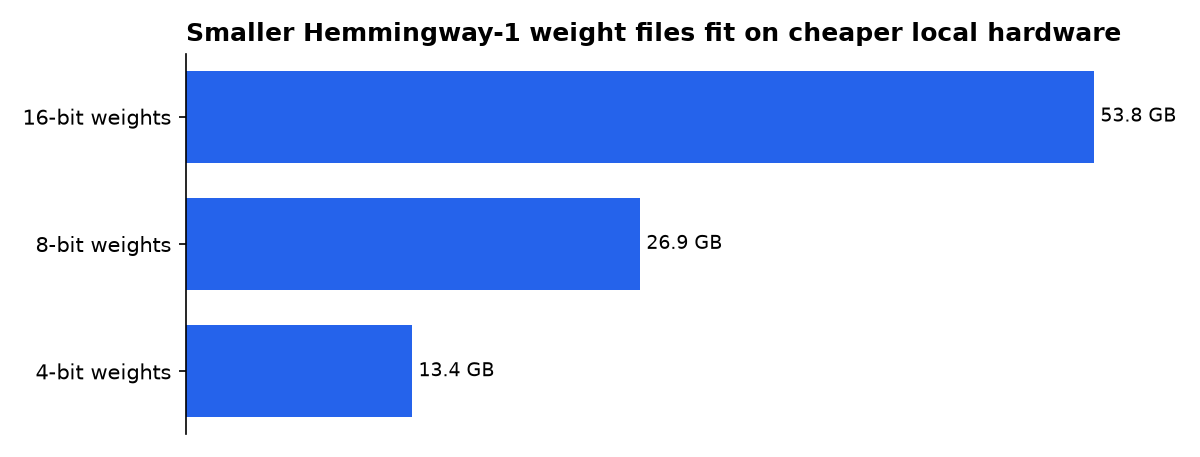
The published planning estimates are useful because they put the trade-off in plain terms. At 16-bit precision, the weights alone need about 53.8GB of memory. At 8-bit, they need about 26.9GB; at 4-bit, the estimate is about 13.4GB.
These are weight-only calculations, not a benchmark of speed, quality or laptop compatibility. Quantisation means storing model weights with fewer bits, which reduces memory use. It can make local operation more practical, but it does not remove other memory demands.
| Hemmingway-1 weight format | Estimated weight memory | Meaning for a buyer | Evidence tier |
|---|---|---|---|
| 16-bit weights | 53.8GB | Plan for the weights before allocating memory to the runtime or prompt cache. | Calculation from published files |
| 8-bit weights | 26.9GB | Uses less weight memory, but the full application still needs additional capacity. | Calculation from published files |
| 4-bit weights | 13.4GB | The smallest weight-only planning figure in this comparison. | Calculation from published files |
The parameter declaration, file size and planning figures appear on Altworld’s Hemmingway-1 page. The table compares weight memory only, so buyers should test their intended context length and runtime before relying on it for daily work.
Local use can offer control over where a draft runs, but it also moves responsibility to the operator. You need to manage the model files, inference software, updates and the review process. The model’s weight size alone says nothing about whether its output is suitable for a customer email, a contract summary or a research report.
Use a short, representative test set before committing hardware or workflow time. Include the kinds of messages you actually write, the terminology your team uses and the constraints that matter. Review factual preservation, tone, revision effort and response time separately.
How should writers avoid generic AI voice?
Start with material only the writer or organisation can provide: the real decision, the evidence, the constraints and the intended reader. Then ask the model to organise or revise that material. A style prompt cannot supply missing reporting, experience or responsibility.
A study published through arXiv identified 21 focal words whose increased use in scientific abstracts was likely connected to large-language-model use. The researchers found no evidence that model architecture, algorithm choices or training data alone explained the lexical overrepresentation. Their model testing was consistent with human-feedback training playing a role, but the paper does not establish a single cause.
The point is not that one word proves AI use. Readers notice patterns across vocabulary, sentence structure and information order. Replacing a few words can leave the underlying problem intact if the draft still hides actors, uses vague references or spends too long announcing its point.
yomiyasu’s approach is useful here because it gives an editor a checklist. Name the actor. State the action. Replace a vague pronoun with the thing it refers to. Keep technical conditions and numbers. Remove framing that does not help the reader perform a task.
A separate Japanese-language analysis argues that fully removing AI-associated style is difficult. It recommends prioritising the parts that reduce usability, rather than treating surface vocabulary as the entire problem. It also argues that an editor remains responsible for understanding and standing behind the final text.
That analysis is an informed commentary rather than a controlled benchmark. Its practical advice still fits newsroom work: write freely first, then edit for the reader’s comprehension. Use the final pass to remove vague abstractions, overlong caveats and unsupported generalities.
A reliable two-pass process is simple:
- Draft with the facts, source material, audience and required outcome in view.
- Rewrite for clarity while preserving the original conditions, figures and attribution.
- Check each factual statement against the source material outside the style pass.
- Read the final version as the recipient, not as the person who prompted the model.
Do not turn this into a mechanical ban list. A technical term may be the clearest available word. The useful test is whether the term helps a specific reader understand the work, rather than merely making the prose sound formal.
Is Claude or GPT better at writing?
No source in this comparison establishes that Claude, GPT or another general model is best for every writing task. A fair comparison would need a shared set of prompts, disclosed editing conditions, representative languages and human assessment by the intended readers. Those conditions are rarely identical in public product claims.
Instead, compare the systems on work you actually do. Give each one the same brief, the same source material and the same length limit. Check whether it retains the facts, follows the requested format and reduces the time required for human revision.
OpenAI’s own account of early ChatGPT limitations is a useful reminder that writing quality and reliability differ. OpenAI said ChatGPT could be excessively verbose and overuse certain phrases, partly because trainers preferred longer responses that appeared more comprehensive. Asking for a shorter answer can help, but an editor still needs to decide which detail belongs in the final draft.
For Japanese polishing, a dedicated skill may be more useful than repeating “sound natural” in a general prompt. For English local drafting, a model’s published file requirements may matter more than an abstract quality claim. The comparison should reflect the bottleneck in your own workflow.
Which AI is better than ChatGPT for writing?
There is no verified basis here for claiming that one system is better than ChatGPT for all writing. A tool can be better for a constrained job without being a better writer in every language and format. yomiyasu is a plausible fit for Japanese structural revision because that is the task its documentation addresses.
Hemmingway-1 is a possible local option where its published memory requirements are acceptable. That does not establish that it produces better prose than a hosted model. It establishes only that builders can plan its weight memory from published figures.
For factual writing, the key distinction is between assistance and accountability. OpenAI’s warning about plausible but incorrect answers applies to a general risk of language-model output: fluent text can conceal a mistake. A writer should therefore treat generated prose as a draft until the evidence has been checked.
For learner-facing explanations, iterative simplification can be more useful than one aggressive rewrite. Researchers behind a learner-dictionary study reported that their LLM-based method used iterative simplification and produced definitions with high lexical simplicity under their proposed evaluation criteria. The study also built Japanese reference definitions with a professional lexicographer, which shows why clear evaluation criteria matter.
The result does not prove that every repeated rewrite improves every document. It does support a narrower method: simplify in stages, assess whether meaning survived, and judge the result against the reader’s task. That is more useful than asking a model to make text “better” without defining better.
How should builders use AI writing tools in a workflow?
Put the model at the stage where it has a defined job. Use it to create an outline from supplied facts, produce alternatives for a difficult sentence, compress a repetitive draft, or apply a documented editing rule. Do not ask it to invent evidence for a conclusion you already want.
For search-led articles, content optimisation scores should remain secondary to reader need and original reporting. Ahrefs found weak correlations between ranking and content scores across five tools. Its analysis recommends using scores as relative indicators of topic coverage rather than treating keyword repetition as proof of quality.
That is especially relevant when AI can generate complete-looking pages quickly. A score can show that a competitor mentioned a subtopic. It cannot establish that your explanation is accurate, useful or distinct from the material already available.
Use a content score after you have identified the reader’s intent and assembled the reporting. Check for a missing question or relevant concept, then decide whether it belongs in the article. Do not add a section merely because a tool lists a term.
When a team uses Japanese output, run the prose through a structural edit after the factual draft is stable. When it uses a local model, test memory use and revision quality before making it part of production. In both cases, preserve source links and track meaningful edits.
What should readers actually do?
Use yomiyasu for Japanese rewriting when the goal is clearer subjects, actions and technical wording. Consider Hemmingway-1 only after checking whether 13.4GB of 4-bit weight memory, plus runtime overhead, fits the intended machine. For every model, keep the human review focused on facts, reader needs and the responsibility attached to the final text.
What could we not verify?
No independent public benchmark in the material reviewed establishes that nanaism/yomiyasu, Xuanwo/cida, Hemmingway-1, Claude or GPT is the single best AI for writing. Public sources support specific descriptions of yomiyasu and published Hemmingway-1 file figures. They do not support a universal quality ranking.
We could not verify a fixed commercial price, a general API price, a quality score across languages or a standard hardware configuration for Hemmingway-1. The published memory figures cover weights only. They do not measure output quality, speed, context-cache use or total system memory.
We also could not verify performance claims for Xuanwo/cida from the material available for this article. Its repository remains listed below because it was part of the original comparison, but this article makes no product claim about it without supporting documentation.

