
Google launched Gemini 4 Neon on 18 November 2026 at $3 per million input tokens and $15 per million output tokens. OpenRouter lists its batch variant at $1.50 and $7.50, while both variants have a 1,048,576-token context window. (Google; OpenRouter)
At a glance
- Google lists Gemini 4 Neon at $3 per million input tokens and $15 per million output tokens.
- OpenRouter lists Gemini 4 Neon batch at $1.50 input and $7.50 output per million tokens.
- The standard route has a 1,048,576-token context window.
- The batch listing has a 1,048,576-token context window and supports up to 1,048,576 completion tokens.
- A direct, independent Neon-versus-Claude Opus 5.5 test result is not public in the benchmark pages reviewed here.
What launched on 18 November 2026?
Google released Gemini 4 Neon on 18 November 2026. The model is available through the Gemini API, Google AI Studio, Gemini for business, Google Antigravity, and paid Gemini app subscriptions, according to Google.
Google prices Neon at $3 per million input tokens and $15 per million output tokens. Cached input costs $0.15 per million tokens, which Google describes as a 95% discount from the listed input rate.
Tokens are the text fragments a model reads and bills by. Input tokens include prompts, files and prior conversation; output tokens include the answer, code or tool instructions.
That distinction matters for agentic software. An agent can reread a large repository, then produce a much smaller answer, or generate a long patch and incur a larger output charge.
Neon offers four reasoning levels: low, medium, high and xhigh, according to Google’s launch announcement. The setting changes how much reasoning the model applies, but the announcement lists the same headline token prices.
Which Gemini 4 option should you buy?
Choose standard Neon when a person or service needs an immediate answer. Choose batch Neon when the work can wait. Choose Hydrogen when its execution-focused design and lower listed price fit the task.
Google lists Gemini 4 Hydrogen at $1.50 per million input tokens and $7.50 per million output tokens across its 1-million-token context window.
| Concrete option | Posted input price | Posted output price | Context and response limit | Best fit | Evidence tier |
|---|---|---|---|---|---|
| Gemini 4 Neon standard | $3.00 / 1M | $15.00 / 1M | 1,048,576 context; completion limit not listed on the cited page | Interactive coding agents and user-facing tools | PROVIDER LISTING |
| Gemini 4 Neon batch | $1.50 / 1M | $7.50 / 1M | 1,048,576 context; 1,048,576 completion | Queued reports, large migrations and offline jobs | PROVIDER LISTING |
| Gemini 4 Hydrogen | $1.50 / 1M | $7.50 / 1M | 1M context | Lower-cost execution and worker-agent tasks | PRIMARY VENDOR PRICE |
Neon standard prices and context come from OpenRouter’s provider catalogue. Neon batch prices, cache rates and completion capacity come from OpenRouter’s batch listing. Hydrogen pricing comes from Google’s announcement.
The table shows why batch is not automatically the best model purchase. Neon batch and Hydrogen carry the same listed input and output prices, but they represent different choices: batch keeps the Neon name and positioning, while Hydrogen is Google’s model for rapid execution across everyday agent workflows.
How much does Gemini 4 Neon batch save?
Gemini 4 Neon batch halves both listed text-token rates: $1.50 rather than $3 for input, and $7.50 rather than $15 for output. OpenRouter lists cache reads at $0.075 per million tokens and cache writes at $0.08333 per million tokens.
The following calculation uses OpenRouter’s listed prices and three usage profiles. It assumes 1,000 identical requests and no cache hits.
| Workload per 1,000 requests | Neon standard | Neon batch | Exact saving | Evidence tier |
|---|---|---|---|---|
| Chat turn: 1,000 input + 500 output tokens | $10.50 | $5.25 | $5.25 | FUTURPULSE CALCULATION |
| RAG answer: 8,000 input + 500 output tokens | $31.50 | $15.75 | $15.75 | FUTURPULSE CALCULATION |
| Agent step: 30,000 input + 2,000 output tokens | $120.00 | $60.00 | $60.00 | FUTURPULSE CALCULATION |
These figures use the usage profiles and list prices recorded by OpenRouter. They exclude search calls, image and audio inputs, cache hits, retries, routing effects and enterprise contract terms.
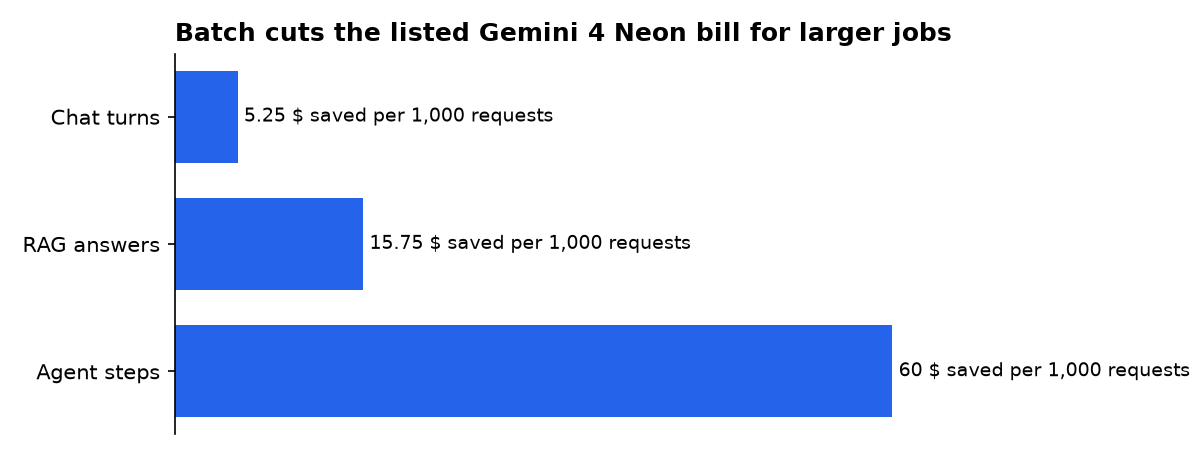
Batch produces its largest dollar saving when software sends long prompts and receives long answers. The calculation shows a $60 saving per 1,000 agent steps under the stated profile.
That does not make batch free. A long output still costs money, even at half the standard rate. Teams should cap responses, record retries and separate model charges from the labour needed to check generated work.
What is the 1M-context catch?
Context length and completion length are different limits. OpenRouter lists standard Neon with a 1,048,576-token context window, but the cited standard listing does not state a separate completion maximum.
In plain English, the context window describes how much material the model can consider in a request. It does not promise that the model will return an equally large answer.
The distinction matters for repository analysis, document bundles and long conversations. A model can inspect a substantial input while still producing a response that needs to be divided into files, steps or checkpoints.
The batch listing states that Neon batch supports 1,048,576 context tokens and up to 1,048,576 completion tokens. That makes the batch route the clearer fit for very large offline outputs.
Even then, output limits are ceilings, not targets. A service should set deliberate limits, save intermediate results outside the prompt and retry only when the failure is understood.
What does the public evidence show about Opus 5.5?
Google reports Neon at 71.3% on HLE-Diamond and 46.2% on FrontierCode 2.0 at its default high setting. Those figures are reported through Google’s launch material and the OpenRouter model page, not through a matched independent comparison.
The independent HLE-Diamond leaderboard reports Claude Opus 5.5 at 54.6% and Gemini 4 Argon at 56.9%. It does not list Gemini 4 Neon in that table.
HLE-Diamond contains 1,000 questions, according to the Center for AI Safety and Scale AI. The published comparison evaluates models without tools and uses high reasoning, so changing tools or settings would change what the scores mean.
The coding evidence has the same limitation. Cognition’s FrontierCode 2.0 table reports Claude Opus 5.5 at 47.3% and Gemini 4 Argon at 27.6%; Neon is absent.
Those results should not be combined into a single race. Google’s Neon score and Cognition’s Opus score come from different published comparisons, and the benchmark pages do not establish identical settings, tools or spending.
A third-party analysis projects that Neon would beat Opus 5.5 in 48.3% of cases. That analysis assumes Neon resembles Carbon and models the effect of response speed; it is a hypothesis, not a controlled evaluation.
Can Neon’s science claims be checked?
Google says Neon scores 84.0% on RiemannBench. The underlying paper describes Riemann-Bench as a private benchmark of research-level mathematics problems.
The Riemann-Bench paper says its authors used an estimator based on 100 independent runs per problem. Its abstract does not publish a Neon result table.
That does not prove Google’s score false. It means an outside buyer cannot reproduce the specific Neon result from the public paper alone.
The paper also says that all frontier models in its study scored below 10%. That result belongs to the paper’s evaluated model set, not necessarily to Neon, so it should not be used as a substitute for Google’s separate claim.
For a science team, the useful test is narrower. Compare Neon with alternatives on the team’s own equations, source documents, code and failure cases. Measure corrected work and review time, not only generated-token cost.
What should API buyers do now?
Use standard Neon for interactive work. Use batch when the queue can absorb the delay and the lower listed rate matters. Use Hydrogen for execution-heavy workloads after it passes a quality test against the team’s own tasks.
- Start with standard Neon in a small interactive pilot. Apply strict output limits.
- Move repeatable jobs to batch when they can run asynchronously.
- Cache stable instructions and retrieved context after checking the cache terms listed by OpenRouter.
- Measure corrected outcomes, including failed tool calls, retries and human review time.
- Do not buy on the Opus comparison alone until a shared public evaluation tests both models under matching conditions.
The immediate commercial choice is clear. Batch is the lower-cost Neon route for non-urgent workloads, while standard Neon is the simpler route for interactive requests.
The 1-million-token context label helps with large inputs. It does not remove the need to control output length, retries or agent loops.
What remains unverified?
Google has not publicly published a direct Neon-versus-Claude Opus 5.5 result on the independent HLE-Diamond or FrontierCode 2.0 pages cited here. The benchmark owners could resolve that gap with matched runs covering reasoning settings, tool access, token budgets and variance.
Public pages do not establish batch turnaround guarantees, enterprise discounts or regional availability terms. The cited batch listing says that it is served by Google Vertex, but it does not provide a turnaround commitment.
The listed prices also do not predict a real application’s monthly bill. Retries, cache behaviour, multimodal inputs, routing and search calls can change actual usage.
OpenRouter reports standard Neon performance data, including a 3.02-second P50 latency and 84 tokens per second at the best provider in the displayed measurement. Those figures describe the displayed provider data, not a universal service guarantee.
The next useful evidence would be an independent Neon evaluation against Opus 5.5 with the same benchmark, tools, reasoning level and budget.
Which sources support these figures?
- Google: Introducing Gemini 4 Neon
- OpenRouter: Gemini 4 Neon pricing and limits
- OpenRouter: Gemini 4 Neon batch pricing and limits
- Google: Introducing Gemini 4 Hydrogen
- Cognition: FrontierCode 2.0
- Center for AI Safety and Scale AI: HLE-Diamond
- Riemann-Bench research paper
- micjm: Gemini 4 Neon projection against Opus 5.5

