
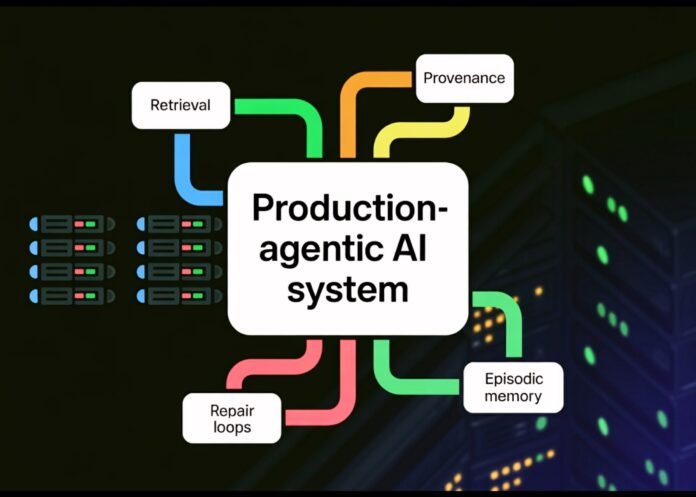
agentic AI — Key Takeaways
- Hybrid retrieval using TF-IDF and OpenAI embeddings enhances information accuracy.
- Provenance tracking ensures original source traceability, reinforcing data integrity.
- Episodic memory stored in SQLite allows the system to learn from previous operations.
- Repair loops enhance continually improving outputs by adapting strategies over time.
- Robust guardrails ensure all claims made by the AI are evidence-based and credible.
What We Know So Far
Understanding the Foundations of Agentic AI
Agentic AI systems are designed to function autonomously, managing tasks such as planning, execution, and learning. This capability allows them to test different approaches and refine their strategies over time. Through this systematic evaluation, agentic AI can continuously reach new levels of efficiency and effectiveness.

Related image — Source: marktechpost.com — Original
These systems utilize complex algorithms and extensive datasets, which further empower their adaptability in ever-changing environments.
Recent developments showcase the integration of hybrid retrieval mechanisms utilizing TF-IDF and OpenAI embeddings for effective information management, enhancing retrieval accuracy and relevance. This signifies an evolution in how agentic AI engages with data sourcing.
The combination of these techniques represents a significant advancement, allowing systems not only to retrieve but also to synthesize information meaningfully and contextually.
Key Details and Context
More Details from the Release
The system employs hybrid retrieval using both TF-IDF and OpenAI embeddings for information retrieval.
The system uses normalized schemas for plans and final answers to validate citations, ensuring consistency and integrity in retrieved information. These schemas play a crucial role in shaping how data interacts within the system’s architecture.

Related image — Source: marktechpost.com — Original
The architecture includes a feedback mechanism known as repair loops to autonomously improve outputs. This self-optimizing feature is essential, as it enables the AI to reevaluate previous findings, thereby continuously enhancing its performance.
Furthermore, the system orchestrates multiple agents to perform tasks like planning, synthesizing, and validating outputs. This orchestration allows for collaborative processing, where different agents can contribute their strengths toward achieving a unified goal.
Guardrails are strictly enforced so every major claim made by the system is grounded in retrieved evidence. These safeguards are not merely procedural but are critical for maintaining the trustworthiness of the AI’s output.
The proposed AI system can adapt its strategies over time due to persistent episodic memory, which facilitates a deeper engagement with past performance. This evolving memory capability allows the AI to learn effectively from its history.
Additionally, episodic memory is stored in SQLite to help the system recall efficient strategies from previous runs, streamlining future operations.
Provenance tracking is implemented to ensure that every piece of text can be traced back to the original source. This commitment to traceability not only enhances credibility but also allows for thorough verification of the information presented by the AI.
Moreover, the system employs hybrid retrieval using both TF-IDF and OpenAI embeddings for information retrieval, which is a critical aspect of its design that supports effective data sourcing and utilization.
Provenance and Repair Mechanisms
The implementation of provenance tracking ensures that every piece of information can be traced back to its original source. This approach strengthens the integrity of data used by the AI, effectively bolstering user trust. Trust in AI systems is paramount, as it governs user interaction and engagement with AI-generated outputs.
Moreover, the system utilizes repair loops which function as feedback mechanisms to automatically improve outputs. This adaptive approach allows AI to evaluate its previous decisions and enhances future performance, ensuring a cycle of ongoing improvement.
What Happens Next
Persistent Learning and Adaptation
Integrating episodic memory is crucial. Stored within a SQLite database, it enables the AI to recall prior strategies and decisions, thereby improving efficiency over time. This persistent memory sustains a learning effect crucial for self-improvement, reinforcing the AI’s capability to evolve based on its operational history.
Related image — Source: marktechpost.com — Original
As the system continues to evolve, it is expected to orchestrate multiple agents aimed at tasks such as synthesis, planning, and validation of outputs, effectively expanding its operational capacity and fortifying its functional versatility.
Why This Matters
The Future of AI Systems
Establishing robust guardrails ensures that all significant claims made by the AI are underpinned by retrieved evidence. This development highlights a crucial aspect in the trustworthiness of AI systems, fostering a new era of insight and accountability.
Overall, the combination of advanced retrieval methods, memory architecture, and a continuous feedback loop sets the stage for groundbreaking improvements in AI applications. Most importantly, moving towards smarter and more reliable systems is expected to redefine their roles across diverse sectors.
FAQ
Common Questions about Agentic AI
What is agentic AI? It refers to capable AI systems autonomously planning and executing tasks, continuously learning from experiences.
The architecture includes a feedback mechanism known as repair loops to autonomously improve outputs.
Sources
- Primary source
- How to Build a Production-Grade Agentic AI System with Hybrid Retrieval, Provenance-First Citations, Repair Loops, and Episodic Memory
- A Coding, Data-Driven Guide to Measuring, Visualizing, and Enforcing Cognitive Complexity in Python Projects Using complexipy
- Waymo Introduces the Waymo World Model: A New Frontier Simulator Model for Autonomous Driving and Built on Top of Genie 3
- Anthropic Releases Claude Opus 4.6 With 1M Context, Agentic Coding, Adaptive Reasoning Controls, and Expanded Safety Tooling Capabilities

