

Key Takeaways
- OAT, developed by researchers from Harvard and Stanford, enhances robotics with scalable actions.
- It converts continuous robot movements into discrete tokens using a transformer encoder.
- The Nested Dropout technique prioritizes essential actions, improving execution speed.
- OAT showed superior performance in 20+ tasks over previous methods like Diffusion Policy.
- Prefix-based detokenization allows a balance between computational efficiency and action accuracy.
What We Know So Far
Introduction to OAT
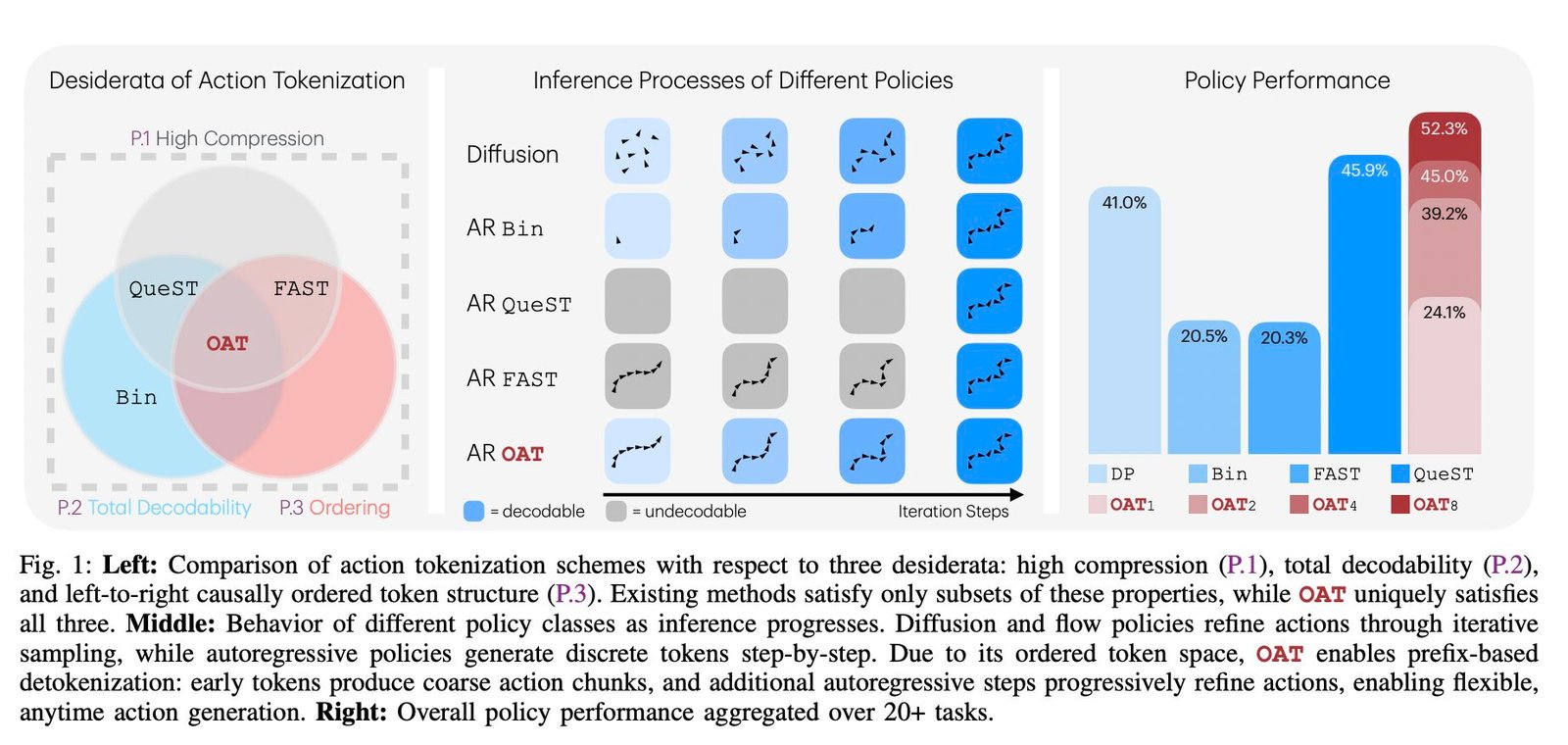
OAT in robotics — Researchers at Harvard University and Stanford University have announced the development of a transformative framework known as Ordered Action Tokenization (OAT) . This innovative system aims to enhance robotics by integrating powerful LLM-style scaling.
Related image — Source: marktechpost.com — Original
OAT addresses a vital challenge in robotics: the conversion of continuous robot movements into discrete tokens. This meaningful advancement simplifies model training and augments the performance of robotic systems.
Core Mechanism
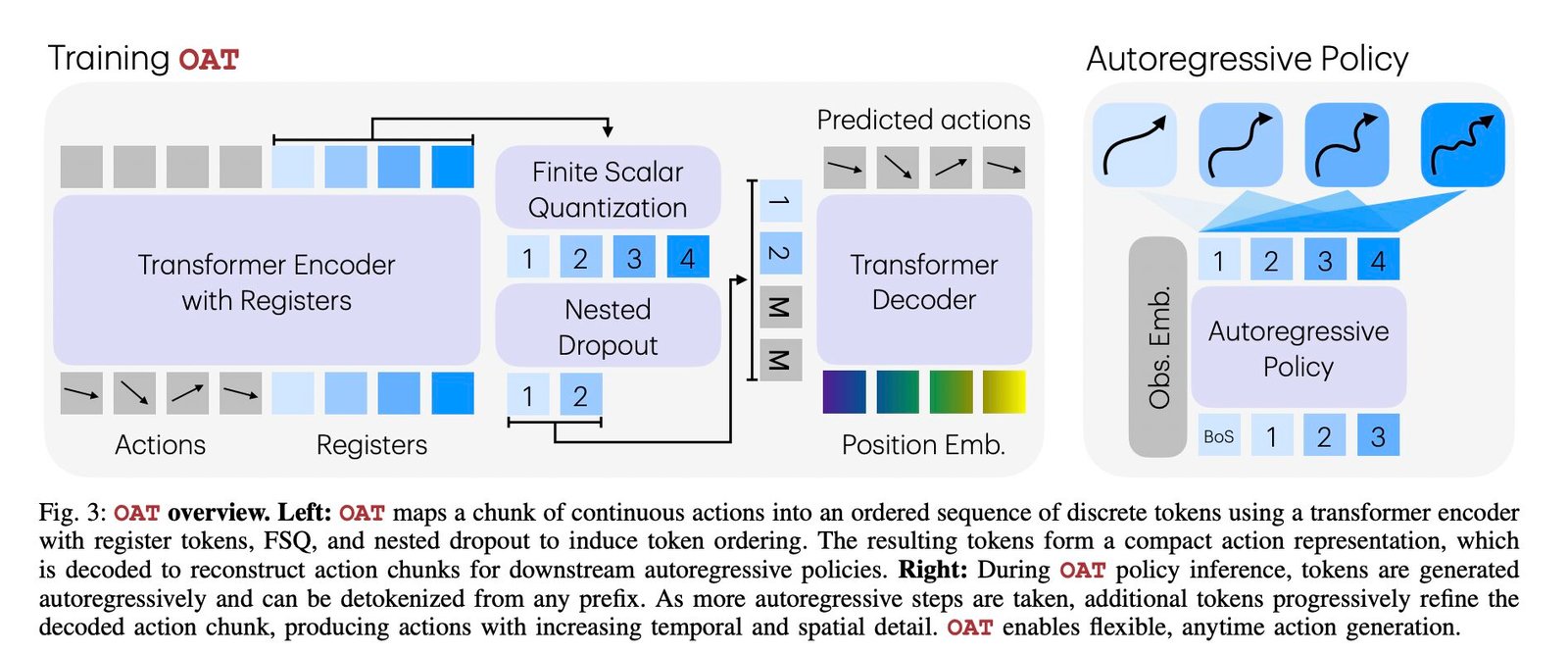
The core of OAT employs a transformer encoder, a structure prevalent in natural language processing (NLP), which effectively processes and categorizes continuous actions into manageable tokens. This is pivotal for executing complex actions with precision.
Additionally, OAT benefits from an innovative technique called Nested Dropout, which allows the model to prioritize essential actions. This capability significantly improves the efficiency of robotic operations by focusing computational resources on what matters most.
Key Details and Context
More Details from the Release
The introduction of OAT marks a significant shift toward integrating LLM-style scaling in robotics, enabling flexible and timely inference.
Previous tokenization strategies used for robotics faced critical limitations that OAT aims to resolve.
Tokenization enables the summarization of complex robot actions into chunks, which improves the efficiency of training models on robotic tasks.
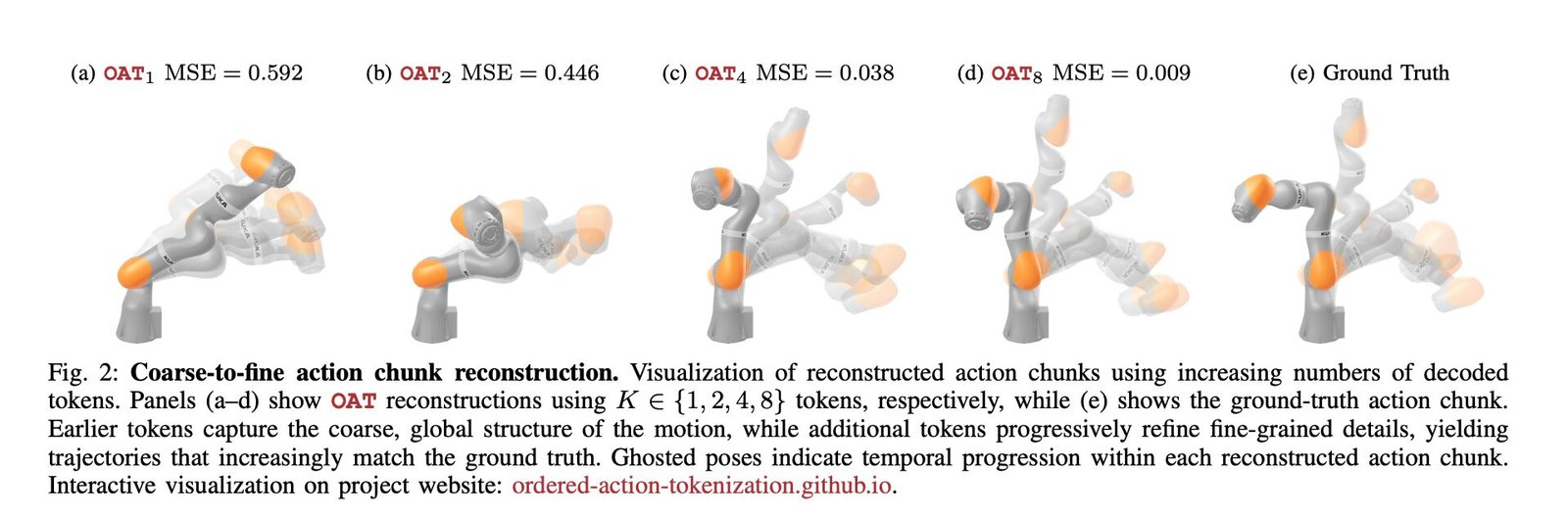
A significant benefit of OAT is its ability to allow for prefix-based detokenization, enabling a trade-off between computation costs and action fidelity.
OAT was tested across 20+ tasks using 4 major simulation benchmarks and consistently outperformed Diffusion Policy and previous tokenizers.
The framework uses an innovative approach called Nested Dropout to help the model prioritize important actions.
OAT addresses the challenge of converting continuous robot movements into discrete tokens using a transformer encoder.
The researchers from Harvard University and Stanford University developed a framework called Ordered Action Tokenization (OAT) to advance robotics.
The introduction of OAT marks a significant shift toward integrating LLM-style scaling in robotics, enabling flexible and timely inference.
Previous tokenization strategies used for robotics faced critical limitations that OAT aims to resolve.
Tokenization enables the summarization of complex robot actions into chunks, which improves the efficiency of training models on robotic tasks.
A significant benefit of OAT is its ability to allow for prefix-based detokenization, enabling a trade-off between computation costs and action fidelity.
OAT was tested across 20+ tasks using 4 major simulation benchmarks and consistently outperformed Diffusion Policy and previous tokenizers.
The framework uses an innovative approach called Nested Dropout to help the model prioritize important actions.
OAT addresses the challenge of converting continuous robot movements into discrete tokens using a transformer encoder.
The researchers from Harvard University and Stanford University developed a framework called Ordered Action Tokenization (OAT) to advance robotics.
Testing and Validation
The OAT framework underwent rigorous testing across more than 20 tasks, utilizing four major simulation benchmarks. Results showed that OAT consistently outperformed current leading methods, including Diffusion Policy and former tokenization strategies.
Related image — Source: marktechpost.com — Original
This performance edge not only demonstrates OAT’s potential but also highlights the framework’s capability to adapt and excel across various robotic tasks.
Significant Capabilities
One of the standout features of OAT is its ability to facilitate prefix-based detokenization. This allows developers to effectively balance computation costs while maintaining high fidelity in action execution, essential for real-world applications.
Furthermore, tokenization through OAT consolidates complex robot actions into simplified chunks. This process accelerates the training of models, making them more efficient and capable of handling diverse tasks more competently.
What Happens Next
Future Implications
The introduction of OAT heralds a significant shift within the robotics domain. As this framework integrates LLM-style scaling, it enables more flexible and timely inference. This advancement is crucial as the demand for responsive and efficient robotic systems continues to rise.
Related image — Source: marktechpost.com — Original
Continued research and development of frameworks like OAT is expected to likely pave the way for further innovations in robotics, potentially leading to systems that can learn and adapt more rapidly than ever before.
Broader Industry Impact
OAT’s capability to enhance model training and performance through advanced action tokenization represents a breakthrough in robotics. It opens avenues for more complex robotic behavior and improved interaction with dynamic environments.
As industries increasingly adopt robotic solutions, the implications of incorporating OAT could reshape how robots are employed across sectors, from manufacturing to service industries and beyond.
Why This Matters
The significance of OAT extends beyond academic interest; it highlights a transformative approach in robotics that can deliver profound changes in operational efficiency, performance, and overall effectiveness of robotic systems. The framework’s focus on scalable action representation is set to inform future research avenues.
In an era where artificial intelligence and robotics converge, innovations like OAT serve as critical building blocks for the next generation of intelligent systems, capable of executing complex tasks with increasing sophistication.
FAQ
Additional Insights
As interest in OAT and its capabilities expands, many questions arise about its implementation and advantages. Here, we provide answers to some of the most anticipated inquiries.
“The introduction of OAT marks a significant shift toward integrating LLM-style scaling in robotics, enabling flexible and timely inference.”
Sources
- Primary source
- Meet OAT: The New Action Tokenizer Bringing LLM-Style Scaling and Flexible, Anytime Inference to the Robotics World
- Home – MarkTechPost
- Waymo Introduces the Waymo World Model: A New Frontier Simulator Model for Autonomous Driving and Built on Top of Genie 3
- Mistral AI Launches Voxtral Transcribe 2: Pairing Batch Diarization And Open Realtime ASR For Multilingual Production Workloads At Scale

