
Fish Audio Drama 3 is a 35B-parameter text-to-speech model that activates 3B parameters per token and supports scripts with up to 16 tagged speakers. Its 13 October 2026 technical report also confirms take revision, speech infilling and streaming in one architecture, although the public product remains a preview. Fish Audio’s technical report states the model’s core design and release capabilities.
At a glance
- SGLang’s Drama 3 guide documents 16 speaker tokens, numbered from 0 through 15, in one synthesis request.
- The published Drama 3 repository lists a 36B model class and a 41.5 GB repository download.
- The available int4 checkpoint reports a 20.8 GB engine-weight footprint, against 37.0 GB for the FP8-expert version.
- Fish Audio’s software repository describes Drama 3 as 35B-A3B, while its earlier S2-Pro model has 4B parameters.
What can Fish Audio Drama 3 do with multiple speakers?
Fish Audio Drama 3 can assign dialogue turns to 16 speaker tokens in a single text prompt. That makes it a scene generator, rather than a tool that creates one isolated voice clip at a time. The documented format uses tokens from <|speaker:0|> through <|speaker:15|>, with separate reference audio available for cloning voices. The SGLang implementation guide specifies the 16-character ceiling.
That ceiling is a concrete control limit, not proof that every 16-character scene will preserve identity perfectly. Fish Audio’s technical report says whole-scene dubbing gives the model the full dialogue, allowing a line’s delivery to depend on later lines. This matters for interruptions, reactions and pacing, where generating each line independently can lose conversational context. The report describes scene dubbing as a prompt format trained with all lines available together.
Drama 3 also retains conventional voice cloning. A reference clip and transcript define the target voice, while speaker tags select whose turn it is. The public server requires both reference audio and accompanying text for cloning, so a clean audio file alone is not enough for this workflow. The vLLM-Omni recipe specifies the paired ref_audio and ref_text requirement.
How does Drama 3 control tone and individual words?
Drama 3’s main distinction is that direction is part of the script. A point tag such as [sighs] asks for an event at that location, while a scoped tag such as <whisper>...</whisper> applies only to selected words. Natural-language notes can also describe intent, pace or emphasis without relying on a fixed tag vocabulary. Fish Audio’s control-syntax table documents those separate forms.
For a producer, scoped controls are more useful than a broad “happy” voice setting. They offer a way to stress one phrase, lower one aside, or slow only the last clause. Fish Audio’s preview page says the web editor can combine plain-language directions, sounds, pauses and paired tags in the same line. Fish Audio’s product page describes the controls as readable text that users can edit and reuse.
The claim needs a practical qualification. Fish Audio labels Drama 3 a preview and says results vary between takes. In other words, the controls exist, but a production team should still audition alternatives rather than treat a prompt as deterministic audio automation. Fish Audio’s preview notice says users should generate several takes and select the best result.
How is Drama 3 different from Fish Audio S2-Pro?
Fish Audio Drama 3 is larger and adds editing-oriented controls that Fish Audio does not list for S2-Pro. Both models support multi-speaker generation, voice cloning and inline natural-language instructions. Drama 3 adds multi-turn director revision, local speech infilling and long-dialogue production, while Fish Audio positions S2-Pro as the faster previous-generation model. Fish Audio’s comparison table states those capability differences.
The architectural change explains some of the size increase. Drama 3 uses a mixture-of-experts, or MoE, text backbone: many specialist weight blocks exist, but only a subset runs for each token, the small chunks of text or audio representation the model processes. It combines hybrid linear and full attention with a codebook decoder that produces 10 audio codes per frame. The vLLM-Omni recipe describes the 35B-total, 3B-active MoE design and its 44.1 kHz mono output.
By contrast, Fish Audio lists S2-Pro at 4B parameters. That makes S2-Pro the more plausible choice when speed, lower deployment requirements and simple voice work matter more than revising a finished take or generating an entire directed scene. This is a vendor-family comparison, not a universal ranking of all TTS systems. Fish Audio’s repository lists the respective 35B-A3B and 4B model sizes.
How large is Drama 3 in practice?
Drama 3’s published repository is listed at 41.5 GB, but that download number is not the same as live GPU memory. The MoE checkpoint stores routed experts in FP8, an eight-bit floating-point format, while other components remain in bf16, a 16-bit format. The distinction matters because a server also needs memory for prompts, cached attention states and the audio decoder. The Hugging Face repository lists the 41.5 GB download figure.
Our calculation Treating Fish Audio’s declared 35.9 billion parameters as uniformly stored weights gives a theoretical 71.8 GB at 16-bit precision, 35.9 GB at eight-bit precision and 17.9 GB at four-bit precision. Those are arithmetic estimates from parameter count, not a hardware test, and they do not include runtime cache or audio-decoder memory. The base checkpoint listing is the source for the published model identity and weight availability.
| Representation | Weight footprint | What the number means |
|---|---|---|
| Our 16-bit estimate | 71.8 GB | Weights alone, assuming every declared parameter uses 2 bytes. |
| Original FP8-expert server checkpoint | 37.0 GB | Measured engine weight memory, not total GPU memory. |
| Hybrid int4 checkpoint | 20.8 GB | Measured engine weight memory, with selected components retained in bf16. |
The first row is FuturPulse arithmetic. The other rows are checkpoint measurements published with the int4 release. The int4 model card reports both deployed weight figures.
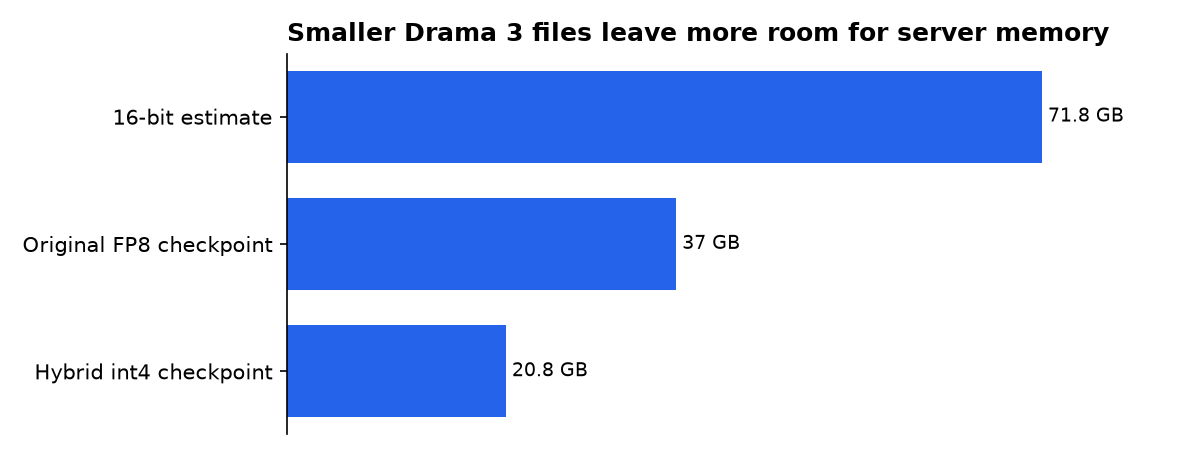
The int4 result should not be read as proof that Drama 3 runs on a 21 GB card. The checkpoint author explicitly separates engine weights from total serving memory. An earlier test used an 80 GB A100 and reported 57.3 GB at startup, under its stated split-memory configuration. The int4 release notes say 20.8 GB is only the engine-weight footprint.
What hardware does Drama 3 need?
Fish Audio’s own installation guide sets a minimum of 48 GB of GPU memory for the FP8 Drama 3 configuration. It also limits the official path to NVIDIA GPUs and says Drama 3 does not support CPU, Apple MPS or AMD ROCm deployment. That places the unquantized model outside normal consumer-laptop use. Fish Audio’s installation requirements list the 48 GB minimum.
The SGLang recipe shows why reference audio changes the budget. Each reference is limited to 60 seconds by default, and longer clips need both a higher configured limit and more preprocessing memory. The guide also caps prompts at 8,192 rows, which include script text, reference transcripts and audio codec frames. The SGLang serving limits state the 60-second and 8,192-row defaults.
For local serving, that means the model is not only a question of downloaded weights. A long multi-character scene can use multiple cloned voices, each with reference audio, and every reference consumes context and preprocessing resources. Operators should test their longest expected script and reference set, not just confirm that the checkpoint loads.
How fast is Drama 3 when it streams audio?
In the submitted vLLM-Omni integration test, a warm H100 server reached median time to first audio of 129 ms at one concurrent request. Time to first audio is the delay before a listener hears the opening sound. The same submission recorded a real-time factor of 0.26, meaning generation took about one quarter of the resulting audio duration in that specific setup. The merged vLLM-Omni integration reports those test conditions and results.
Those are promising implementation figures, but they are not a blanket performance promise. The submission says the first request after launch took about 8.6 seconds because GPU kernels compiled, while warm-up requests removed later spikes. It also recorded extra silence after some prompts containing event tags. The same integration notes the cold-start delay and tag-prompt failure mode.
Fish Audio’s model architecture is designed to reduce repeated decoder work. The technical report says Drama 3 uses four shared decoder layers plus nine codebook-specific layers, rather than repeatedly traversing a separate fast autoregressive path. That is a technical reason it can remain streamable despite its larger total parameter count. The architecture section explains the 13-layer codebook multi-token-prediction decoder.
What shipped, and what remains a promise?
Drama 3’s release story has two tracks: the available model and service integrations, and the broader product claims around revision and editing. The dated timeline below separates the announced capability from the implementation evidence.
Promised: Fish Audio’s technical report presented one model for multi-character scenes, multi-turn revision, infilling, long-form generation and streaming. Shipped: the public model repository made Drama 3 weights available under Fish Audio’s licence. The technical report dated 13 October describes the unified capability set.
Promised: vLLM-Omni proposed an OpenAI-compatible speech endpoint with voice cloning and streaming. Shipped: the Drama 3 support pull request was merged into the project’s main branch after review fixes, although the review recorded 9 of 11 checks passing at merge. The merge record shows the implementation entered main on 14 October.
Promised: Fish Audio’s product interface presents directed dialogue, word-scoped changes and API access. Shipped: those controls are exposed in a preview product, but Fish Audio still says results can vary between takes. Fish Audio’s preview page says the model remains under active improvement.
What can developers use through an API today?
Fish Audio says Drama 3 can be called through its text-to-speech API using the drama-3 model header. Its API example sends script text and a reference ID, while the same direction tags used in the editor are intended to work in requests. Fish Audio’s API example shows the model-header selection.
Self-hosted routes differ by runtime. SGLang exposes /v1/audio/speech with optional references and streaming, while the vLLM-Omni recipe uses its own compatible endpoint and documents 44.1 kHz PCM streaming. That compatibility reduces client-side migration work, but it does not make every advanced editing control available through every server today. The vLLM-Omni recipe documents its streaming endpoint and response format.
What we could not verify?
Fish Audio has not published a stable, vendor-operated API specification for every editing operation, including a complete request format for speech infilling and multi-turn previous_takes revision. The vLLM-Omni integration also lists long-text chunking, previous-take editing and per-request seeds for codebook heads as follow-up work rather than features in that pull request. The integration’s stated exclusions include those functions.
There is also no public, independently reproduced benchmark for 16-character identity retention across long scenes. Fish Audio could settle that question with a multi-speaker test set, turn-level speaker-confusion scores and repeated-take consistency results. Until then, teams building audio drama, games or dubbing systems should test their own cast, languages and longest scripts before committing to a production workflow.
Sources
- Fish Audio Drama 3 Technical Report
- Fish Audio Drama 3 on Hugging Face
- Fish Audio Drama 3 int4 checkpoint
- Fish Speech repository
- Fish Speech installation guide
- SGLang Omni Drama 3 cookbook
- vLLM-Omni Drama 3 recipe
- Fish Audio Drama 3 preview page

