

FuturPulse analysis · 19 October 2026
The European Commission cited EN 18286:2026 in the Official Journal on 14 October 2026. The citation gives providers a presumption of conformity for the Article 17 quality-management requirements covered by the standard.
EN 18286 is voluntary. It is not a certificate for an AI system, and it does not cover every duty under the EU AI Act. Its importance is narrower and more practical: it gives providers of high-risk AI systems a documented route for building the required quality-management system.
At a glance
- EN 18286:2026 is the first harmonised AI Act standard referenced in the Official Journal.
- The standard supports Article 17, which requires providers of high-risk AI systems to maintain a documented quality-management system.
- BS EN 18286:2026 was published by BSI on 31 July 2026 and is identical to EN 18286:2026.
- The standard covers lifecycle controls, data management, supply chains, post-market monitoring and serious-incident reporting.
- ISO/IEC 42001, ISO 9001 and sector systems such as ISO 13485 can be integrated with EN 18286 rather than replaced by it.
What changed on 14 October 2026?
On 14 October 2026, the European Commission cited EN 18286:2026 in the Official Journal. The reference appears in Commission Implementing Decision (EU) 2026/2274.
A harmonised standard can provide a presumption of conformity. In plain English, a provider applying the standard is presumed to meet the legal requirements covered by it.
The presumption can be challenged. It is also limited to the requirements that EN 18286 covers.
That distinction matters for buyers and product teams. Applying EN 18286 does not approve an AI system, remove the need for conformity assessment or settle every question about risk, data or performance.
The Commission describes EN 18286 as the only AI quality-management-system standard with a presumption of conformity. It maps the standard to Article 17 and organises the controls around the AI system lifecycle.
When did EN 18286 move from draft to cited standard?
EN 18286 passed through several different stages. A draft can guide preparation, but only a published standard cited in the Official Journal provides the relevant presumption of conformity.
-
The European Commission records that prEN 18286 entered public enquiry on 30 October 2025. Public enquiry is the consultation stage for a proposed European standard. The project was not yet a completed harmonised standard at that point.
-
CEN-CENELEC JTC 21 said national standards bodies had 12 weeks to vote and submit comments. The draft could help organisations prepare, but it could not itself create a presumption of conformity.
-
Schellman described prEN 18286 as a proposed European quality-management framework on 17 February 2026. Its discussion treated prEN 18286 and ISO/IEC 42001 as complementary preparation tools.
-
BSI lists BS EN 18286:2026 as published on 31 July 2026. The BSI record says the British standard is identical to EN 18286:2026. Publication made a completed standard available, but it did not replace the separate Official Journal step.
-
Nemko Digital reports that the Official Journal decision entered into force on 14 October 2026. The citation changed EN 18286 from a published standard into a harmonised route for the covered Article 17 requirements.
-
The Commission described EN 18286 as the first harmonised standard supporting implementation of the AI Act on 19 October 2026. It also said further harmonised standards are expected.
What does Article 17 require in practice?
Article 17 requires providers of high-risk AI systems to maintain a documented quality-management system. A QMS is a set of policies, procedures and records for controlling how an organisation provides a product.
The Commission’s description covers design and development controls, risk management, data management, records and post-market monitoring. These areas turn a legal duty into work that a team can assign, document and review.
For an AI team, the change is operational. A release should have evidence of what changed, why it changed and how the change was checked.
The same record should identify the relevant data controls and the person who approved deployment. This does not prescribe one software tool. It requires a controlled process that can be explained later.
The work continues after release. Post-market monitoring gives the provider a way to record performance, identify incidents and decide whether corrective action is needed.
BSI says EN 18286 covers inception, design and development, verification and validation, deployment, operation and monitoring. Those stages connect product work with quality records.
The BSI description also lists supply-chain management, changes to AI systems, serious-incident reporting and nonconformities. It addresses consultation on fundamental rights and the estimation of risk and impact on affected persons.
That scope is wider than model testing. It includes management responsibility, resources, competence, communication and the controls used to explain organisational decisions.
How does EN 18286 fit with ISO 42001?
EN 18286 does not replace ISO/IEC 42001. ISO/IEC 42001 is an international AI management-system standard, while EN 18286 is a European standard designed for the AI Act’s Article 17 quality-management duty.
The distinction is one of purpose and scope. ISO/IEC 42001 helps an organisation set broader AI governance policies, responsibilities, risk processes and improvement work.
EN 18286 connects lifecycle controls to a specific EU legal obligation. Its focus is the provider’s high-risk AI system and the quality-management evidence needed for that system.
The Commission says EN 18286 is designed to be layered on ISO/IEC 42001, ISO 9001 or a sectoral QMS such as ISO 13485. A provider can therefore integrate controls instead of creating an entirely separate management system.
Integration does not make every existing certificate sufficient. A provider must compare its documented processes with EN 18286 and with the obligations that apply to its AI systems.
| Framework | Primary job | Article 17 context | What EN 18286 adds for an EU high-risk AI provider |
|---|---|---|---|
| ISO/IEC 42001 | Organisation-wide AI governance | 17 | Lifecycle evidence tied to the AI Act’s quality-management duty. |
| ISO 9001 | General quality-management discipline | 17 | AI-specific controls for data, system changes, monitoring and affected persons. |
| ISO 13485 or another sector QMS | Sector product-quality controls | 17 | AI Act requirements can be integrated into an existing regulated-product system. |
| EN 18286:2026 | Article 17 QMS compliance for high-risk AI | 17 | Presumption of conformity for the Article 17 requirements covered by the standard. |
Source: European Commission.
BSI presents the standards as different tools. Quality management supports governance, testing, monitoring and improvement. The legal duties determine what the provider must demonstrate.
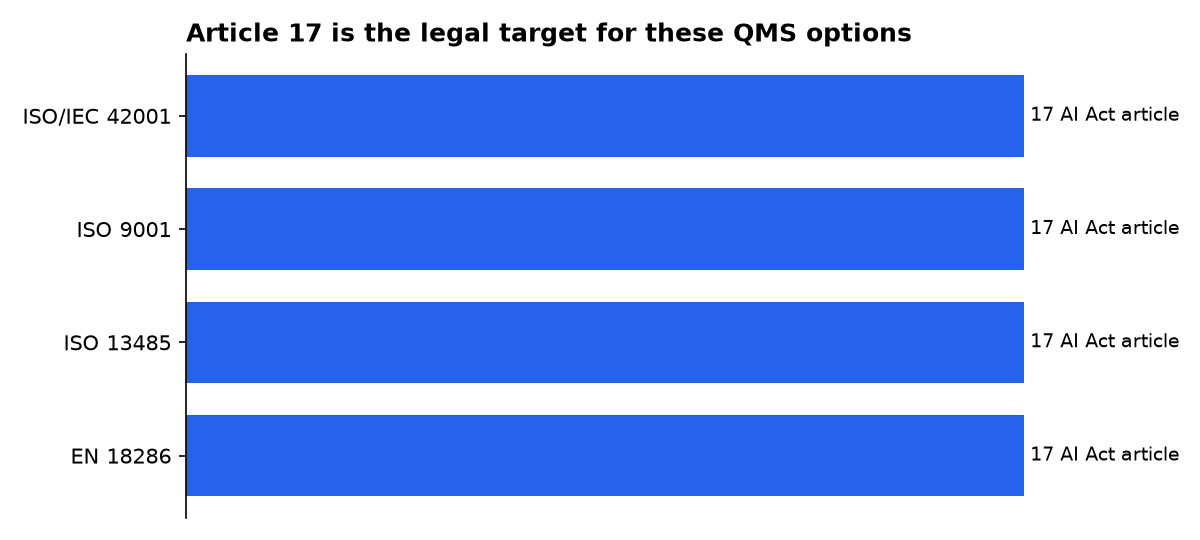
The useful implementation question is not which certificate to buy. It is which existing controls can produce Article 17 evidence, and where the gaps remain.
What should an AI product team build now?
An AI product team should build a traceable release process before its high-risk obligations become urgent. Traceability means an auditor can follow a decision from the requirement through design, testing, deployment and monitoring.
Start by identifying whether the company is the provider. BSI defines the relevant organisations as those providing high-risk AI systems, including organisations placing them on the market or putting them into service.
Then define the system boundary. A team cannot manage lifecycle evidence if it has not stated which model, data pipeline, supplier component and deployment environment fall inside the controlled system.
- Create a regulatory-compliance plan for each high-risk AI system in scope.
- Set documented controls for design, development, verification and validation.
- Maintain a change register linking system, data and supplier changes to approvals.
- Set monitoring thresholds and an escalation route for incidents or degraded performance.
- Keep evidence that post-market findings feed back into fixes and release decisions.
This is not only an engineering checklist. BSI includes management responsibility, resource management, competence and communication alongside product-realisation and risk controls.
The standard also addresses data management, environmental sustainability, supply-chain management, serious-incident reporting and nonconformities. Those areas involve procurement, legal, compliance, product and operations teams.
Nemko Digital says Article 17 permits providers already subject to sectoral quality-management obligations under EU law to integrate the AI Act’s QMS elements into their existing system. That option does not show that a particular existing system automatically meets EN 18286.
Which high-risk AI rules does EN 18286 support?
EN 18286 is most directly relevant to providers of high-risk AI systems. The standard does not classify every AI use as high-risk.
Its focus is the provider’s management system, not a technical evaluation of one model’s performance. That makes it useful for organising evidence, but not a substitute for every technical or legal control.
The Commission says the AI Act covers high-risk systems that can affect safety, health and fundamental rights. Its examples include critical infrastructure and law enforcement.
The Commission asked CEN and CENELEC to develop standards across 10 areas: risk management, dataset governance, record keeping, transparency, human oversight, accuracy, robustness, cybersecurity, quality management and conformity assessment.
That programme shows why EN 18286 is not a complete technical compliance package. It supplies the quality-management structure. Other obligations may require separate evidence, controls or standards.
A quality process can require testing and monitoring. The QMS itself is not one accuracy score, cybersecurity test or human-oversight design.
Teams should map each applicable AI Act obligation to evidence. They should also record which standard, process or technical control supports that evidence.
How are harmonised AI standards developed?
CEN and CENELEC develop the European standards requested by the Commission. Their Joint Technical Committee JTC 21 works on AI standards and coordinates input through national standards bodies.
JTC 21 said the prEN 18286 consultation gave national bodies 12 weeks to vote and submit comments. Consultation feedback forms part of the route from draft text to an approved standard.
The Commission then assesses whether published standards meet the intended objectives and legal requirements of the AI Act. Only after that assessment are standards referenced in the Official Journal.
The Commission says the application of standards remains voluntary. Providers can use another framework to demonstrate compliance.
A cited harmonised standard offers an additional legal route. The presumption applies only to the requirements covered by that standard, and it remains rebuttable.
What should buyers ask before adopting EN 18286?
Buyers should first ask which legal role their organisation has. The standard is primarily intended for organisations providing high-risk AI systems, not for every company that uses an AI tool.
They should then ask which evidence already exists. An organisation may have policies for supplier review, data governance, release approval or incident management, but those policies need owners and records.
The next question is whether the evidence follows the AI system through its lifecycle. A policy that covers development but not deployment, monitoring or serious incidents leaves a gap in the quality-management record.
Procurement teams should ask suppliers how they handle system changes. The BSI description specifically includes changes to AI systems, supply-chain management, post-market monitoring and nonconformities.
Legal and compliance teams should ask which Article 17 requirements the implementation covers. The presumption does not extend automatically to other AI Act requirements.
Finally, buyers should ask how the organisation will maintain the system. EN 18286 concerns defining, implementing, maintaining and improving a QMS, so a one-off gap assessment cannot replace continuing controls.
What we could not verify?
The full text of EN 18286:2026 is not freely published in the public material reviewed here. The exact clause wording, annexes and detailed mappings therefore cannot be confirmed from public summaries.
No public source here confirms a universal certification scheme, a required certification body or a fixed audit method for EN 18286. A provider should not treat an ISO/IEC 42001 certificate, an EN 18286 purchase or a consultant’s assessment as automatic proof that every AI Act obligation has been met.
The sources also do not establish a single technical benchmark for accuracy, robustness, cybersecurity or human oversight under EN 18286. Those matters sit within the wider AI Act standardisation programme.
The Commission says further harmonised standards are expected. Until those standards are published and cited, providers should check the Official Journal and the applicable AI Act obligations rather than rely on draft mappings.
Sources
- European Commission: First harmonised standard supporting the AI Act published in the Official Journal
- European Commission: AI Act standardisation
- BSI Knowledge: BS EN 18286:2026
- BSI: EN 18286 guide
- CEN-CENELEC JTC 21: prEN 18286 enquiry stage
- Schellman: prEN 18286 and ISO 42001
- Nemko Digital: EN 18286 Official Journal citation

