
On 13 November 2026, Higurashi released Haru-4B, a 5.3-billion-parameter voice model that listens and speaks every 133 ms. It can replace a separate text-to-speech stage for live, open-ended conversation, but not yet for dependable scripted narration or factual assistants because the release is a research base model.
At a glance
- Haru-4B processes incoming and outgoing speech at 7.5 frames per second, or one frame every 133 ms.
- Higurashi says Haru-4B was pretrained on more than 40 million hours of speech across more than 160 languages.
- The developer says 13 million hours of its training mixture were reconstructed full-duplex dialogue, with samples up to 60 minutes.
- Higurashi reports a 65.2 ms median system latency on an Apple M1 Max, before up to 133 ms of audio framing delay.
- Our estimate puts Haru-4B’s published BF16 weights at 10.5 GB, compared with 0.8 GB for ZONOS3-Mini’s published safetensors.
What is the Haru-4B model?
Haru-4B is a speech-to-speech model, meaning it takes audio in and returns audio directly. Unlike a conventional voice assistant, it does not have to wait for a person to finish speaking, turn speech into text, create a written answer, and then send that answer to a separate text-to-speech system.
Higurashi’s model card says the model combines user audio, its own outgoing audio, and its text stream in one language-model position. That design lets it keep listening while it speaks. The model card lists English, Spanish, Portuguese, German, French, Chinese, Japanese, Russian and Korean as supported languages.
The technical distinction matters. A normal TTS pipeline is designed to render supplied text clearly. Haru-4B is designed to decide when to speak, whether to give a short backchannel such as “mm-hm,” and whether a response can overlap with the caller.
Can Haru-4B replace a TTS pipeline?
For a live conversational character, partly yes. Haru-4B combines dialogue generation and speech generation in one loop, so a developer can remove the hand-off between an LLM and a standalone TTS engine. That can make interruptions and short acknowledgements feel less delayed.
For a production narration or support stack, no. This is an assessment based on the release’s stated limits: Higurashi describes Haru-4B as a pretrained research model that is not reliable for facts and does not follow instructions like an assistant. A scripted TTS system still has a clear advantage when the application must speak approved wording exactly.
Zyphra’s ZONOS3-Mini model card illustrates the other approach. It takes written text and a speaker reference, then generates audio. It supports voice cloning and 43 languages, but it is text-to-speech rather than a model of two people talking over each other.
- Use Haru-4B for prototype phone agents, conversational companions and research on timing, overlap and backchannels.
- Keep TTS for prerecorded clips, regulated scripts, accessibility announcements and systems where a text model remains the policy-controlled source of truth.
- Consider a hybrid when a product needs Haru-like live interaction but must fall back to approved TTS for sensitive statements.
What did Haru promise and what shipped?
The public record shows a quick release cycle, but it also shows the boundary between the shipped base model and future work. The important date is 13 November 2026: that is when Higurashi published the model announcement, weights and inference code.
J-Moshi’s research paper described a Japanese full-duplex model trained in two stages. It reported that synthetic dialogue from multi-stream TTS was used to augment training, and said its evaluation beat Japanese baselines for naturalness and meaningfulness.
Haru’s public repository history begins the day before launch. The repository later recorded a 0.1.1 update to its NVIDIA and vLLM packages, including a fix for the Triton audio codec on GPUs such as the RTX 4090.
Higurashi released Haru-4B as a pretrained full-duplex foundation model. The company promised a research base for real-time dialogue and published its claimed 65 ms Apple Silicon result, its training-scale figures, and code for PyTorch, Apple MLX and vLLM-Omni.
The shipped GitHub repository included three inference paths: PyTorch with a web demo, MLX with a native macOS app, and a vLLM-Omni plugin for GPU serving. It also specified about 12 GB of GPU memory for the NVIDIA quick-start path.
A published hands-on report documented public Japanese phone demos and noted that conversations could still falter. That is useful evidence of a callable demonstration, not an independent benchmark of reliability.
How does full-duplex change response timing?
Full-duplex means both sides can produce sound simultaneously. In human calls, that supports interruption, laughter, acknowledgements and the small overlap that makes dialogue feel active. A turn-based pipeline usually suppresses those behaviours because it waits for a detected end of speech.
Higurashi says Haru-4B uses a 64-dimensional continuous audio representation at 7.5 Hz. “Continuous” here means the audio representation is a set of numeric values, rather than a sequence of selected codebook symbols. The developer says it generates each audio frame in one sampling step and needs no separate audio Transformer.
The company’s Apple M1 Max measurement is more nuanced than the headline suggests. Higurashi reports 65.2 ms median latency for the microphone, model, audio decoding and wired I/O using int8 weights. Its 133 ms frame size can add up to 133 ms of algorithmic delay, so “65 ms” is not the only delay a caller experiences.
That distinction is important for procurement. The 65.2 ms figure is a vendor result on one machine and app configuration. It is not a general guarantee for browser microphones, Bluetooth headsets, cloud networks or a busy GPU server.
What training scale is disclosed?
Higurashi discloses unusually large headline counts, but not a public dataset inventory. The company says it pretrained Haru-4B on more than 40 million hours of real speech in more than 160 languages. It says nine languages form the main training mix.
Higurashi also says it excluded LLM-generated dialogue and TTS-generated speech from that mixture. Its stated rationale is that real recordings include hesitation, interruptions, overlapping speech and irregular turn-taking that synthetic turn-by-turn data may not preserve.
The second stage is the key full-duplex claim. Higurashi says it created temporally aligned speaker streams from mixed recordings, then trained on more than 13 million hours of separated full-duplex dialogue. The company says samples included conversations as long as 60 minutes.
Those numbers describe training-data scale, not a measured quality score. Haru-4B’s announcement does not publish a multilingual leaderboard, word-error rate, speaker-similarity score, human preference study, or a matched comparison against a conventional TTS-plus-LLM stack.
Which languages does Haru-4B support?
Haru-4B explicitly lists nine supported languages: English, Spanish, Portuguese, German, French, Chinese, Japanese, Russian and Korean. That is a narrower deployment claim than its more-than-160-language pretraining coverage.
The difference matters. Pretraining exposure can improve robustness, but it does not prove equal conversation quality in every language. Higurashi identifies the same nine languages as its primary languages, which is the safer set for an early evaluation plan.
For comparison, ZONOS3-Mini lists 43 supported languages, including many European, South Asian and Southeast Asian languages. But a broader TTS language list does not mean it offers full-duplex timing or a dialogue policy. It answers a different product need.
How much local memory will it need?
Haru-4B is not a tiny local voice model. Higurashi’s repository recommends an NVIDIA GPU with about 12 GB of memory for its quick-start route. That figure covers more than static weight storage, including the runtime needed to converse.
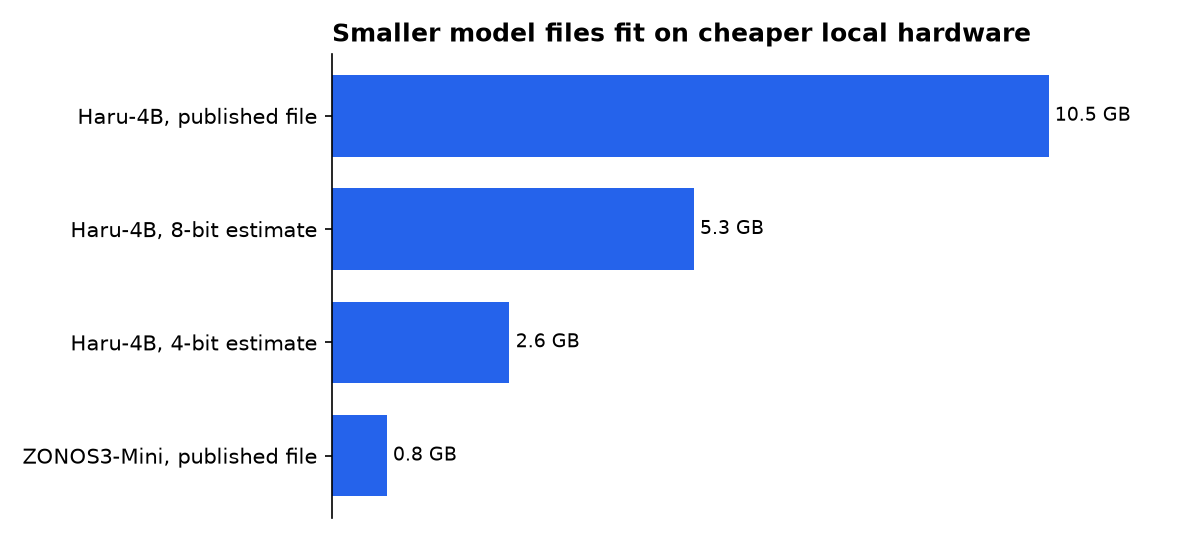
Our calculation from Haru-4B’s published 10.5 GB safetensors weights estimates 10.5 GB for the model at 16-bit precision, 5.3 GB at 8-bit precision and 2.6 GB at 4-bit precision. These are weight-only estimates, not tested memory requirements; real use also needs a context cache, audio buffers and application overhead.
| Model file option | Weight storage or estimate | What it means |
|---|---|---|
| Haru-4B, published BF16 weights | 10.5 GB | Before runtime overhead; close to Higurashi’s 12 GB quick-start guidance. |
| Haru-4B, 8-bit estimate | 5.3 GB | Lower weight storage, but performance and implementation support still need checking. |
| Haru-4B, 4-bit estimate | 2.6 GB | Smallest weight estimate, not evidence of equivalent voice quality or latency. |
| ZONOS3-Mini, published safetensors | 0.8 GB | Much smaller file, but it is a text-to-speech model rather than full-duplex dialogue. |
Haru estimates are FuturPulse calculations from published file sizes. ZONOS3-Mini’s file total comes from its published model files.
How does Haru compare with J-Moshi and ZONOS3-Mini?
Haru-4B sits between two different reference points. J-Moshi is the closer architectural comparison because it is also a full-duplex spoken dialogue system. ZONOS3-Mini is the closer deployment comparison for teams asking whether they still need a dedicated local TTS engine.
J-Moshi was built on an English 7B-parameter Moshi model and adapted to Japanese dialogue. Its paper says the system was trained on Japanese spoken dialogue, then fine-tuned with high-quality stereo dialogue data. The work also used synthetic multi-stream TTS dialogue in an augmentation stage.
Haru’s declared difference is scale and multilingual coverage. Higurashi says Haru-4B has a 4B Qwen3.5 text backbone and uses more than 40 million hours of speech. J-Moshi’s public work provides an evaluation claim against Japanese baselines; Haru’s launch materials instead foreground architecture, latency and data volume.
Practical reading: Haru-4B is the experiment to evaluate if your product fails because its voice waits too long. ZONOS3-Mini is the experiment to evaluate if your product needs compact, controllable text rendering. J-Moshi remains the more directly documented Japanese full-duplex research baseline.
What we could not verify?
No public Haru-4B evaluation pack currently establishes equal quality across its nine named deployment languages. A multilingual human-preference study, benchmark prompts, recordings and scoring method from Higurashi could settle that question.
There is also no public matched test showing that Haru-4B beats a modern LLM-plus-TTS pipeline on user satisfaction, interruption handling, cost or error rate. A reproducible side-by-side test using the same prompts, microphones, voices and network conditions would settle the replacement claim.
Higurashi says it is preparing more detailed technical material and training code. Until that arrives, the strongest verified conclusion is narrower: Haru-4B ships an open full-duplex voice base model with unusually large stated speech-data scale, but it is not yet a verified all-purpose replacement for TTS pipelines.
Sources

