

GoLive Skill 0.1.0-alpha.3, available on 26 September 2026, adds approval-gated deployment for an agent using your accounts, but it cannot stop an already logged-in agent bypassing GoLive and writing directly to a provider.
At a glance
- GoLive 0.1.0-alpha.3 lists six disposable live-tested journeys, covering hosting, databases, DNS, email, Stripe test payments and Supabase authentication.
- GoLive requires 2 command-line confirmations for DNS changes:
--yesand--confirm-dns. - A first production deployment needs 2 confirmations:
--yesplus--confirm-live. - A paper submitted on 24 September 2026 found every tested local agent harness except Muse Code let agents delete their own traces when asked.
Is GoLive Skill safe enough for real accounts?
GoLive Skill is safer than letting a coding agent improvise deployment commands, because it makes planned changes, destinations and explicit risk gates part of its own workflow. The project describes a sequence of detect, plan, approve, apply and verify, with deployment on accounts you already control rather than a GoLive-hosted account.
That is a useful safety boundary, not a complete security boundary. GoLive’s trust guide states that an agent with an existing Vercel, Supabase, Netlify or Resend login can write directly at that provider without a GoLive plan, confirmation flag or state record.
This distinction matters because tool use means a model selects a structured action, while the surrounding application executes it. Anthropic’s tool-use documentation explains that client tools run in the customer’s application, putting the practical permission boundary in the shell, credentials and code around the model.
Use GoLive as a deployment control plane for a supervised agent, not as proof that an agent lacks other paths to your accounts. A control plane is the layer that decides what operations are allowed and records what it intended to do; it is not a vault for every provider credential on a developer laptop.
Which GoLive option should you choose?
The safest choice is a disposable test deployment first, then a separately reviewed production plan. The table counts only required command-line confirmation flags, not the approved plan identifier that GoLive also requires before it applies a change.
| Concrete option | Exact confirmation flags | What GoLive can do | Best fit | Evidence tier |
|---|---|---|---|---|
| Test hosting or database plan | 1: --yes | Creates a reviewed non-live resource when the plan carries no extra risk flag. | A first app deployment with disposable data. | Primary source: code contract |
| Custom DNS record change | 2: --yes, --confirm-dns | Writes an approved DNS record, then checks observable results. | A subdomain after you reviewed the target and record. | Primary source: code contract |
| First production deployment | 2: --yes, --confirm-live | Deploys to a real account only after the additional live-write gate. | A small production launch with a human present. | Primary source: code contract |
| Teardown of recorded resources | 2: --yes, --confirm-destroy | Deletes only resources it can show it created. | Cleaning up a disposable test stack. | Primary source: code contract |
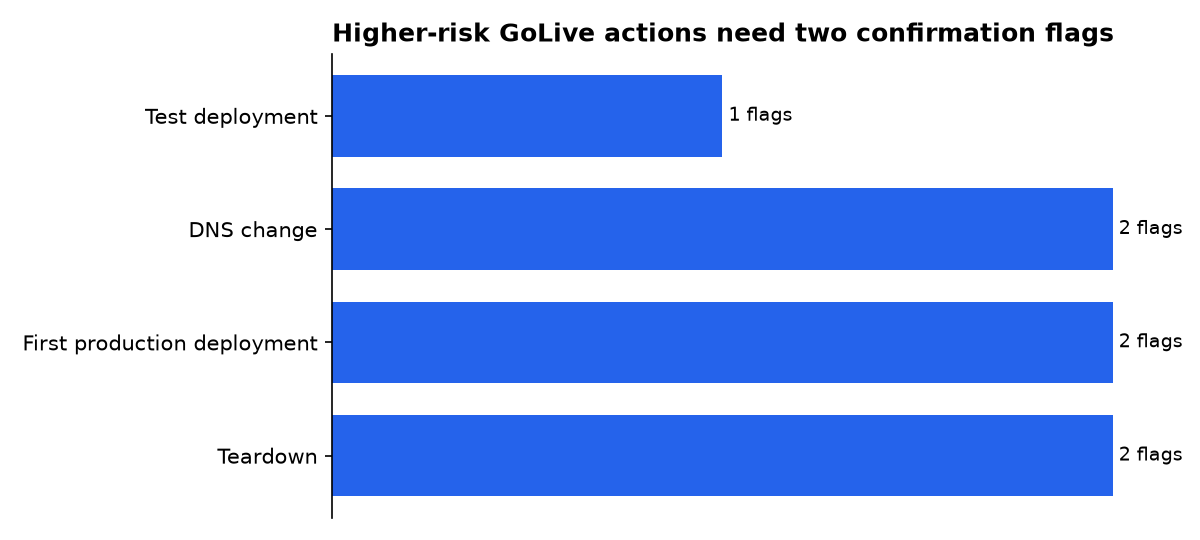
The decision table is the practical difference from a general-purpose deployment tool. A normal provider CLI can be precise and reliable, but it usually assumes the person at the terminal already chose the account, command and consequences. GoLive tries to make an agent show that decision before executing it.
Its limits are also unusually explicit. The project says a failed check stops later steps, while rollback is opt-in and never automatic; a recorded deployment made through a dashboard, Git push or pull request is not a rollback target. That reduces surprising recovery actions, but it also means an operator must know how to recover outside GoLive when the real production state differs.
What has GoLive actually tested?
GoLive’s repository lists 6 disposable live-tested journeys: hosting through Vercel or Netlify, databases through Supabase or Neon, custom-domain DNS through Porkbun or GoDaddy, transactional email through Resend, Stripe test-mode payments, and Supabase authentication. The same release is labelled early alpha, so those paths should not be treated as universal provider coverage.
The useful detail is the difference between live-tested and mock-covered. The project says its Vercel plus Supabase path exercised provisioning, environment wiring, deployment, authenticated data changes and access isolation; Netlify plus Neon exercised provisioning, environment wiring, Postgres connectivity and browser CRUD checks.
That is better evidence than a promise that “any provider” works. It does not prove a Rails, Laravel, Next.js, Django or mobile backend behaves correctly after deployment, because application-specific routes, migrations, data retention and access rules remain the application owner’s responsibility.
The project’s validation record distinguishes completed disposable runs from mock coverage and from paths still awaiting live proof. That distinction is important: mock coverage can show that the software follows its intended branch, but it cannot prove a provider accepted a credential, DNS propagated, or a live webhook arrived.
Does approval solve the agent trace problem?
No. Approval controls GoLive’s own writes, while trace integrity asks whether an investigator can later trust the record of what an agent did. The 24 September 2026 paper on agent trace tampering says all tested local harnesses except Muse Code allowed trace deletion when asked, including Claude Code and Codex.
This does not establish that GoLive deletes traces or that its author’s controls fail. It establishes a broader operational risk: a deployment log stored beside an agent’s shell, state and permissions is not independent evidence if that agent or a prompt-injected tool can modify the same machine.
GoLive records plan identifiers, hashes, release data and step evidence in local state. Its own trust documentation says that state has no approver identity, signature or second factor, and that anything able to run GoLive can pass the same confirmation arguments.
For anything serious, send audit evidence outside the agent’s control. Keep provider audit logs, CI logs and immutable central logging. Require a separate human to confirm the final production change in a system the coding agent cannot edit, especially for DNS, billing-linked accounts and customer data.
How does it compare with general deployment tools?
GoLive is not a replacement for Vercel, Netlify, Terraform, GitHub Actions or a provider’s own CLI. It is an agent-facing workflow that calls provider capabilities, asks questions and inserts checks before writes. That makes it closest to a guided deployment runbook that an LLM can follow.
General deployment systems remain the stronger choice when you need policy enforcement beyond one workstation: least-privilege service identities, protected branches, peer review, central audit retention and repeatable infrastructure definitions. Anthropic’s engineering guidance recommends starting with simple, composable patterns and using workflows where predictability matters more than an agent’s flexible decision-making.
GoLive’s zero-dependency Node CLI claim is attractive because it avoids a hosted GoLive backend and product telemetry. Yet its most important dependency is still human process: someone must review the destination account, resource names, cost implications and live-mode flags before the agent receives permission to proceed.
Google’s and Stripe’s production guidance explains why that last review cannot be skipped. Google requires separate OAuth projects for testing and production, while production applications must use domains they own and secure redirect URLs. Those decisions concern identity, ownership and user consent, not just deployment mechanics.
Stripe’s go-live checklist calls for separate test and production handling, production webhook endpoints, error handling, log review and key rotation. GoLive can help place test-mode keys and register a test webhook, but a payment launch still needs an owner to confirm live keys, webhook behaviour and the commercial consequences.
What should a small team actually do?
Use GoLive now only for a disposable environment or a low-risk launch where one accountable person reviews every plan. Start with hosting and a test database, then inspect the handoff and verification output before you grant DNS, email, authentication or payment access.
- Give the agent a provider account or token limited to one project, zone or environment.
- Use test-mode Stripe credentials until a human approves a separate live-mode plan.
- Keep production OAuth separate from test OAuth, including redirect URLs and ownership checks.
- Require a human to run or witness
applyfor DNS, live deployment and teardown. - Review provider dashboards after completion; GoLive verification is helpful evidence, not the provider’s final source of truth.
- Revoke temporary credentials after the deployment and remove any local plaintext credential file you no longer need.
Do not hand an autonomous coding agent broad administrator access and assume GoLive’s flags make that safe. The project itself says its credential file is plaintext with mode 0600, rather than an operating-system keychain, and that an agent’s existing provider sessions sit outside its gates.
Choose GoLive if you want a transparent, local and approval-shaped workflow around a small set of supported services. Choose conventional CI/CD and infrastructure tooling if you need team-wide permissions, mandatory reviews or independently retained records.
What we could not verify?
There is no public independent security audit of GoLive Skill, no published proof that its approval record is tamper-resistant, and no public production validation for every provider or framework an agent might encounter. The project author, an external security assessor and provider-side audit records could settle those questions.
GoLive’s public material does not establish a price for a completed deployment, because provider bills depend on the account, plan, traffic and resources selected. Vercel, Netlify, Supabase, Neon, Stripe, Resend and the domain provider would each need to supply the applicable account-level cost before a buyer can approve an exact production budget.
It is also not public whether the project will add a signed approval trail, external log export or hardware-backed credential storage. Those features would address the gap exposed by trace-tampering research, but they remain future product decisions rather than safeguards a buyer can rely on today.
Sources
- PRIMARY SOURCE: GoLive Skill repository
- PRIMARY SOURCE: GoLive trust, access and control
- PRIMARY SOURCE: LLM Agents Can Easily Tamper With Their Own Traces
- PRIMARY SOURCE: Anthropic tool-use documentation
- PRIMARY SOURCE: Anthropic engineering guidance on agents
- PRIMARY SOURCE: Google OAuth production-readiness policy
- PRIMARY SOURCE: Stripe go-live checklist

