
FuturPulse analysis · 19 October 2026
OpenAI lists GPT-6 Astra at $450 per million output tokens in Ultrafast long-context mode, the highest publicly posted text-model API rate in this comparison on 19 October 2026. The ordinary GPT-6 Astra rate is far lower, so the answer depends on delivery speed and prompt length.
At a glance
- OpenAI charges $450 per million output tokens for GPT-6 Astra in its Ultrafast long-context tier.
- GPT-6 Astra costs $50 per million output tokens on OpenAI’s standard short-context tier.
- Google’s Gemini 4 Argon Priority rate rises to $36 per million output tokens on 1 December 2026.
- Mistral Large 4 is on a published sale rate of $2.09 per million output tokens.
- ChatGPT Plus costs $20 a month, but that subscription does not include separately billed API use.
How did we define “most expensive”?
“Most expensive AI model” needs a billing rule before it has a useful answer. This comparison ranks public text-generation API tariffs by output price, because output tokens are the model-written chunks of text that often drive a long answer or agent bill.
A token is a small unit of text used for billing. Perplexity’s documentation estimates that one English token is roughly four characters, though the exact count changes by language and wording. Perplexity’s price guide also separates model tokens from web searches, file fetches and sandbox sessions, which can add costs beyond the model itself.
This is not a leaderboard for intelligence, subscriptions, private contracts or image generation. It is a buyer’s comparison of published, metered text prices. A faster service class can make the same model several times more expensive than its standard API tier.
Which AI model is most expensive?
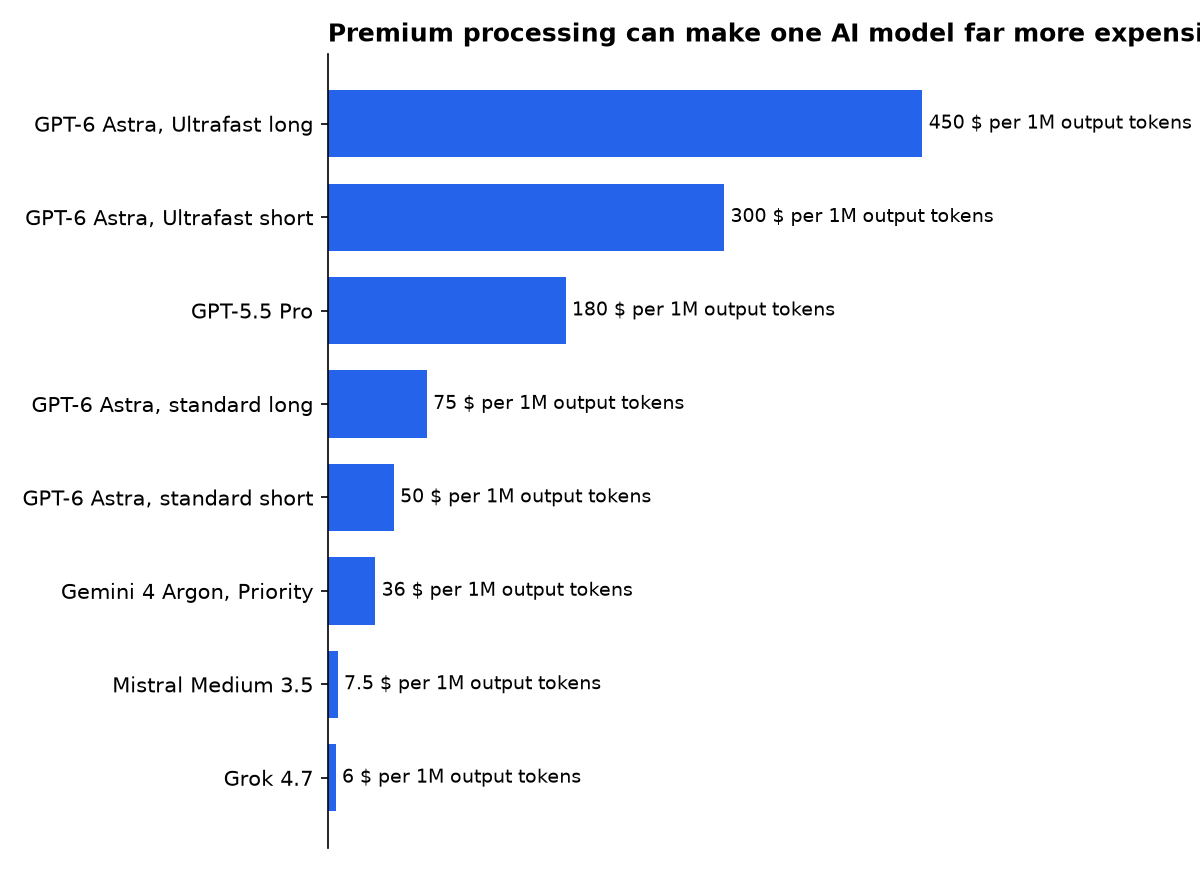
OpenAI GPT-6 Astra is the costliest confirmed option here when bought in its premium delivery configuration: Ultrafast processing with long context costs $450 for one million output tokens. OpenAI’s API price card lists $300 for Ultrafast short context, showing that a large prompt can raise the output rate by half again.
The practical lesson is simpler than the headline figure. Most teams should not budget $450 merely because they select GPT-6 Astra. They incur that rate only if they choose Ultrafast delivery and cross the long-context boundary.
| Buyer option | What the price covers | Input price per 1M tokens | Output price per 1M tokens | Evidence tier | Decision |
|---|---|---|---|---|---|
| OpenAI GPT-6 Astra Ultrafast, long context | Premium speed for prompts beyond the short-context tier | $120 | $450 | Primary vendor price card | Use only where waiting is costlier than the model bill. |
| OpenAI GPT-6 Astra Ultrafast, short context | Premium speed within the short-context tier | $60 | $300 | Primary vendor price card | Avoid as a default route for ordinary chat. |
| OpenAI GPT-5.5 Pro Standard | Extended-reasoning model | $30 | $180 | Primary vendor price card | Reserve for hard tasks with a measured quality gain. |
| OpenAI GPT-6 Astra Standard, long context | Normal processing for larger prompts | $20 | $75 | Primary vendor price card | Budget carefully for document-heavy workloads. |
| OpenAI GPT-6 Astra Standard, short context | Normal API processing | $10 | $50 | Primary vendor price card | The relevant GPT-6 Astra baseline for most requests. |
| Google Gemini 4 Argon Priority from 1 December 2026 | Priority API processing | $7.20 | $36 | Primary vendor price card, future dated rate | Plan for the December increase before signing a volume commitment. |
| Mistral Medium 3.5 Standard | Flagship-family API model | $1.50 | $7.50 | Primary vendor price card | A lower-cost premium-text option. |
| xAI Grok 4.7 Standard | Text and code model with a 500k-token context window | $2 | $6 | Primary vendor price card | Cheaper than the highest-priced frontier tiers on token cost alone. |
Rates are list prices in US dollars per one million tokens. “Long context” and speed tiers are provider-specific products, so this table compares purchase choices rather than claiming identical performance.
What pricing changes should buyers calendar?
Google has published the clearest upcoming change in this set. Google’s Gemini pricing page says Gemini 4 Argon Standard output rises from $10 to $20 per million tokens on 1 December 2026. Its Priority output price rises from $18 to $36 on the same date.
That schedule matters because it is a stated future list-price change, not a prediction about AI costs. Gemini 4 Argon also has Batch and Flex rates, which cut the posted standard price but trade away immediate processing. Do not compare its discounted asynchronous rate with another vendor’s premium low-latency service.
Mistral has moved the other way for one new model. Mistral Large 4 entered public preview on 6 October 2026, and Mistral’s current API card shows a sale price of $0.68 per million input tokens and $2.09 per million output tokens. The page also shows struck-through higher original rates, so buyers should treat the sale as a price condition rather than a permanent baseline.
OpenAI’s card shows another kind of change: service segmentation. Standard GPT-6 Astra output costs $50 per million tokens for short context, while the Ultrafast equivalent costs $300. The price movement is therefore sometimes a choice made in routing settings, not a vendor-wide list-price increase.
Which option should API buyers choose?
Choose the lowest-priced model that meets a measured task target, then reserve premium routes for exceptions. xAI prices Grok 4.7 at $2 per million input tokens and $6 per million output tokens, with a 500,000-token context window. That is not proof it matches GPT-6 Astra on every job, but it is a clear starting point for a cost-controlled test.
Z.AI gives another useful middle-price reference. Z.AI lists GLM-5.3 at $1.40 per million input tokens and $4.40 per million output tokens. Its GLM-5.3-Flash tier is $0.15 for input and $0.50 for output, making routing meaningful even within one vendor.
For routine classification, extraction or short customer replies, a cheaper tier often has the better business case. For difficult code, long analysis or regulated work, first run a small evaluation set. Pay more only if the premium model produces fewer failures, less review work or a faster completed workflow.
- Set a maximum output length before selecting a premium model.
- Keep ordinary requests below the provider’s long-context threshold where possible.
- Send retries to a lower-cost model unless the failure is quality-related.
- Record model, service tier, token count and tools on every production request.
How much does ChatGPT cost?
ChatGPT Plus costs $20 per month for an individual account, while ChatGPT’s free plan costs $0. That is not the same purchase as API access: OpenAI states that API usage is billed separately, which means a ChatGPT subscription does not cap a company’s GPT-6 Astra token spending.
OpenAI’s listed ChatGPT business product, Team, costs $25 per user each month when billed annually or $30 when billed monthly. Enterprise pricing is contact-sales rather than a posted public figure. Subscription plans also carry usage limits and changing model access, so they cannot be converted reliably into a per-token API equivalent.
For an individual writing emails or analysing a few files, $20 a month is simpler than building an API workflow. For an application serving customers, use API pricing and usage logs instead. The expensive model story is mainly an API and agent-budget story, not a typical personal ChatGPT bill.
How can searches and tools change the bill?
A model may be the largest cost, but it is not always the only one. Perplexity charges $0.0025 for a standard web search invocation and $0.0005 for a URL fetch in its Agent API. Those charges sit on top of the requested model’s token tariff.
Tool prices can be easier to predict than long answers, because each call has a fixed listed charge. Perplexity lists a 20-minute sandbox session at $0.03. A workflow that searches repeatedly, fetches pages and runs code can therefore spend more than a simple chat exchange even when it uses a low-cost model.
OpenAI also bills tools separately. Its API card lists web search at $10 per 1,000 calls, plus the retrieved search-content tokens at the chosen model rate. That means an agent using GPT-6 Astra can combine one of the market’s highest model prices with extra retrieval costs.
What do real workflow calculations show?
List prices become useful when turned into a request shape. Our calculation from OpenRouter list prices assumes a chat turn uses 1,000 input tokens and 500 output tokens. At 1,000 such turns, DeepSeek V4 Pro 0813 costs $1.65, while MoonshotAI Kimi K2.7 Code costs $2.35.
For retrieval-augmented generation, or RAG, the model reads supporting material before answering. Our calculation assumes 8,000 input tokens and 500 output tokens per answer. At 1,000 RAG answers, DeepSeek V4 Pro 0813 costs $6.27 and MiniMax M2 costs $2.55.
Agent steps are where input volume starts to dominate. Our calculation assumes 30,000 input tokens and 2,000 output tokens per step. At 1,000 steps, Kimi K2.7 Code reaches $26.84, while DeepSeek V4 Pro 0813 reaches $23.76.
These calculations use listed token prices, not performance testing. They show why the nominal output rate is not the whole story: an agent that repeatedly carries a large working history can become costly even with a model that looks inexpensive in a basic chat comparison.
What should buyers do now?
Do not make GPT-6 Astra Ultrafast long context the default. Its $450 output rate is a specialist purchase for cases where response time and very large prompts have a proven value. Put a spending ceiling around it before any broad rollout.
Use standard GPT-6 Astra only after comparing it against less expensive models on your own accepted tasks. Keep prompts short, cache repeatable context where the provider supports it, and use batch or flexible processing for work that does not need an immediate reply.
Calendar Google’s 1 December 2026 Gemini 4 Argon change if that model is in your stack. Then separate your budget into model tokens, tool calls and storage. A single blended “AI spend” number hides the routing decisions that can save the most money.
What we could not verify?
No public price card can settle the cheapest model for a specific company, because discount agreements, regional processing, volume commitments and task failure rates differ by customer. Vendors can settle contract pricing through a written quote, while a buyer’s own evaluation can settle whether a cheaper model meets its accuracy and reliability target.
We also could not establish a universal dollar price for “one AI answer.” Prompt length, output length, cached material, searches and retries all change the bill. The published rates above establish list-price ceilings and changes, not a guaranteed monthly invoice.
Sources
