

FuturPulse analysis · 18 October 2026
Four notable AI releases landed between 13 and 17 October 2026: Reflection AI’s 501B-parameter Beam, Liquid AI’s d1-ultra and 24B LFM2.5-24B-A2B, plus DeepSeek V4.1 Flash 1017. Only the first three publish enough technical detail for a useful comparison. (benchlm.ai)
At a glance
- Reflection AI released Beam on 16 October 2026 with 501B total parameters, while 23B parameters are active for each generated token. (openrouter.ai)
- Liquid AI released d1-ultra on 15 October at $0.042 per million input tokens, with no output-token charge. (liquid.ai)
- Liquid AI released LFM2.5-24B-A2B on 13 October with 24B total parameters and a 131,072-token context window. (liquid.ai)
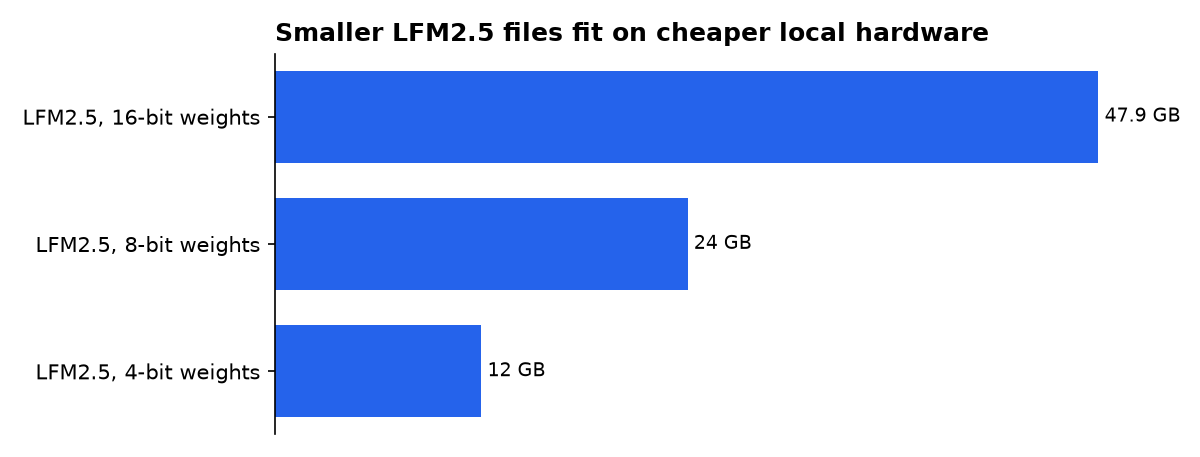
- Our calculation puts LFM2.5’s weights at about 47.9GB in 16-bit form, 24.0GB at 8-bit, and 12.0GB at 4-bit, before working memory. The published files total about 48GB. (huggingface.co)
Which AI models were released this week?
The clearest answer is a split between general-purpose models and specialist systems. Beam is a downloadable text model for coding, reasoning, and agents: software that can call tools, inspect results, and continue a multi-step task. d1-ultra is different. It takes text or images and returns probabilities for a pre-defined decision rather than writing a conventional chat response. ([]())
LFM2.5-24B-A2B is the practical local option. Liquid AI describes it as a reasoning model for private on-device agents, with 24B total parameters but 2.45B active parameters per token. A parameter is a learned numerical setting; an “active” count matters because sparse models do not use every setting on each word. (huggingface.co)
DeepSeek V4.1 Flash 1017 entered the release timeline on 17 October. The tracker records an exact-day release and points to a DeepSeek API changelog, but the public material examined here does not establish a comparable parameter count, price, or deployment limit. Treat it as a release to watch, not a quantified alternative to Beam or LFM2.5. (benchlm.ai)
How do Beam, d1-ultra and LFM2.5 differ?
Reflection AI says Beam is a sparse mixture-of-experts model, meaning it selects a small subset of specialist model components for each token, the chunks of text a model reads and bills by. Beam has 501B total parameters, 23B active parameters, and a 1M-token context window. Its weights are under the Apache 2.0 licence, which permits broad reuse subject to its terms. ([]())
Liquid AI’s d1-ultra does not compete on that axis. The company says it reads text, images, or both in one forward pass and returns probabilities for yes-or-no, choice, or score questions. That design suits a damage claim, quality-control image, or routing decision where a calibrated confidence score matters more than an essay. (liquid.ai)
LFM2.5-24B-A2B sits between those two approaches. It is a text-only model that can use functions, or structured calls to outside software, and it has a 131,072-token context limit. Liquid AI says it supports 16 languages and recommends retrieval or web search for knowledge-heavy work, rather than relying on the model alone. (huggingface.co)
| Model | Release date | Published size | Distinctive feature | Best first use |
|---|---|---|---|---|
| Reflection AI Beam 1.0 | 16 October 2026 | 501B total; 23B active | Open weights with a 1M-token context | Large coding and tool-using agents |
| Liquid AI d1-ultra | 15 October 2026 | Not disclosed | Returns probability-based decisions, not generated text | Image and document triage |
| Liquid AI LFM2.5-24B-A2B | 13 October 2026 | 24B total; 2.45B active | Open-weight reasoning for local agents | Private developer tools |
Sources: Reflection AI’s Beam release; Liquid AI’s d1-ultra release; LFM2.5 model card. (liquid.ai)
Can LFM2.5 run on a local machine?
It can, but “local” does not mean any laptop. By our calculation from the published LFM2.5 files, the original 16-bit weights need about 47.9GB before the extra memory needed to process a prompt and generate text. An 8-bit version brings the weights to about 24.0GB, while a 4-bit version brings them to about 12.0GB. The repository lists ten weight shards and a total repository size of 48GB. (huggingface.co)
Those figures are storage and weight-memory arithmetic, not a speed test. Actual requirements rise with context length, batch size, software, and the model’s working cache. The useful buying rule is simple: a 12GB graphics card might accommodate a compressed 4-bit model in some setups, but it does not guarantee smooth long-context agent work.
| Weight format | Estimated weight memory | What it changes |
|---|---|---|
| 16-bit | 47.9GB | Closest to the original published checkpoint |
| 8-bit | 24.0GB | Fits more consumer and workstation GPUs |
| 4-bit | 12.0GB | Lowest stated weight footprint, with quantisation trade-offs |
Our calculation assumes 24.0B parameters and 16, 8, or 4 bits per parameter; it excludes runtime overhead. Liquid AI’s model card lists the 24.0B parameter count. (huggingface.co)
What are the latest updates on artificial intelligence?
The newest meaningful update is not one universal chatbot upgrade. It is a divide between huge open models, specialised decision services, and infrastructure built around coding agents. Beam’s public release makes a 501B-parameter sparse model available for self-hosting, while d1-ultra sells an API for answers such as “defect” or “no defect” with a probability attached. ([]())
There is also a related tooling shift. The independent open-source project gitai describes itself as Git designed for AI agents and says it is an MIT-licensed, vendor-neutral implementation of ideas from Anthropic’s internal Scion system. It moves key source-control work to servers, aiming to help many short-lived coding agents work on a shared codebase. (github.com)
That distinction matters for buyers. A model release changes what an agent can reason about. A source-control project changes whether many agents can safely work together. Neither claim proves that a company will get better software, but both are more concrete than treating every new model name as a general productivity upgrade.
What’s new in AI in 2026?
October 2026’s visible pattern is specialisation. Liquid AI’s releases separate a local text reasoning model from a service for probability-based decisions. Reflection AI’s Beam instead combines a large open model with deployment integrations and an agent command-line tool called Mirror. ([]())
Multimodal work is moving in parallel. Black Forest Labs’ FLUX 3 Image Klein package is not part of this week’s verified release sequence, but it shows the local-image direction: a 5.6B image transformer that accepts up to 10 reference images. The supplied ComfyUI package also includes separate text encoders, a prompt upsampler, and an image autoencoder. (huggingface.co)
The package’s file layout explains why a model’s headline parameter count can mislead. The 5.6B figure covers the image transformer, not every supporting file required by the workflow. Its distilled image checkpoint is listed at 11.1GB in BF16, while the separate BF16 prompt upsampler is listed at 18.8GB. That is a more useful planning figure than the model name alone. (huggingface.co)
What is the latest model of OpenAI?
The latest OpenAI entry listed in the release tracker used here is GPT-6.1 Sol, dated 29 September 2026. It is not one of the models released during the 13–17 October window, so it should not displace Beam, d1-ultra, or LFM2.5 in a weekly-release comparison. (benchlm.ai)
A sensible choice depends on the job rather than a single “latest” label. OpenAI’s latest tracked release may be the right hosted general model for an existing OpenAI workflow. It does not offer an announced substitute for Beam’s Apache-licensed weights, d1-ultra’s decision-only interface, or LFM2.5’s clearly published local files.
That is also why the release date must be stated precisely. “Latest” is true only at a moment in time. As of 18 October 2026, this article’s answer covers releases tracked through 17 October 2026, not an assumed permanent ranking.
What are the top 5 AI models right now?
There is no defensible universal top five from the data published for this week. Models differ by task, licence, price, hardware, and whether a vendor has released independent evaluations. A coding model, a decision model, and an image generator should not be placed on one scoreboard simply because each is called AI.
For practical shortlisting, start with five projects rather than a false league table:
- Beam 1.0 for self-hosted coding and long-horizon agent work.
- d1-ultra for probability-scored document and image decisions.
- LFM2.5-24B-A2B for local text agents with tool calling.
- DeepSeek V4.1 Flash 1017 for monitoring, pending comparable public specifications.
- FLUX 3 Image Klein for local image generation and reference-image editing.
Beam’s listed OpenRouter rates illustrate a second reason not to use broad rankings. One provider lists $0.25 per million input tokens and $1 per million output tokens, while another lists $1 and $3 for the same model. Pricing, availability, speed, and regional routing vary by provider. (openrouter.ai)
Who is making the performance claims?
Reflection AI is selling access to Beam, hosted inference, and a wider agent ecosystem. Its statements about Beam’s coding, reasoning, and long-horizon agent use therefore come from the model’s developer. The open-weight release and Apache 2.0 licence are directly checkable; performance claims still need testing on a buyer’s own codebase. ([]())
Liquid AI sells API access and related deployment tools. Its d1-ultra claim of outperforming other decision models by at least eight points on the Artificial Analysis Decision Index, and its LFM2.5 benchmark comparisons, are vendor claims. They are useful disclosure, but they are not an independent procurement evaluation. (liquid.ai)
OpenRouter is a model-routing marketplace. Its listed Beam prices and throughput figures describe providers available through its service, not all possible self-hosted performance. Hugging Face hosts the published model repositories and reports their files, but it does not independently certify the vendors’ benchmark claims. (openrouter.ai)
BenchLM runs a release timeline and has a commercial interest in being a trusted discovery and comparison destination. Its dates are useful corroboration, but a release date should be paired with a vendor statement where the vendor has published one. That standard is met here for Beam, d1-ultra, and LFM2.5, but not yet for DeepSeek’s detailed specifications. (benchlm.ai)
What we could not verify?
DeepSeek has not yet published, in the material checked here, the parameter count, price, context limit, licence, or benchmark method for DeepSeek V4.1 Flash 1017. DeepSeek could settle those points with a dated model card, API pricing page, and evaluation report.
Reflection AI has released Beam in multiple precision formats, but a public, comparable minimum-memory figure for each supported deployment has not been established here. Reflection AI or its hosting partners could settle it with tested configurations that state the GPU, precision, context length, batch size, and output speed.
Liquid AI has not disclosed d1-ultra’s parameter count or a public model-weight download. That is consistent with an API product, but it means buyers cannot compare its local hardware needs with Beam or LFM2.5. Liquid AI could settle the question only by publishing those technical details.
Sources
- BenchLM AI model release timeline
- PRIMARY SOURCE: Reflection AI, Beam release
- OpenRouter Beam model page
- PRIMARY SOURCE: Liquid AI, d1-ultra release
- PRIMARY SOURCE: Liquid AI, LFM2.5-24B-A2B release
- Liquid AI LFM2.5-24B-A2B model card
- LFM2.5 published file listing
- gitai repository

