
FuturPulse analysis · 16 October 2026
Muse Spark Open shipped on 15 October 2026 as downloadable weights: Meta lists 816B total parameters, 42B active parameters and a 1M-token context window, while the full BF16 download needs roughly 2TB of GPU memory.
At a glance
- Meta’s model card lists 816B total parameters and 42B active parameters per generated token.
- Muse Spark Open supports a 1,048,576-token context window, although a validated TensorRT-LLM setup uses 49,152 tokens.
- OpenRouter lists $1.25 per million input tokens and $4.25 per million output tokens for hosted Muse Spark Open.
- Meta’s BF16 model card says local inference needs 2TB of GPU memory, while its NVFP4 version needs at least 700GB.
- The release is open-weight, not unrestricted: a $20m annual-revenue threshold applies to model-as-a-service providers.
What shipped on 15 October 2026?
Muse Spark Open shipped as an open-weight release, rather than a public source-code project. The Hugging Face model card names 15 October 2026 as the release date and makes the checkpoint available under Meta’s Muse Model License.
The shipped model is a sparse mixture-of-experts, or MoE, system. That means it stores many specialist parameter blocks but activates only a selected portion for each token, the chunks of text a model reads and generates. Meta lists 256 experts and routes each token to eight of them.
15 October 2026 · Promise
Meta said Muse Spark Open would bring agentic coding and long-context work to local hardware. Its launch announcement said two Apple M5 Ultra Mac Studios could run the model through MLX, Apple’s machine-learning framework.
15 October 2026 · Shipped
The weights, configuration and license arrived on Hugging Face. The release includes a BF16 checkpoint, meaning 16-bit floating-point weights, plus an NVFP4 version intended for smaller GPU memory footprints.
15 October 2026 · Deployment evidence
NVIDIA published a TensorRT-LLM guide with a validated four-GPU GB300 NVL setup. That does not make four GPUs a universal minimum, but it is concrete evidence that a production-oriented deployment path exists.
16 October 2026 · Hosted access
OpenRouter lists Muse Spark Open with a 1.05M-token context limit and public token prices. That establishes an API route for teams that cannot store or serve the checkpoint themselves.
The headline parameter count needs care. Hugging Face’s file interface displays 822B parameters, while Meta’s model card describes the product as 816B total and 42B active. The most useful reading is that 816B is the declared model figure, while 822B is the repository’s displayed count for the complete checkpoint.
How large is Muse Spark Open in practice?
Muse Spark Open is large enough that “open” does not mean “runs on an ordinary desktop.” The published checkpoint reports BF16 weights and a displayed 822B parameter total, while Meta’s model card sets the practical local target at 2TB of GPU memory for BF16 inference.
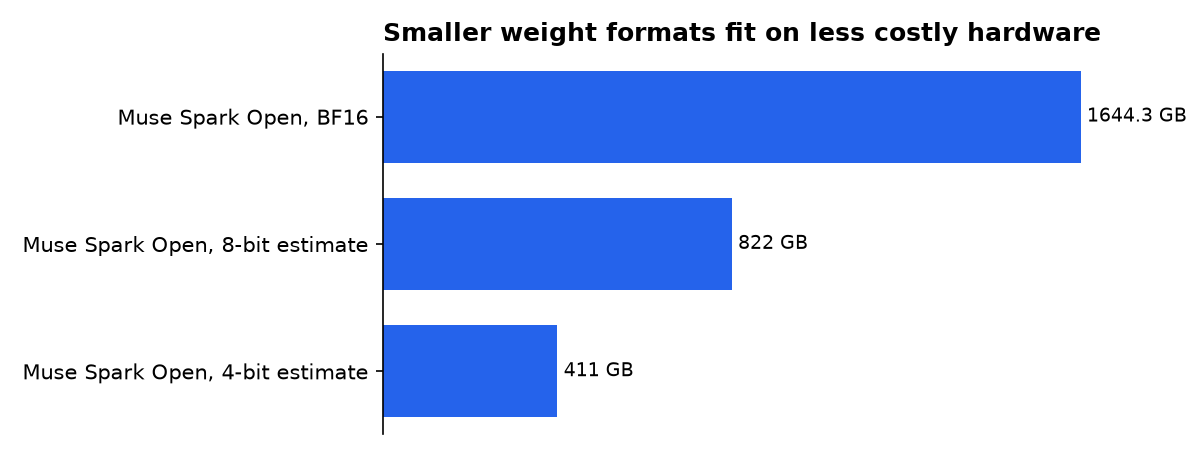
By our calculation from the published weight files, BF16 weights alone occupy about 1,644.3GB on disk. Simple precision arithmetic puts the same weights near 822.0GB at 8-bit precision and 411.0GB at 4-bit precision. Those figures exclude the KV cache, the temporary memory that preserves earlier tokens, plus framework overhead and operating headroom.
| Checkpoint form | Published or calculated size | What it means for deployment |
|---|---|---|
| BF16 weights | 1,644.3GB on disk | Meta says plan for 2TB of GPU memory. |
| 8-bit equivalent | 822.0GB by our calculation | Still a multi-accelerator deployment. |
| 4-bit equivalent | 411.0GB by our calculation | Weight storage falls sharply, but long-context cache remains costly. |
Our calculation assumes one byte per parameter at 8-bit precision and half a byte at 4-bit precision. It is a weight-size estimate, not a speed test or a guarantee of fit.
Meta’s 42B active figure explains why the model may generate faster than an 816B dense model with every parameter active. It does not mean the full 816B checkpoint disappears from the machine. The serving stack still needs the experts available when the router selects them.
How does its context compare with open models?
Muse Spark Open’s advertised 1M-token window is among the release’s clearest differentiators. The model card lists 1M tokens at inference, enough in principle to hold a large repository, test output, issue history and agent notes in one request.
That headline maximum is not the same as a default production setting. NVIDIA’s validated TensorRT-LLM configuration sets its serving window to 49,152 tokens, while stating that longer windows require proportionally more KV-cache memory.
The gap matters because agentic coding sessions are not one prompt followed by one answer. They repeat growing context after each tool call. A 1M-token ceiling gives engineers room to keep work together, but capacity depends on how many users share a GPU and how much cache each session retains.
SGLang’s deployment guidance makes that trade-off explicit. Its Muse Spark Open cookbook describes 46 sliding-window layers, each retaining at most 2,048 tokens, and 16 full-attention layers that retain the wider context. This mixed design can reduce some cache pressure, but it does not eliminate the cost of long full-attention sessions.
What does Muse Spark Open cost through an API?
OpenRouter lists Muse Spark Open at $1.25 per million input tokens and $4.25 per million output tokens. Input tokens are the code, instructions and history you send; output tokens are the model’s response, tool arguments and generated patches.
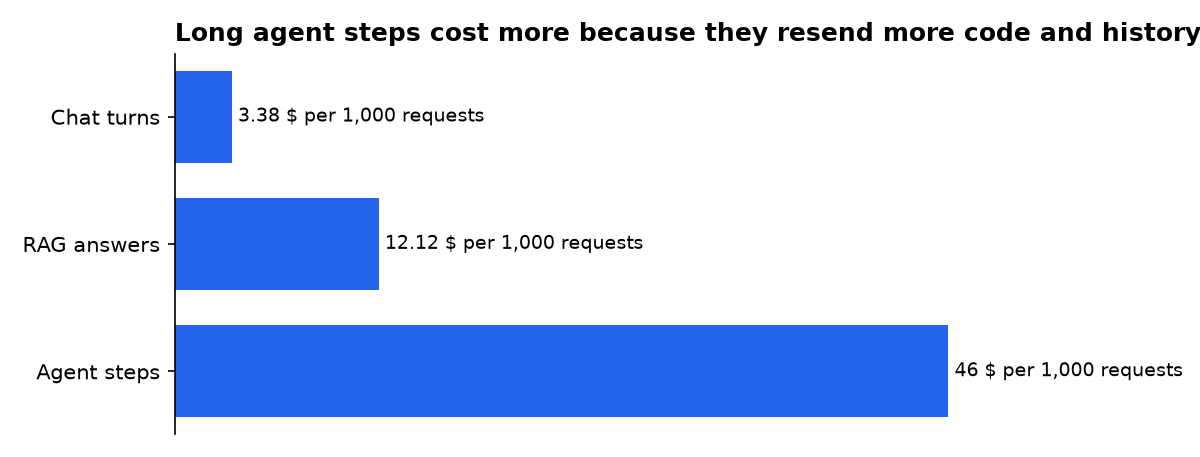
By our calculation from those list prices, 1,000 modest chat turns of 1,000 input and 500 output tokens cost $3.38. That is manageable for testing, but longer agent loops change the bill because they repeatedly resend repository context.
| 1,000-request workload | Input and output per request | Muse Spark Open list-price estimate |
|---|---|---|
| Chat turn | 1,000 input + 500 output tokens | $3.38 |
| RAG answer | 8,000 input + 500 output tokens | $12.12 |
| Agent step | 30,000 input + 2,000 output tokens | $46.00 |
Our calculation uses OpenRouter’s listed input and output rates. It excludes provider-specific discounts, cache pricing, storage, tool execution and retries.
OpenRouter’s list also shows Muse Spark 1.1, 1.2 and 1.3 at the same listed standard price. Its “Contributor” variants are far cheaper at $0.10 per million input tokens and $0.20 per million output tokens, but they are distinct listings. A lower hosted price is not evidence that they offer the same coding, multimodal or deployment characteristics.
What is unique about its agentic coding claim?
Muse Spark Open is built around multi-step coding work rather than a one-shot code completion. Meta’s model card lists planning, sequential tool calls, failure recovery and debugging as intended capabilities.
That is a useful distinction. A coding assistant can write a function from a short prompt. An agentic coding system must inspect files, choose tools, interpret errors, revise a patch and decide whether the test result answers the original task.
NVIDIA’s deployment analysis says the model supports codebase understanding, tool use, output evaluation and iterative refinement. Those are vendor claims, not independent proof that every software task succeeds. Meta’s own benchmark table makes the same limitation visible: Muse Spark Open trails several named rivals on parts of the published coding suite.
For example, Meta reports a 76.4 result on Terminal-Bench 2.1, versus 82.0 for Qwen3.8-2.4T-A95B and 85.0 for Kimi K3 under the respective settings shown. Meta reports 60 on DeepSWE 1.1, below the 67 and 68 shown for GLM 5.3 and Kimi K3. These are vendor-published comparisons, so they establish a test result, not a universal ranking.
What hardware does deployment require?
Meta says local BF16 inference requires 2TB of GPU memory, while NVFP4 requires at least 700GB. That makes the release feasible for specialist workstations, servers and hosted providers, not for a typical laptop with a discrete GPU.
The NVIDIA Megatron Bridge implementation describes 62 decoder blocks and top-eight routing over 256 experts. Its training examples use 48 or 64 GB200 GPUs for large fine-tuning runs, which should not be confused with inference requirements.
For serving, NVIDIA’s TensorRT-LLM guide validates a four-GPU GB300 NVL node with tensor parallelism and expert parallelism both set to four. The same guide supports tool-call extraction and reasoning-content parsing, useful for an agent framework that needs structured actions rather than plain chat text.
SGLang offers broader hardware paths. Its deployment page lists NVFP4 for NVIDIA, MXFP4 for AMD MI355X, INT4 for Intel Xeon and BF16 for the original Meta checkpoint. “Supported” still does not equal cheap, fast or suitable for high concurrent traffic.
Is Muse Spark an open model?
Muse Spark Open is an open-weight model: developers can download weights and Meta permits use, modification, fine-tuning, distribution and sales under its license terms. It is not equivalent to an unrestricted public-domain model, and “open model” can mean different things across the industry.
The Muse Model License requires products using the software or derivatives to display “Built with Muse Spark Open.” It also incorporates a usage policy that restricts several categories of harmful or unlawful use. The weights are accessible, but use comes with contractual terms.
Is Muse Spark Open?
Yes, Muse Spark Open is open-weight. Meta has released the model checkpoint, associated configuration and license for download, and it explicitly allows developers to modify and fine-tune the software. That enables local control and customization that a closed API does not provide.
However, the release is not simply “open source” in the everyday sense. The model is under Meta’s own Muse Model License, not a standard permissive software license. Teams should read the license before shipping a product, especially if they will host the model for outside customers.
Is Muse Spark completely free?
No. The license grants access without a download fee, and Meta says many developers can use it for free. But running the model has real costs: storage, hardware, electricity, cloud GPUs, engineering time and API usage all remain paid resources.
The license also adds a commercial condition for model-as-a-service businesses. If the provider and affiliates exceed $20m in gross revenue across any consecutive 12-month period, they must notify Meta and reach a separate written agreement before offering Muse Spark Open or derivatives as a model service.
Is Muse Spark really that good?
Muse Spark Open has credible published strengths, but the available evidence does not support a blanket claim that it is the best open-weight model. Meta’s model card reports strong scores in agentic and multimodal tests, including an 80.4 result on OSWorld Verified and 72.8 on Toolathlon Verified.
The same table reports weaker results than named rivals in some coding and general tests. Qwen3.8-2.4T-A95B, GLM 5.3 and Kimi K3 lead Muse Spark Open on several listed measures. A buyer should therefore match the model to the job: tool-heavy repository work, multimodal input and very long context are its stated focus.
The Hacker News reaction mentioned in the news peg cannot establish capability by itself. Comments can flag practical problems or enthusiasm, but they are not controlled evaluations. Independent reproductions on real codebases, with disclosed prompts, tools and costs, would be more useful evidence.
What we could not verify?
No public material here establishes an independently reproduced end-to-end success rate for Muse Spark Open on production coding tasks. Meta and NVIDIA describe agentic strengths, but a neutral third party would need to publish the tasks, tool permissions, retries, time limits and scoring rules to settle that question.
We also could not verify a standard monthly operating cost for self-hosting. That depends on the chosen precision, cache length, traffic pattern, GPU rental contract and engineering design. A cloud provider or Meta could settle it with a published reference deployment and metered workload.
Finally, the full text of any Hacker News discussion was not part of the public evidence reviewed here. It cannot establish whether developers have reproduced the launch claims, encountered failures or measured comparable alternatives.
Sources
- Hugging Face: Muse-Spark-Open-816B-A42B model card and license
- Meta AI Research: Introducing Muse Spark Open
- OpenRouter: model pricing and context listings
- NVIDIA Megatron Bridge: Muse Spark Open example
- NVIDIA TensorRT-LLM: Muse Spark Open deployment guide
- SGLang: Muse Spark Open deployment cookbook
- NVIDIA Technical Blog: scaling agentic coding workflows

