
Key Takeaways
- Cosmos Policy showcases a state-of-the-art approach to robot control, utilizing the Cosmos Predict-2 model for manipulation tasks.
- It encodes robot actions and future states, achieving superior results on LIBERO and RoboCasa benchmarks.
- Through innovative video frame representation, it learns robot actions, physical states, and success scores via a sophisticated diffusion process.
- The policy can operate as both a direct policy or a planning policy for action evaluation, leading to improved task management.
- Enhancements, such as model-based planning, have shown to increase task completion rates by 12.5%, solidifying its real-world applicability.
What We Know So Far
Overview of Cosmos Policy
The NVIDIA Cosmos Policy is a breakthrough in robot control technology, deploying the advanced Cosmos Predict-2 model. It offers enhanced manipulation capabilities through sophisticated policy construction.
This technology accurately encodes robot actions and future states, establishing a new benchmark in the field of robotics.
Performance Metrics
Achieving impressive results on LIBERO and RoboCasa, Cosmos Policy demonstrates capabilities that elevate task completion rates significantly—showcasing around 12.5% higher completion when combined with model-based planning.
Additionally, this framework learns vital interactions through a unique diffusion process, akin to training on video data.
Key Details and Context
More Details from the Release
The Cosmos Cookoff is an open hackathon where developers can experiment with Cosmos world foundation models.
Cosmos Policy is evaluated on real-world bimanual manipulation tasks using the ALOHA robot platform.
The performance of Cosmos Policy benefits significantly from pretraining with video data compared to models trained from scratch.
Cosmos Policy has shown a 12.5% higher task completion rate when enhanced with model-based planning.
Cosmos Policy can be deployed as either a direct policy or a planning policy to evaluate candidate actions.
Cosmos Policy represents robot actions, physical states, and success scores as frames in a video, learned via a diffusion process.
Cosmos Policy encodes robot actions and future states, achieving state-of-the-art performance on LIBERO and RoboCasa benchmarks.
Cosmos Policy is a state-of-the-art robot control policy that utilizes Cosmos Predict-2 model for manipulation tasks.
The Cosmos Cookoff is an open hackathon where developers can experiment with Cosmos world foundation models.
Cosmos Policy is evaluated on real-world bimanual manipulation tasks using the ALOHA robot platform.
The performance of Cosmos Policy benefits significantly from pretraining with video data compared to models trained from scratch.
Cosmos Policy has shown a 12.5% higher task completion rate when enhanced with model-based planning.
Cosmos Policy can be deployed as either a direct policy or a planning policy to evaluate candidate actions.
Cosmos Policy represents robot actions, physical states, and success scores as frames in a video, learned via a diffusion process.
Cosmos Policy encodes robot actions and future states, achieving state-of-the-art performance on LIBERO and RoboCasa benchmarks.
Cosmos Policy is a state-of-the-art robot control policy that utilizes Cosmos Predict-2 model for manipulation tasks.
How Cosmos Policy Works
Cosmos Policy uses a novel representation, where robot actions and physical states are coded as video frames. This inventive approach allows for better efficiency and precision in robot control.
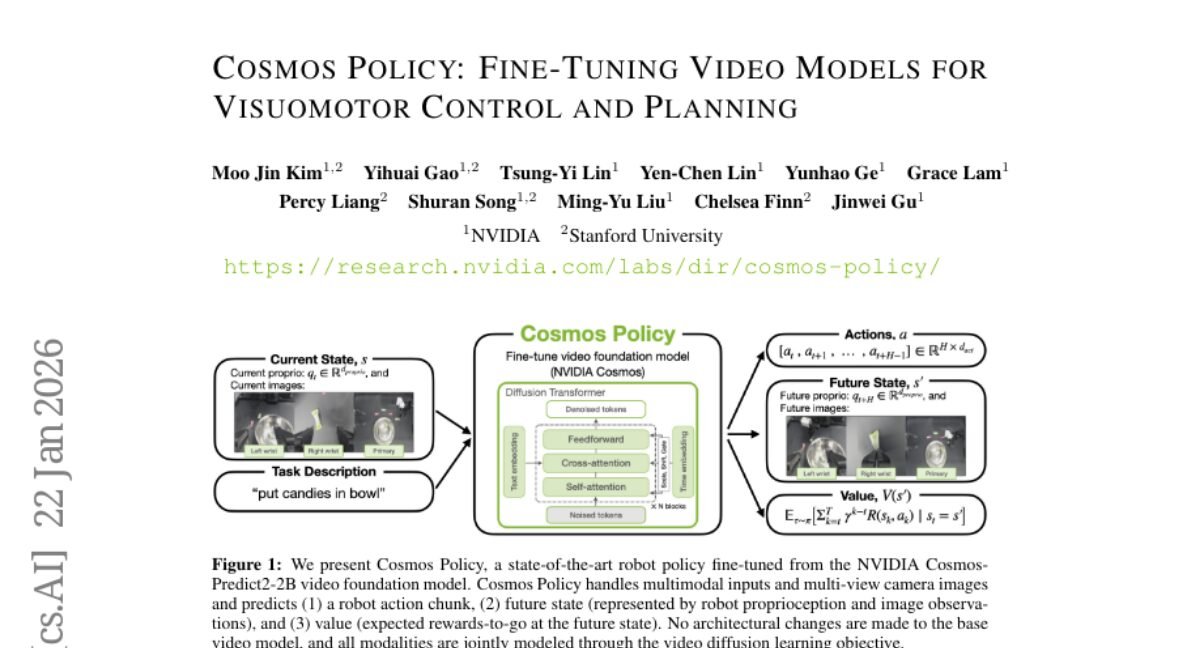
As an adaptable framework, it can function both as a direct policy and a planning policy, empowering robots to evaluate candidate actions effectively.
Deployment and Real-World Applications
Evaluated on the ALOHA robot platform, Cosmos Policy has proven its capability in practical, real-world bimanual manipulation tasks. This makes it a viable option for various industrial applications.
Such evaluations signify a strong commitment to not only testing the technology but ensuring that it meets operational benchmarks crucial for practical deployment.
What Happens Next
Future of Robot Control
The innovative Cosmos Cookoff invites developers to participate in an open hackathon, encouraging exploration and enhancement of these advanced robot control models.
This ongoing initiative hints at exciting progress in the realms of robotics, as innovations from the hacker community push boundaries further.
Continued Research
Future developments is expected to likely delve deeper into combining visual representations with robotic manipulations, enhancing capabilities that could redefine efficiency in automation.
We can anticipate ongoing iterations and refinements of Cosmos Policy that is expected to set new standards in the industry.
Why This Matters
Importance to the Robotics Landscape
The advent of the NVIDIA Cosmos Policy marks a pivotal advancement in robotics, offering tools that can significantly influence automation in multiple sectors.
Technologies that heighten the capabilities of machines not only enhance productivity but also lay groundwork for innovative applications in industries from manufacturing to healthcare.
Effect on Future Technologies
As we witness robots becoming more adept in tasks traditionally reserved for human capability, the implications stretch into areas of safety, efficiency, and overall operational prowess.
Adopting such advanced frameworks is expected to transform how we interact with machines, making the future of work more collaborative between humans and robotics.
FAQ
Common Questions
For additional clarity on the NVIDIA Cosmos Policy and its advancements, here are some common inquiries:
What is the NVIDIA Cosmos Policy?
The NVIDIA Cosmos Policy is an advanced robot control framework that enhances manipulation tasks using the Cosmos Predict-2 model.
What benchmarks does Cosmos Policy perform well on?
Cosmos Policy achieves state-of-the-art performance on the LIBERO and RoboCasa benchmarks.
Can Cosmos Policy be used in real-world applications?
Yes, it has been evaluated successfully on real-world bimanual manipulation tasks using the ALOHA robot platform.

