
Key Takeaways
- Researchers at the University of Pennsylvania and the University of Michigan created the smallest autonomous robots, measuring 200x300x50 micrometers.
- The robots possess the ability to sense their environment and respond independently.
- They can swim at speeds up to one body length per second and operate for months on end.
- Equipped with electronic sensors, these robots can detect minute temperature changes.
- Communication among the robots is conducted through coordinated movements, akin to a ‘dance’.
What We Know So Far
Innovative Creation by Leading Universities
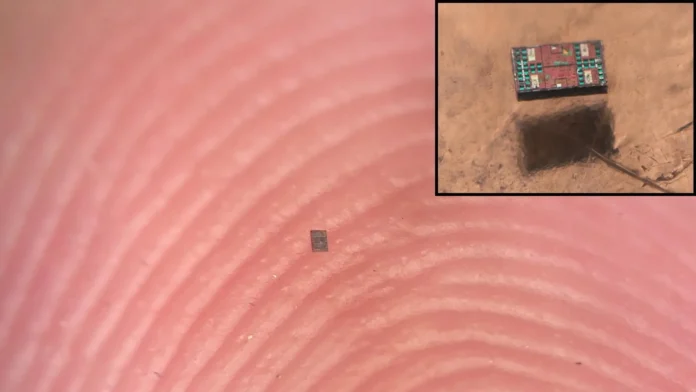
Microrobots — Researchers at the University of Pennsylvania and the University of Michigan have built the smallest fully programmable autonomous robots ever created. Each robot measures roughly 200 by 300 by 50 micrometers, which makes them smaller than a grain of salt. This size allows them to be utilized in applications where traditional robots cannot function.

The development of these tiny robots represents a groundbreaking advancement in the field of robotics, enabling them to operate independently while being able to sense their environment and respond accordingly. Their unique design and functionality position them to revolutionize various industries.
These innovative robots is expected to push the boundaries of how robots interact within complex ecosystems, allowing for previously unattainable levels of automation and responsiveness. Their capabilities is expected to expand significantly in the coming years.
How They Function
The robots are capable of performing various tasks autonomously. They can follow programmed paths and actively respond to local environmental changes, such as temperature fluctuations. Their sophisticated build incorporates advanced technology, allowing them to continuously adapt to their surroundings.
Utilizing an innovative mechanism, the robots generate an electrical field that gently pushes charged particles in their surrounding liquid, enabling them to move. They can even swim at speeds of up to one body length per second. This rapid swimming capability is crucial for their operational efficiency in dynamic environments.
Key Details and Context
More Details from the Release
The ability to communicate is achieved through a ‘dance’ the robots perform, encoding messages in their movements. This method of communication is not only fascinating but also effective in orchestrating coordinated actions among the robots.

“We’ve made autonomous robots 10,000 times smaller,”
These robots include electronic temperature sensors that can detect changes as small as one third of a degree Celsius. Such precise measurements are vital for tasks that require acute environmental awareness.
The robots can swim at speeds of up to one body length per second, showcasing their agility in aquatic environments. Their design caters to dynamic operational contexts, making them adaptable to various scenarios.
Each robot can follow programmed paths, detect local temperature changes, and adjust their movement in response. This adaptability is essential for the efficiency and effectiveness of their functions.
These robots measure roughly 200 by 300 by 50 micrometers, making them smaller than a grain of salt. Their minuscule size opens the doors to applications that were once unimaginable.
Researchers at the University of Pennsylvania and the University of Michigan have built the smallest fully programmable autonomous robots ever created. Their dedication to innovation is paving the way for future advancements in micro-robotics.
Features and Capabilities
Each robot is outfitted with electronic temperature sensors that can detect temperature changes as minute as one third of a degree Celsius. This capability enhances their ability to operate effectively in various environments, making them suitable for applications ranging from environmental monitoring to medical interventions.
A unique aspect of these tiny robots is their method of communication. They perform a ‘dance’, encoding messages through their movements, allowing them to coordinate tasks efficiently. This capability enables them to work as a cohesive unit, dramatically enhancing their efficiency.
Challenges Overcome
Building robots that function independently at sizes below one millimeter has been a formidable challenge for researchers. As highlighted by Marc Miskin, “The field has essentially been stuck on this problem for 40 years.” This breakthrough in miniature robotics paves the way for future advancements.
According to Miskin, if you’re small enough, “pushing on water is like pushing through tar,” emphasizing the complexities faced at such diminutive scales. Overcoming these challenges is a testament to the ingenuity of the researchers involved.
What Happens Next
Future Research Directions
This development is expected to inspire further research in microrobot technology. Future projects may explore additional functionalities, enhanced communication methods, and improved environmental adaptations. The field is ripe for exploration as advancements in materials and engineering techniques emerge.

The implications for various industries could be vast, from medical applications to environmental monitoring, showcasing the versatile potential of these robotic systems. Their adaptability could revolutionize current practices in these sectors.
Collaboration and Funding
In this endeavor, the researchers received support from the National Science Foundation and collaborated closely with other institutions, indicating a robust interest in promoting innovation in this cutting-edge field. This collaborative approach enriches the research landscape and fosters holistic advancements.
The continued investment in robotic research and development is expected to likely lead to significant advancements and applications in real-world scenarios. The pursuit of excellence in micro-robotics is expected to potentially yield groundbreaking results in the future.
Why This Matters
Significance of Microrobots
The development of these microrobots marks a significant milestone in the field of robotics. Their ability to operate independently in dense and complex environments represents a major step toward employing robotics in a broader context. This advancement brings robotics closer to everyday applications.

“That opens up an entirely new scale for programmable robots.”
Furthermore, the technology can provide a better understanding of autonomy and multi-agent interactions, making it essential for advancing robotic capabilities in varying environmental conditions. This insight can lead to the development of next-generation robots with even greater functionalities.
Potential Applications
As these robots can function autonomously, their applications could range from health monitoring and drug delivery to environmental detection of pollutants. The future could see a new era of robotics that fundamentally alters how we understand and utilize technology in daily life. The possibilities are limitless as we explore the potential of these microrobots.
FAQ
What are microrobots?
Microrobots are tiny machines that can perform tasks autonomously, often too small to be seen with the naked eye.
How small are the recently developed microrobots?
These microrobots are approximately 200 by 300 by 50 micrometers in size, smaller than a grain of salt.
What capabilities do these robots have?
They can sense their surroundings, respond autonomously, swim, and detect small temperature changes.
Which universities led the development of these microrobots?
The University of Pennsylvania and the University of Michigan played key roles in their development.

