

ZCode v3.14.3 was updated on 23 September 2026. For metered model use, Z.ai lists GLM-5.2 at $1.40 per million input tokens and $4.40 per million output tokens, while an equivalent OpenRouter profile for Claude Fable 5 totals $400 per 1,000 assumed agent steps.
At a glance
- Z.ai lists GLM-5.2 at $1.40 per million input tokens and $4.40 per million output tokens.
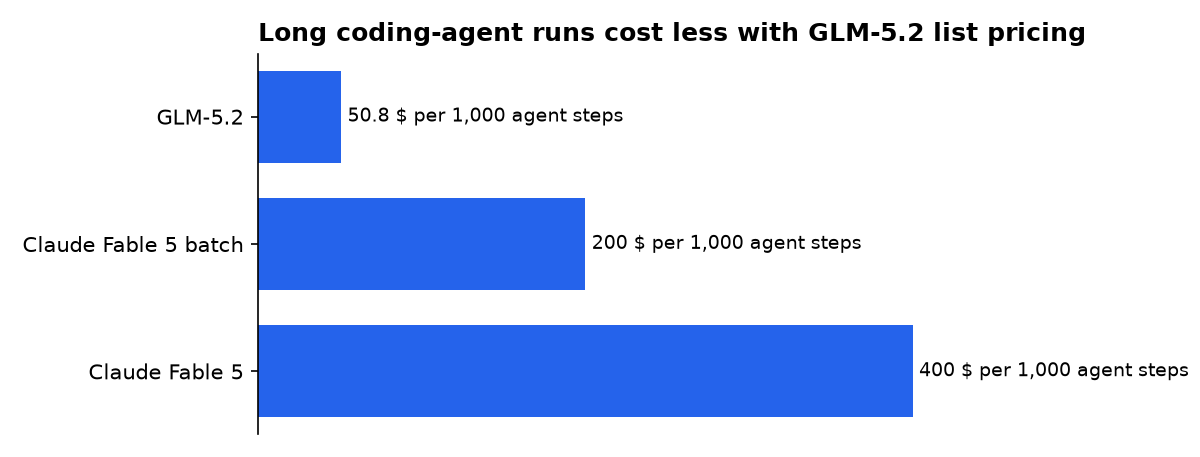
- Using the same assumed request profile, GLM-5.2 costs $50.80 per 1,000 agent steps, against $400 for Claude Fable 5.
- ZCode’s repository includes desktop, web, server and terminal-agent components.
- Semgrep measured 39% F1 for GLM-5.2 and 32% for Claude Code on its IDOR test, but the models did not run in identical harnesses.
How are ZCode and Claude Code actually different?
ZCode and Claude Code are coding-agent harnesses, not simply chat interfaces. A harness is the software that supplies repository context, runs tools, accepts or applies edits, and controls the loop around a language model. That surrounding software can change a model’s practical result as much as the model itself.
ZCode describes itself as an AI coding workbench with a desktop application, browser interface and terminal agent. Its public repository contains Electron desktop packages, a web client, HTTP and WebSocket server components, provider code, shared user-interface code, and an agent command-line interface. That gives a team several ways to run the same general workspace.
The repository also documents local web operation. Its command-line distribution can start a terminal interface or a web interface, while the source tree separates the server, web client and agent runtime. ZCode therefore looks like a configurable workbench that a technical team can inspect, build and adapt.
Claude Code is a different product choice because it is primarily a Claude-centred terminal workflow. The published material available for this comparison does not provide a matched technical inventory of Claude Code’s internals. That difference matters: public source visibility is useful for teams that need to inspect deployment paths, but it is not proof of security, support quality or enterprise suitability.
A team should first decide which workflow it needs. ZCode is the clearer candidate where developers want a visible, multi-surface harness and are prepared to choose and pay for model access separately. Claude Code is the clearer candidate where the team already values its terminal-agent workflow, but the public evidence here does not establish a universal winner.
Which costs less for real coding-agent work?
GLM-5.2 has the lower published token price in this comparison. Z.ai lists $1.40 per million input tokens and $4.40 per million output tokens for GLM-5.2. Tokens are the units of text a model processes, so repository files, terminal output and previous agent messages can all affect the bill.
The comparison below uses three fixed request profiles. A chat turn contains 1,000 input tokens and 500 output tokens. A retrieval-augmented generation, or RAG, answer contains 8,000 input tokens and 500 output tokens because it includes retrieved project material.
An assumed agent step contains 30,000 input tokens and 2,000 output tokens. It is a spending model, not a completion benchmark. A real task can take fewer steps, require retries, use caching, or fail despite consuming the full context.
OpenRouter lists Claude Fable 5 at $10 per million input tokens and $50 per million output tokens. The figures below compare those listed rates with Z.ai’s listed GLM-5.2 rates. They do not show that the models complete the same number of tasks, produce the same patches, or consume the same context in their respective products.
How to read these figures Each figure multiplies a listed input rate and output rate by the stated profile, assuming uncached input. Z.ai also lists a lower cached-input rate for GLM-5.2, but cache hits depend on the actual request pattern. Budget on measured usage rather than assuming every repeated repository segment will be cached.
| Usage profile | GLM-5.2 cost per 1,000 requests | Claude Fable 5 cost per 1,000 requests | Difference | What it means |
|---|---|---|---|---|
| Chat turn: 1,000 input + 500 output tokens | $3.60 | $35.00 | $31.40 | Short questions have a small absolute bill, but the rate gap remains large at scale. |
| RAG answer: 8,000 input + 500 output tokens | $13.40 | $105.00 | $91.60 | Repository search and retrieved documentation make input-token pricing important. |
| Agent step: 30,000 input + 2,000 output tokens | $50.80 | $400.00 | $349.20 | Long tool-using runs create the largest difference in this fixed spending profile. |
The table uses Z.ai’s published GLM-5.2 prices and OpenRouter’s listed Claude Fable 5 prices. It is useful for setting an API budget, not for predicting cost per accepted pull request. A cheaper unsuccessful run is still wasted spend.
What should a team actually buy?
The best purchase depends on who will operate the harness and who will control model spending. A small engineering group can accept more configuration in return for lower metered token rates. A larger organisation may value central controls and familiar account administration more than a lower unit price.
| Concrete option | Exact figure | Best fit | Main limitation | Evidence tier |
|---|---|---|---|---|
| ZCode with GLM-5.2 API | $50.80 per 1,000 assumed agent steps | Teams that can measure API use and want a configurable coding workbench. | The estimate does not measure task success or operational support. | Published price + transparent calculation |
| Claude Fable 5 through the compared rate card | $400.00 per 1,000 assumed agent steps | Teams evaluating the listed model rate against a fixed agent profile. | The rate comparison is not a direct Claude Code subscription comparison. | Published marketplace rate + transparent calculation |
| GitHub Copilot Business | $19 per user each month | Teams that want pooled credits, access controls and a GitHub-native control plane. | Credits are a different purchasing model from direct API token billing. | Verified vendor plan |
| Z.ai Lite subscription claim | $18 per month | Potentially relevant only if Z.ai confirms the plan and regional terms. | No current public Z.ai pricing page in this comparison confirms that tier. | Not procurement-ready |
GitHub lists Copilot Business at $19 per user each month and includes 1,900 credits per user. GitHub also says Business includes access control, budget control and governance. That makes Copilot a distinct option for teams seeking a control plane rather than a like-for-like replacement for either ZCode or Claude Code.
GitHub says its Copilot workspace can launch work from GitHub, track progress across multiple agents, review changes and merge completed work. It also advertises access to third-party agents, including Claude Code and Codex. That is relevant when a team wants to govern several agent products from one existing development platform.
Do not confuse a monthly plan, credits or an API price with a guaranteed number of completed coding jobs. They answer different questions. Procurement should ask how many reviewed changes the team accepts per dollar, while finance should separately ask who can incur spend and how that spend is capped.
Does benchmark evidence settle the model choice?
No. Semgrep reported 39% F1 for GLM-5.2 and 32% for Claude Code on its IDOR detection benchmark. That is useful security evidence, but it does not prove that ZCode will outperform Claude Code on a team’s normal backlog.
F1 balances precision and recall. Precision measures how many reported findings are genuine. Recall measures how many real findings the system catches, so F1 penalises a system that is strong on one measure but weak on the other.
Semgrep’s experiment is especially relevant because it separates model choice from harness design. Its open-weight models ran in a simple Pydantic AI harness with the same prompt and codebase. Claude Code ran through the Claude Code SDK, while Semgrep’s own multimodal pipeline used a purpose-built security harness.
That purpose-built pipeline reached between 53% and 61% F1. Semgrep says its harness enumerated application endpoints, narrowed the relevant code and directed the model to it. The result is a warning against treating a single model score as a buying decision.
IDOR means insecure direct object reference. It is an access-control flaw where a request exposes an identifier without checking whether the caller may access the underlying object. It is a demanding test because the model must reason across routes, authorisation checks and data access rather than flag a single suspicious function.
The practical lesson is to test the exact workflow your developers will use. Use representative repositories, include the team’s tests and review process, and record false positives as well as successful patches. A security benchmark can identify a promising model, but it cannot substitute for an evaluation of your harness and controls.
What does GLM-5.2 bring to a long-running coding agent?
Mem0 describes GLM-5.2 as a 753-billion-parameter mixture-of-experts model with a 1-million-token context window. A context window is the amount of text the model can consider in one request. For a coding agent, that can include source files, task instructions and tool output.
A large context window is not persistent memory. Mem0 notes that prompt content and context state disappear after a request or process ends. Teams that need an agent to retain project conventions or previous findings across sessions need a separate storage and retrieval design.
The distinction is important for cost as well as capability. Re-sending a large repository context can increase input-token use. A durable memory layer can store compact facts and retrieve only relevant material, but it also introduces another component that must be tested, secured and maintained.
GLM-5.2’s reported long context therefore strengthens the case for long-running agent experiments. It does not eliminate the need for repository access controls, test gates, code review or a plan for retaining project knowledge. Teams should separate “what fits in a prompt” from “what persists after the agent stops.”
Is ZCode worth the money?
ZCode itself is worth evaluating when metered model economics are the binding constraint and the team can operate a bring-your-own-key workflow. Its repository exposes the desktop app, web interface, terminal agent, server and provider layers. That is more evidence of a substantial workbench than a simple prompt wrapper.
The economic case comes from the model rate rather than a claim that the harness makes every task cheaper. Z.ai’s published GLM-5.2 price is $1.40 per million input tokens and $4.40 per million output tokens. The team can then connect usage to internal cost controls, provided it records requests, failures and accepted code changes.
Its limits are equally important. A public repository does not establish enterprise support terms, data-processing commitments, uptime obligations or a complete marketplace. Those are procurement questions that require current contractual documentation, not inferences from a source tree.
ZCode is a sensible pilot candidate for reviewable work with a clear test suite. Start with changes that are easy to inspect, such as internal tooling, repetitive refactors or documentation-linked fixes. Do not grant an agent broad deployment authority merely because it can edit a repository.
Is there anything better than Claude Code for coding?
There is no universal replacement because “better” combines cost, task quality, controls and developer workflow. ZCode with GLM-5.2 has a clear rate advantage under the fixed profiles in this article. Claude Code may still be preferable where its existing workflow saves enough engineering time to justify its different cost structure.
GitHub Copilot is another route when governance matters more than choosing a single harness. GitHub says Copilot can manage agent-driven work, track activity with audit logs and manage agents from a single control plane. Those controls may matter more to a larger team than the lowest token rate.
Security teams should also consider specialised workflows. Semgrep’s result shows that a purpose-built harness can outperform general-purpose agents on a narrow vulnerability test by supplying the model with better context. That does not make the specialised system better at all coding work, but it does show why task-specific evaluation matters.
Is Claude Code still the best default for coding?
Claude Code can remain a practical default for a developer who already relies on its terminal workflow, but the evidence here cannot verify a general “best” claim. The direct price comparison in this article uses OpenRouter’s Claude Fable 5 list rate, not a measurement of every Claude Code plan, allowance or task outcome.
The operational details also deserve testing. An independent investigation reported that Claude Code’s AGENTS.md loader could fail when telemetry-related settings prevented a remote feature flag from resolving. The report says a CLAUDE.md file importing AGENTS.md worked as a workaround.
That report is not an Anthropic service guarantee, and teams should reproduce the behaviour in their own configuration. The useful precaution is simple: test project instructions with a harmless canary phrase before relying on them for build, security or deployment rules. Silent instruction failures can look like model errors when the file was never loaded.
What could we not verify?
We could not verify a current public Claude Code subscription allowance, a current Claude Code plan price, or a direct subscription cost-per-task figure from the evidence used here. The comparison therefore does not claim that the OpenRouter Claude Fable 5 rate is the price a Claude Code subscriber will pay.
We could not verify a current public Z.ai page confirming the reported $18 monthly Lite plan, its prompt allowance, regional availability, quota multipliers or enterprise service terms. A dated vendor page covering those terms would be needed before treating that tier as procurement-ready.
There is no standardised public head-to-head test proving that ZCode and Claude Code complete the same backlog at the same success rate. A useful independent test would use identical repositories, tasks, budgets, harness settings and human review of the resulting patches.
The next useful step is a limited pilot. Run representative, reviewable tasks in both workflows, measure accepted pull requests, developer review time and total spend, then decide which tool should receive broader access.

