
FuturPulse analysis · 18 October 2026
The newest verified AI-model releases this week are DeepSeek V4.1 Flash 1017 on 17 October, Reflection Beam 1.0 on 16 October, and Liquid AI d1-ultra on 15 October 2026, with sharply different access and pricing models.
At a glance
- BenchLM records 24 confirmed releases across 19 providers through 17 October 2026.
- Reflection AI released Beam on 16 October with 501 billion total parameters and 23 billion active parameters per generated token.
- Liquid AI released d1-ultra on 15 October at $0.042 per million input tokens, with no output-token charge.
- Liquid AI’s LFM2.5-24B-A2B weights total 47.9GB, while the published model has a 131,072-token context limit.
Which AI models were released this week?
The verified answer is three headline releases in consecutive days, plus several specialist launches. BenchLM’s dated release ledger lists DeepSeek V4.1 Flash 1017 on 17 October, Beam 1.0 501B-A23B on 16 October, and d1-ultra on 15 October. It also lists Jais 3, Muse Spark Open and two NVIDIA Nemotron releases on that same date.
That pace does not mean each release is a substitute for the others. DeepSeek V4.1 Flash 1017 is recorded as an API release. Beam is downloadable open-weight software. Liquid AI’s d1-ultra is a decision service that returns probabilities rather than writing conventional text responses.
| Release | Date | What is distinct | Access status |
|---|---|---|---|
| DeepSeek V4.1 Flash 1017 | 17 October | Newest confirmed API-model entry in the tracker. | API model ID recorded as deepseek-flash. |
| Reflection Beam 1.0 | 16 October | Large sparse coding and agent model. | Apache 2.0 weights and hosted access. |
| Liquid AI d1-ultra | 15 October | Probability-based image and text decisions. | Liquid AI API. |
| Liquid AI LFM2.5-24B-A2B | 13 October | On-device reasoning and tool use. | Downloadable model weights. |
| Meta Muse Wonder | 12 October | Latest frontier-model entrant cited by rankings sites. | Availability varies by Meta product. |
The dated entries above combine the tracker’s release record with direct vendor pages where those are public. A release date confirms availability, not independent superiority. (benchlm.ai)
What is different about Beam and d1-ultra?
Reflection AI’s Beam is the week’s clearest open-weight release for software work. Reflection describes Beam as a sparse mixture-of-experts model, meaning it has many components but activates only part of the model for each token, the chunks of text a model reads and bills by. It has 501B total parameters and 23B active parameters.
Beam’s practical attraction is control. Reflection says developers can download, self-host, evaluate and customize the weights under Apache 2.0. It also launched with more than 40 partners and integrations, which matters for teams that need an existing deployment path rather than a research download. (reflection.ai)
Liquid AI’s d1-ultra serves a different job. It accepts text, images, or both, then returns probabilities for yes-or-no, choice, or score questions in one forward pass. A forward pass is one run through the model, without generating a long written answer.
For inspection and claims workflows, that difference is material. Liquid says a 1,024-by-1,024-pixel image is billed as 1,536 input tokens. Each question is billed separately, so a team asking ten questions about one photo should expect ten prompts rather than one bundled charge. (liquid.ai)
How much do this week’s models cost?
Liquid AI lists d1-ultra at $0.042 per million input tokens, with no output-token fee because the service returns decision probabilities. That makes its price easy to understand for classification, but it is not directly comparable with a chatbot that writes hundreds of tokens.
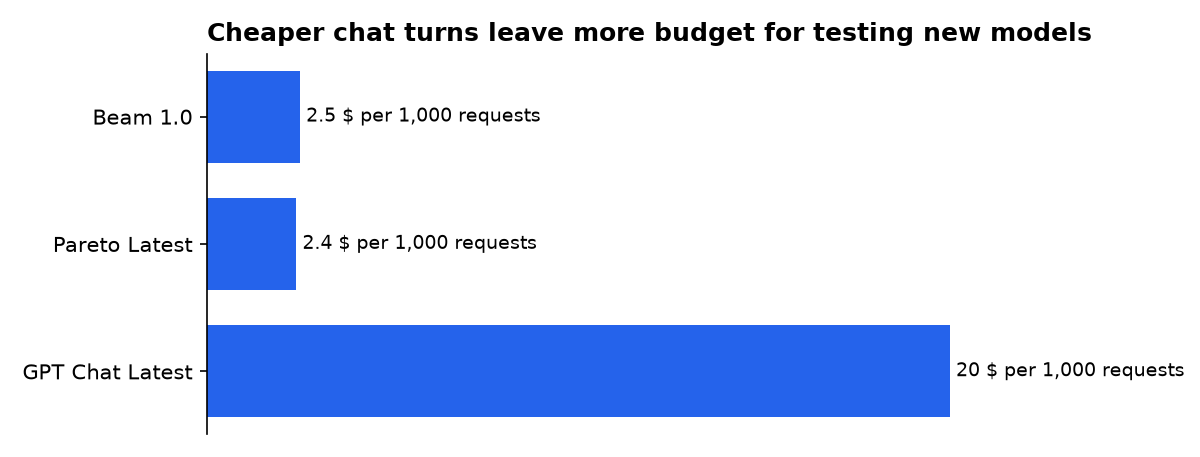
For general-purpose text models, our calculation uses OpenRouter list prices and three fixed request profiles. A chat turn means 1,000 input tokens and 500 output tokens. An agent step means 30,000 input tokens and 2,000 output tokens, reflecting a model that reads files, tool results and instructions.
| Model | Chat turn | RAG answer | Agent step | Listed context |
|---|---|---|---|---|
| Reflection Beam 1.0 | $2.50 | $9.50 | $36.00 | 1,048,576 tokens |
| Pareto Latest | $2.40 | $8.00 | $30.40 | 1,048,576 tokens |
| OpenAI GPT Chat Latest | $20.00 | $55.00 | $210.00 | 400,000 tokens |
Our calculation assumes the published input and output prices, with no caching or batch discount. The OpenRouter model list can change prices and provider availability, so production teams should recheck before setting a budget.
Can you run the new models on your own hardware?
Liquid AI’s LFM2.5-24B-A2B is the more approachable local option among the releases discussed here. Liquid AI’s model card identifies it as a 24B-parameter reasoning model with 2.45B active parameters and a 131,072-token context window. It supports text generation, function calling and local formats including GGUF, ONNX and MLX.
By our calculation from the published files, its 47.9GB safetensors download needs roughly 47.9GB for 16-bit weights alone. Eight-bit weights would need about 24.0GB, while four-bit weights would need about 12.0GB. Those figures exclude working memory, so they are capacity estimates, not laptop performance tests.
Black Forest Labs’ FLUX 3 Image Klein Comfy weights are also downloadable, but they address image generation rather than chat or code. The published repository totals 93.7GB of safetensors files. By our calculation, that is the minimum disk footprint to plan around before allowing for runtime memory.
What’s new in AI in 2026?
The defining October 2026 change is not one winner. It is fragmentation by task and access. This week alone includes an API update, an open-weight coding model, a decision API and local downloadable reasoning weights. The release count is also unusually high: BenchLM counts 24 October releases through 17 October across 19 providers.
For users, the useful filter is now “what work must this model do?” A probability-returning decision model may beat a chatbot for triage. A self-hosted model may be preferable where data cannot leave a network. A hosted model can be simpler when reliability and support matter more than control.
What are some of the most recent AI projects?
One recent project is not a model at all. gitai version 0.1.0 is an MIT-licensed, independent source-control system designed for AI coding agents. Its creator says it moves history queries, landing changes and conflict handling to the server, aiming to avoid the full-clone workflow built for human developers.
That project shows the other October trend: vendors are shipping surrounding tools as well as models. Reflection bundles Beam with its Mirror command-line harness and partner deployment stack. The model release alone is not the product; evaluation, permissions, source control and deployment decide whether an agent is usable at work. (reflection.ai)
What is the latest model of OpenAI?
The latest OpenAI model named in the available October release record is GPT-6.1 Sol, dated 29 September 2026. BenchLM lists GPT-6.1 Sol in its September timeline, while the older TLDL guide remains dated 17 July 2026 and names GPT-5.6 instead. The newer dated tracker is therefore the stronger indication, but it is still not an OpenAI announcement.
For that reason, treat GPT-6.1 Sol as the latest model identified by this release comparison, not as an independently verified current OpenAI product claim. The generic OpenRouter catalogue also exposes “GPT Chat Latest,” but that label is a moving routing name rather than a stable public generation number. (benchlm.ai)
What are the top 5 AI models right now?
There is no verified universal top five, because “top” can mean coding, factual accuracy, image work, local deployment, cost or safety. Fello AI’s 14 October rankings put Claude Opus 5.5 at the top for overall capability and coding, GPT-6 Astra for problem solving, ChatGPT Images 2.5 for images, MiniMax H3 for video, and Gemini Spark for cloud agents.
That is a publisher’s product-ranking view, not a neutral benchmark verdict. For a buyer choosing among this week’s releases, Beam belongs in the shortlist for self-hosted coding agents. d1-ultra belongs in a separate shortlist for probability-based business decisions. LFM2.5-24B-A2B belongs in local-agent testing where hardware capacity permits.
Who is making these claims, and what do they sell?
Liquid AI sells API access and promotes d1-ultra as its most capable decision model. Its pricing and performance statements are vendor claims, although the model’s decision-only billing structure is directly specified in its launch post. Reflection AI sells hosted access and ecosystem services around Beam, while also publishing Beam weights under Apache 2.0.
OpenRouter sells unified access to many providers, so its prices are useful routing data but can change with provider terms. BenchLM, Next AI Model and TrackingAI are trackers: they profit from attention, subscriptions, referrals or directory use where those models are visible, and they should not be mistaken for release authorities. TrackingAI itself warns that directory status does not guarantee a provider still offers a model.
Fello AI publishes rankings while promoting its own multi-model consumer application. Its page advertises the Fello AI app alongside model scores. That does not invalidate the rankings, but it is a commercial reason to treat them as a shortlist, then test models against your own tasks.
What we could not verify?
DeepSeek’s underlying 17 October API changelog was not publicly available in the release record reviewed here, so the model’s price, context limit, benchmarks and availability terms remain unconfirmed. DeepSeek could settle those questions with an official dated changelog and model documentation.
We could not verify an official OpenAI release page for GPT-6.1 Sol, nor a stable public definition behind the “GPT Chat Latest” routing label. OpenAI can settle both points with a dated product announcement, model card and API pricing page. Independent benchmark results for Beam and d1-ultra also remain thinner than vendor-launch claims.
Sources
- BenchLM AI model release timeline
- Reflection AI: Beam is now available
- Liquid AI: d1-ultra launch
- Liquid AI LFM2.5-24B-A2B model card
- Black Forest Labs FLUX 3 Image Klein Comfy repository
- OpenRouter model catalogue
- TLDL latest model releases guide
- Fello AI model rankings
- TrackingAI model directory
- gitai project repository

