
FuturPulse analysis · 19 October 2026
Lightricks’ LTX-2.5 is the local choice for generated footage, while Frametell and huashu-motion are better open-source stacks for explainers and product ads; LTX-2.5’s published weight files total 200.9 GB by our calculation.
At a glance
- Lightricks LTX-2.5 lists a 22B transformer and a 12B text encoder, so it is a serious local-model download rather than a casual laptop install.
- Frametell’s maintainer shows a 72-second, 1080p explainer completed in 12 minutes 52 seconds for $1.59, but that example uses paid model and voice services.
- huashu-motion can make a 30-second launch film from code, and its optional real-instrument sample download is about 55 MB.
- Hugging Face measured an earlier LTX-Video workflow at 17.75 GB of memory under specified A100 test settings, not as a guarantee for LTX-2.5.
Which open-source AI video generator should you choose?
Pick the stack by the thing you need to make, not by a vague “best model” ranking. Lightricks LTX-2.5 generates moving footage from text, images, video and audio inputs. Frametell turns knowledge material into narrated pages. huashu-motion makes designed motion graphics, rather than synthesising camera footage frame by frame.
That distinction matters more than a leaderboard. A product demo with charts, headings and screenshots usually needs stable typography and editable timing. A cinematic cutaway needs generated motion. An ad based on a brand system needs animation that stays editable after the first render.
| Concrete option | Best use | Exact published figure | What runs locally | Licence or cost boundary | Evidence tier |
|---|---|---|---|---|---|
| Lightricks LTX-2.5 with ComfyUI or LTX pipelines | Generated footage, image animation, connected shots and synced audio | 200.9 GB of published safetensors weights, by our calculation from the listed files | Model weights and inference pipeline | Free commercial and production use below $10M annual revenue under the listed community terms | PRIMARY: model card; OUR CALCULATION |
| sitor-ai/Frametell | Explainers from notes, PDFs, slides, images or a one-sentence idea | 72 seconds in 12 minutes 52 seconds for $1.59 in the maintainer’s shown run | Storyboard, browser renderer, project files and provider keys | AGPL-3.0; hosted modified versions trigger source-sharing duties | MAINTAINER EXAMPLE |
| alchaincyf/huashu-motion | Product launches, animated charts, social ads and editable title sequences | 30-second launch-film prompt; about 55 MB optional instrument samples | HTML, browser renderer, audio tools and an agent skill | MIT for its code and documentation, with stated third-party exceptions | MAINTAINER CLAIM |
The decision table exposes a gap in most “top model” lists. KDnuggets’ October 2025 comparison usefully sorts Wan, Hunyuan, Mochi, LTX and CogVideoX by model class. It does not separate footage generation from an explainer pipeline or an editable motion-design tool. Those are different purchases of time, storage and operational complexity.
Is LTX-2.5 actually open source?
Lightricks LTX-2.5 is more accurately called open weights with a custom community licence, not simply “open source” in the permissive-software sense. The model card says commercial and production use is free for entities below $10M in annual revenue. It says organisations above that threshold need a paid commercial agreement.
The practical benefit is self-hosting. Lightricks says LTX-2.5 supports text-to-video, image-to-video, video-to-video, audio-to-video and audio generation. The same page describes native multishot generation, which aims to keep character identity, environment, lighting, voice and style across cuts.
The cost is storage and setup. The main bundle is split across a transformer, a Gemma 4 text encoder, video and audio decoders, an optional duration head and upscalers. “Weights” are the large learned files a model loads; they are not a small application installer.
What makes the LTX-2.5 download so large?
Lightricks LTX-2.5 combines several big components because it generates more than silent clips. The model card names a 22B distilled transformer, a 22B development transformer and a 12B Gemma 4 text encoder. “B” means billions of parameters, the learned values that shape output.
| LTX-2.5 component choice | Published parameter figure | Reader consequence | Evidence tier |
|---|---|---|---|
| Distilled transformer | 22B | Uses a fixed 8-step schedule, aimed at a faster generation path | PRIMARY: model card |
| Development transformer | 22B | Trainable path for people building or adapting workflows | PRIMARY: model card |
| Gemma 4 text encoder | 12B | Interprets the prompt before the video generator acts on it | PRIMARY: model card |
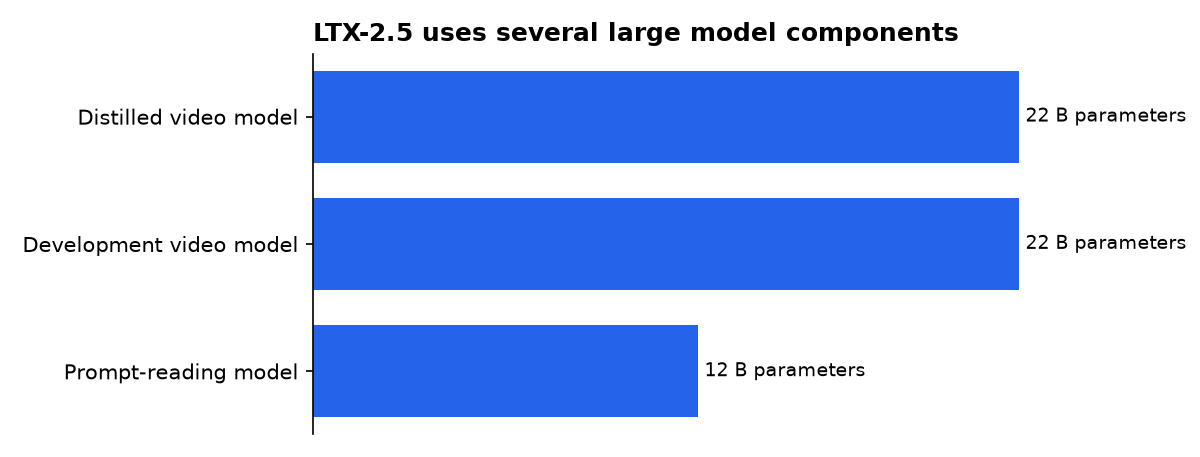
Our 200.9 GB calculation uses the published safetensors file sizes, not a hardware test. It is a download-and-disk figure, not the amount of GPU memory needed while generating. Quantised files can reduce memory pressure, but they are different files and can change speed or output quality.
Which stack makes explainer videos?
Frametell is the clearest choice when the source is an idea, report, deck or PDF and the desired result is an explanation. It does not claim to create video from scratch in the same way as a diffusion model. Instead, its director agent drafts a storyboard for approval, writes narration, makes pages, voices them and renders a subtitle-bearing 1080p MP4.
Frametell supports five built-in styles: warm-story, study, chalkboard, whiteboard and tech-dark. That is useful if you need a consistent training or education series. It also means you should expect designed pages, diagrams and text-led motion, rather than a generated actor walking through a real-looking location.
Frametell supports several providers and compatible endpoints, so the actual bill depends on the language model, voice provider, prompt length and retries.
Its licence deserves attention. AGPL-3.0 allows commercial use, modification and operation. But if a business offers a modified version over a network, the project says it must offer the modified source under the same licence, unless it obtains a separate commercial licence.
Which stack makes product ads?
huashu-motion is the sharper fit for a product launch film, animated data story or software ad. It asks an agent to write a film as an index.html page, then renders it through Chrome or another Chromium browser. That gives you a source file that can be opened, edited and versioned like a web project.
The project’s key promise is targeted revision. Its editor records the timestamp, scene and selected element when you click an area and leave a comment. The agent is then meant to adjust that part instead of regenerating the whole piece, a useful workflow for marketing teams that need to correct prices, labels or product screenshots.
The maintainer says a 30-second film rendered in about 12 to 15 seconds on a 14-core Mac, or roughly one to one-and-a-half minutes with motion blur. Treat that as a single-device claim, not a benchmark. The project says it has only been tested on macOS, and browser rendering varies with project complexity.
Unlike LTX-2.5, huashu-motion does not generate people or live-action footage from nothing. It can composite your the public record and animate code-drawn elements. Its optional voice path can use a roughly 325 MB Kokoro model, while its optional real-instrument package is about 55 MB.
How much hardware does local video need?
Local video generation needs more than a GPU-size shopping rule. Resolution, clip length, frame count, prompt length, audio and the chosen optimisation all change peak memory. Video models work across space and time, so each extra frame adds more work than a still-image workflow.
Hugging Face’s Diffusers team measured an earlier LTX-Video setup at 17.75 GB of memory on an 80 GB A100, using 121 frames at 512×768 resolution and 50 inference steps. That is useful context, but it is neither a LTX-2.5 benchmark nor a consumer-GPU recommendation.
Diffusers, a library for pretrained diffusion workflows, offers offloading and quantisation to run larger models on constrained hardware. Offloading moves some work away from GPU memory; quantisation stores model values in fewer bits. Both can make a model runnable, but neither makes long, high-resolution renders instantaneous.
The Diffusers documentation describes offloading, quantisation and modular pipelines as its main ways to balance control, memory and speed. A sensible LTX-2.5 plan is therefore to start with the distilled path and a short test clip, then add higher-detail or upscaling stages only after the base workflow works.
How do you run an open video stack locally?
For generative footage, install a visual workflow engine first. ComfyUI is the practical common layer because Lightricks says official LTX-2.5 workflow templates ship there. Its node graph is a visual way to connect prompt inputs, model files, image conditioning, output settings and export steps.
For a scripted route, Lightricks documents an LTX pipelines installation using Python 3.12 or later, CUDA 12.7 or later, and a recommended PyTorch 2.7 family. The documented examples use 121 frames, with width and height divisible by 32. Those constraints are format rules, not quality settings.
- Choose one goal: a generated shot, a narrated explainer, or an editable launch film.
- Run the project’s demo before importing brand materials or buying hardware.
- Keep the first output short and low-risk, such as a five-second cutaway or one-page explainer.
- Save the prompt, seed, source images and exported project files together.
- Only add upscaling, longer duration or external voice generation after the base version is repeatable.
Some published comparisons lead readers toward a model choice without describing the production system around it. WhiteFiber’s May 2026 guide, for example, contrasts LTX-Video, HunyuanVideo and Wan 2.1 mainly as generative models. That is useful for footage, but it does not answer who will write a voiceover, lay out a chart, fix a legal line or revise one scene.
What should you actually install?
Install LTX-2.5 only if you need original visual footage and have room for a very large model collection. Use its distilled workflow first. If the first clips meet your motion and prompt needs, then decide whether higher detail, audio or multishot generation justifies the extra storage and complexity.
Install Frametell if your raw material is a report, lecture, product brief, slide deck or research note. It gives a non-editor a storyboard approval point before pages are drawn. Budget separately for the model and voice APIs, because the shown $1.59 result is an example rather than a fixed price list.
Install huashu-motion if your deliverable is a polished announcement, app launch or animated chart and you need to change it later. It is the best match when the final video should remain code, not an opaque generated clip. Its MIT licence is also the simplest of these three for adapting the software itself.
Do not choose solely on claims that an open model “rivals” a closed one. Decrypt’s report on long-form systems and Pixazo’s 2026 model list show how quickly capability and hardware claims move. A one-hour test with your own logo, footage, text and approval process is more valuable than an impressive sample reel.
What we could not verify?
No public, vendor-controlled benchmark here establishes LTX-2.5’s speed, peak memory or finished-video quality on a specific consumer GPU. Lightricks could settle that with reproducible hardware tables covering its distilled, development and quantised paths at stated resolutions and clip lengths.
Frametell does not publish a fixed per-minute price because users select external model and voice services. Those providers, and Frametell’s maintainers, could settle typical costs with a transparent reference workflow. huashu-motion’s stated render times remain a maintainer report from a 14-core Mac; independent repeatable tests across Macs and Windows hardware would settle the broader claim.
For most readers, the action is simple: use Frametell for explainers, huashu-motion for editable product films, and LTX-2.5 only when generated footage is the actual requirement and a 200.9 GB weight download is acceptable.
Sources
- Lightricks LTX-2.5 model card
- sitor-ai/Frametell repository
- alchaincyf/huashu-motion repository
- Hugging Face: State of open video generation models
- KDnuggets: Top 5 Open Source Video Generation Models
- WhiteFiber: Choosing the Best Open-Source Video Generation Model
- Decrypt: Open-source video generators and long-form video
- Pixazo: Best open-source AI video generation models
