

FuturPulse analysis · 21 October 2026
Huashu Motion can make a code-drawn product launch film from a prompt, then turn on-screen comments into targeted edits. Its author reports a 22-second film made in under 30 minutes for ¥1.95, while a separate 30-second render took roughly 12 to 15 seconds on a 14-core Mac. The evidence supports rapid motion graphics, not a replacement for every animation studio.
At a glance
- Huashu Motion asks an agent to present three creative directions before producing a requested 30-second launch film.
- The project includes 20 stated motion languages, 10 starter templates, 23 sound effects and 27 bundled fonts.
- The author reports that a 22-second DeepSeek V4.1 Flash film cost ¥1.95 with a 99.4% cache-hit rate.
- Adobe lists After Effects at $22.99 per month on an annual, billed-monthly individual plan.
- Blender is free software, while Rive’s annual-billing Cadet plan is listed at $9 per seat each month.
Can coding agents really make launch films?
Yes, when the film is largely made from code, product screens, typography, charts and supplied assets. Huashu Motion turns the film into an index.html file, so a browser draws each frame from code and timing rather than generating video pixels with a video model. The repository says the agent can use GSAP, Canvas, Three.js and SVG, then export MP4, transparent MOV, WebM or GIF.
That distinction matters. A coding agent is strong at repeated layout changes, animated numbers, screen captures, logo treatment and exact timing. It is weaker when the brief depends on believable people, original live-action footage or a director’s judgement of whether a music cue feels right.
The project’s published limit is unusually clear: it does not invent real people or live footage. You must provide those materials, after which the skill can composite and package them. The author also says the final listening decision still belongs to a human, because automated checks inspect waveforms and spectra rather than actually hearing the track.
What does Huashu Motion automate?
Huashu Motion automates more of the production chain than a typical web-animation skill. A prompt can trigger product research, three proposed directions, a rhythm sheet, animation code, locally generated music and a browser-based review surface. A rhythm sheet is the timing plan that decides where scenes change, pause and build energy.
The repository says a reviewer can press C, click an object in a frame and leave a comment. The comment carries the timecode, scene, clicked element and source location. The agent is then meant to inspect a close screenshot and change that local part rather than rewrite the film.
This is the practical difference from asking an agent to “make an animation.” The output is not merely a rendered clip. It is a working webpage with editable titles, numbers, colours and hold times, plus versions that can be reversed with ⌘Z. That makes feedback closer to a design review than a fresh prompt lottery.
- Product films: a launch sequence built around a product site or supplied brief.
- Data explainers: a CSV can become a narrated visual story, with numbers exposed as editable fields.
- Voiceover packaging: lower thirds, statistic cards and chapter cards can sit over supplied footage.
- Format changes: the tool can fork a project into a 1080 × 1920 vertical version for a new layout pass.
How fast and cheap is the reported workflow?
The only published end-to-end cost report is promising but not independently verified. The author says a 22-second film, made with DeepSeek V4.1 Flash and three rounds of feedback, took under 30 minutes and cost ¥1.95. That figure included music and sound effects.
The same author reports that a 30-second film rendered in roughly 12 to 15 seconds on a 14-core Mac, or about one to one-and-a-half minutes with motion blur. Motion blur is the deliberate softening of fast movement that makes animation feel less staccato. Those are single-machine claims, not a published benchmark across hardware.
There is a second cost that the ¥1.95 example does not settle: the coding agent and model. Huashu Motion’s code and documentation use an MIT licence, but the repository does not publish a normal subscription price for the skill or a standard cost per finished film. Your total cost therefore depends on the model, prompt length, asset preparation, revisions and your own computer.
Performance claims, separated by evidence
| Claim | Exact figure | What it means for a buyer | Evidence tier |
|---|---|---|---|
| DeepSeek launch-film example | 22 seconds; under 30 minutes; ¥1.95 | A short coded film can be inexpensive when cache reuse is unusually high. | |
| Cache-hit rate in that example | 99.4% | This is not a safe budget assumption for a first-time project. | |
| 30-second render on named hardware | 12–15 seconds | Fast previews are plausible for simple code-rendered scenes on a capable Mac. | |
| Motion-blur render on named hardware | 1–1.5 minutes | Polished output can multiply rendering time even for a short film. | |
| Published independent user study | 0 | There is no public comparative study establishing average quality, speed or revision success. | Not publicly established |
The technical figures above come from the creator’s own repository description. They should guide a pilot, not a procurement forecast.
How does it compare with animation tools?
Huashu Motion competes with traditional animation tools by changing who operates the timeline. In After Effects, Blender and Rive, a human normally drives the interface and makes most timing decisions. In Huashu Motion, the coding agent writes the timeline and the human reviews directions, clicks frames and asks for revisions.
Adobe positions After Effects as a motion-graphics and visual-effects application, while Blender spans 3D modelling, rigging, animation, simulation, rendering and compositing. Rive is closer to interactive product animation, where a team builds a reusable asset for an app or website rather than a conventional launch film.
| Concrete option | Published price figure | Best fit | What you give up | Evidence tier |
|---|---|---|---|---|
| Huashu Motion with a coding agent | No subscription price published | Code-drawn product films, data stories and rapid review-driven changes. | Model bills are variable; quality depends on the agent and supplied assets. | Repository-verified licence; total cost unpriced |
| Adobe After Effects individual plan | $22.99/month | Teams that need established motion-graphics workflows and hands-on craft control. | Someone must build and revise the animation in the application. | Vendor price page |
| Blender | $0 software licence | 3D work, character animation, VFX and a no-subscription toolchain. | It has a broad production toolset, but not Huashu Motion’s agent-led review loop. | Vendor licence statement |
| Rive Cadet, annual billing | $9/seat/month | Shipping interactive animations into apps, sites, games and products. | Its focus is runtime graphics, not an automated launch-film production line. | Vendor price page |
| Framer Motion animation skill | 1 listed GitHub star | React interface motion, gestures and scroll-based interactions. | It is aimed at web interfaces, not audio-led film exports. | Directory listing |
For cash cost alone, Blender and Rive offer the clearest published starting points, while Adobe’s price buys a mature desktop application. Huashu Motion is different: its code is available under MIT terms, but its operating cost is not a fixed software bill. The meaningful comparison is time to first reviewable cut, not just subscription price.
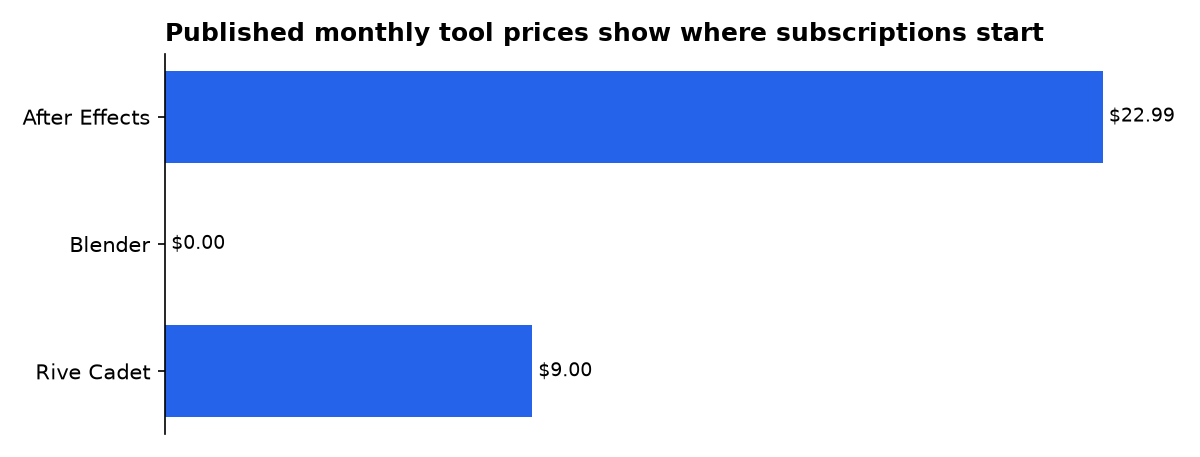
Adobe lists After Effects at $22.99 per month for an individual annual plan billed monthly. Blender says its software is free and open source for any purpose, including commercial work. Rive lists Cadet at $9 per seat per month with annual billing, while its free tier is for creating and learning.
What does Huashu do that rivals do not?
The distinctive feature is source-aware visual feedback. A reviewer can point to an object in a rendered frame and attach a comment with location context. Traditional tools also support review, but the source-aware handoff lets an agent identify the likely code behind the selected object before making a narrow change.
The repository also joins sound to the production process. Composer mode writes an ABC notation score, which is a text representation of music, before aligning scene markers to the animation. Optional sampled piano, strings and drums require a roughly 55 MB download, according to the project; without it, the system uses synthetic instruments.
GSAP’s documentation explains the web-timeline foundation behind this kind of output: timelines sequence individual tweens, or programmed property changes. Huashu Motion builds on that type of deterministic animation. A frame should reproduce from the same code and time, which is helpful when a brand team asks to change one price, colour or scene duration.
The broader skill market has adjacent tools, but they target narrower jobs. Animation Designer is described as a Claude Code skill for Framer Motion, spring physics and responsive web interactions. UI Skills separately routes launch and promo-video briefs toward a product-launch-video skill, showing that agent-assisted motion is fragmenting into specialised workflows.
Can it replace an animator or motion studio?
No, not where taste, footage and original art direction carry the result. Huashu Motion can make an agent follow a method, but methods do not establish whether a cut is persuasive for a specific audience. The author says model taste differs in practice, including between Claude Code with Opus 5.5 and DeepSeek V4.1 Flash.
The project claims to have measured 21 product-launch films and analysed 142 highly engaged launch and motion pieces. It says that work produced 20 motion-language categories. Those are useful indications of an authored playbook, but the underlying film set, coding method and results are not publicly published as a reproducible study.
Huashu Design’s related skill helps explain the philosophy. It requires three directions before execution and treats design as a multi-role process involving art direction, brand research, visual design, motion design and implementation. Huashu Motion applies that approach to a short film, but an experienced animator still has an advantage in visual restraint, performance direction and bespoke 3D craft.
What hardware and setup does it need?
Huashu Motion is a local production workflow, not a browser-only service. The project requires Node.js 22 or later, plus Chrome, Chromium or Edge for capture, inspection and export. It also needs FFmpeg, the common media-processing tool that combines video and sound.
The repository lists macOS as the only environment tested so far. It says Codex sandboxing can block local preview and browser control, requiring manual approval. That matters for a company rollout: a tool that renders locally may fit sensitive product work, but it also adds setup and support work to every user’s machine.
- Use the default setup if you need code animation, browser rendering and exported video.
- Add the optional sample pack if you want recorded-instrument sounds instead of synthetic audio.
- Add voice tooling only when needed for Chinese narration or word-level timing.
- Keep source assets ready if the launch film needs product footage, people or a real-world shoot.
What should a launch team actually choose?
Choose Huashu Motion for a one-week pilot if your launch is screen-led. It is the best fit for a software product, a feature reveal, a pricing story or an animated data explanation where the core material can live in HTML, SVG, Canvas or captured product UI.
- Give the agent a real product URL, screenshots, approved copy and brand assets.
- Ask for three directions and reject two before it writes a full film.
- Set a fixed target: one 20-to-30-second cut, one format and two feedback rounds.
- Measure prompt cost, first-cut time, revision accuracy and whether a human still needs to rebuild scenes.
- Keep After Effects or Blender for footage, character work, complex 3D and final artistic judgement.
Choose After Effects when an experienced motion designer already owns the process and needs predictable manual control. Choose Blender when original 3D objects, lighting or VFX are central. Choose Rive when the asset must run interactively inside a product rather than play as a marketing video.
What we could not verify?
No public independent benchmark compares Huashu Motion with Adobe After Effects, Blender or Rive on time, cost, quality or revision accuracy. The repository’s render times, ¥1.95 example and film-analysis counts remain creator-reported figures. An independent studio, university lab or enterprise customer running the same brief across tools could settle those claims.
The public project also does not set a standard all-in cost for a 30-second launch film. That number depends on the chosen coding agent, its model pricing, cache reuse, revisions, computer hardware and source-material preparation. Huashu Motion’s maintainer could settle the pricing question by publishing repeatable example budgets across several models and machines.
Sources
- Huashu Motion repository and README
- Huashu Design SKILL.md
- Adobe After Effects plans
- Blender licensing and project information
- Rive pricing
- GSAP documentation
- Animation Designer skill listing
- UI Skills catalogue

