
FuturPulse analysis · 25 October 2026
Block announced Dessa on 23 October 2026 as a full-duplex voice model trained from scratch on human conversation audio, without text or pretrained models. The public release is a waitlist and recordings, not downloadable weights or an API. Its meaningful change is training a voice agent to learn timing, tone and overlap directly from sound. (theverge.com)
At a glance
- Block says Dessa listens and speaks at the same time, then runs faster than real time on a MacBook Pro M4 Max or better. (block.xyz)
- Block says Dessa used one NVIDIA GB200 NVL72 system for training, but it has not published a parameter count or training-data duration. (block.xyz)
- Kyutai’s Moshi reported 200ms practical latency in 2024, but its architecture began with a text language model and predicts text alongside audio. (arxiv.org)
- Fish Audio Drama 3 is a text-to-speech model with 35B parameters and text tags such as
[sighs]and[laughs]. (huggingface.co)
What did Block actually release on 23 October?
Block released a Dessa landing page, a waitlist, and recorded conversations. It also invited a small group of safety researchers to request early access. The page does not offer model weights, an installation guide, an API price, or a public benchmark suite. (block.xyz)
That distinction matters. A recording can show a pleasant interaction, but it cannot establish how often the system interrupts correctly, misunderstands a speaker, or gives a wrong answer with convincing emotion. The Verge’s 23 October report also described exchanges that could sound awkward or uncanny, which is a useful reminder that natural timing is not the same as reliable conversation. (theverge.com)
Block’s central claim is narrower and more interesting than “human-sounding voice.” It says Dessa was trained from scratch on human speech alone, with no written text and no pretrained model. If accurate, that makes the training route different from speech systems that use text as their internal language, training signal, or control layer. (block.xyz)
What does full-duplex speech-to-speech mean?
Full-duplex means both sides can send and receive audio at once. In a useful voice agent, that permits a quick “yeah,” a correction during the agent’s reply, or a short interruption without forcing a rigid sequence of turns. Block says Dessa learned when to cut in and when to use backchannels from real conversations. (block.xyz)
Speech-to-speech means sound arrives as the input and sound leaves as the output. A typical voice stack often separates that job into speech recognition, a text model, and text-to-speech. That arrangement is practical, but Kyutai’s Moshi paper says the text middle layer can lose non-linguistic signals, including emotion and non-speech sounds. (arxiv.org)
Dessa’s stated advantage is therefore not simply speed. It is the chance to treat a pause, breath, laugh, raised volume, or overlap as part of the meaning. That could help a voice agent choose whether to answer, wait, soften its tone, or ask for clarification. It does not prove the agent understands a person’s feelings in the human sense.
How is Dessa different from Moshi?
Dessa and Moshi are both framed as full-duplex spoken-dialogue systems, but their published training stories differ sharply. Block says Dessa had only human conversation audio. Moshi began from Helium, a 7B-parameter text language model, then used audio and text streams during its training process. (block.xyz)
Moshi’s paper describes parallel streams for the user’s speech and the system’s speech. It also generates time-aligned text before audio through an “Inner Monologue” method. That design gives the model an explicit textual route for language quality, speech recognition, and text-to-speech tasks. (arxiv.org)
Block has not published an equivalent architecture description for Dessa. There is no disclosed codec, token rate, transformer size, context window, dataset inventory, or training recipe. So it is accurate to call Dessa speech-only by Block’s account. It is not yet possible to say which architectural method makes its conversations work. (block.xyz)
How does Dessa compare with text-to-speech models?
Fish Audio Drama 3 shows why a realistic voice is not necessarily a conversational agent. Its model card calls it text-to-speech, meaning a user supplies text and the system generates audio. It supports multi-speaker scenes, voice cloning, and natural-language control rather than a live two-way exchange. (huggingface.co)
Drama 3 also exposes text controls for vocal events. Its examples place labels such as [sighs] and [laughs] inside a written prompt, then supply a reference clip and its transcript. That can create expressive output, but it is a different design choice from inferring a sigh or laugh from an ongoing conversation. (huggingface.co)
The comparison does not make one approach universally better. Text-directed synthesis is useful when a producer needs exact scripts, named speakers, edits, and repeatable direction. Speech-only conversation could be useful when the hard problem is social timing: knowing that a short acknowledgment is helpful while the person is still talking.
| System | Published input and control path | Conversation design | What is publicly disclosed |
|---|---|---|---|
| Dessa | Audio in and audio out; Block says no text or pretrained models were used for training. | Full-duplex, with simultaneous listening and speaking. | Recordings, waitlist, and selected safety-researcher access. |
| Moshi | Speech and text; text tokens are predicted ahead of audio tokens. | Parallel user and system speech streams. | Paper, code repository, and a reported 200ms practical latency. |
| Fish Audio Drama 3 | Text prompts, tags, reference audio, and transcripts. | Streaming text-to-speech, not a disclosed full-duplex agent. | Weights, serving recipes, and production measurements. |
Sources: Block’s Dessa page; Kyutai’s Moshi paper; Fish Audio Drama 3 model card.
What training data did Dessa use?
Block says Dessa was trained on “nothing but human conversation,” but it has not identified the recordings, languages, speakers, licenses, consent process, or total hours. It also has not said whether the data includes calls, interviews, podcasts, acted dialogue, or other kinds of speech. Those missing details limit outside assessment of privacy, bias, memorisation, and language coverage. (block.xyz)
The company says speech is harder than text because an utterance includes accents, pauses, breathing, emphasis, and tone. It also says the same spoken sentence produces different audio each time. That variation is exactly what could teach conversational timing, but it makes the data and training process more demanding. (block.xyz)
For contrast, Moshi’s paper lays out several training phases. Those included an unsupervised audio dataset, text-only batches, simulated multi-stream speech, the Fisher conversation dataset, and synthetic instruction conversations. The paper also describes noise and echo augmentation, which are deliberate distortions designed to make a model cope with real microphones. (arxiv.org)
That is the key reporting gap around Dessa. A claim of speech-only training answers one question: what the team says it excluded. It does not answer the practical questions that determine behaviour: which conversations were included, how they were filtered, and how the model was evaluated across different people and conditions.
What did Dessa promise versus what shipped?
The timeline separates demonstrated access from the larger capabilities promised by each project. “Shipped” here means something a reader can inspect or install publicly, not a claim that a model performs consistently in every setting.
| Date | Promise or claim | What was public at that point |
|---|---|---|
| 17 September 2024 | Moshi described a full-duplex speech-text model and reported 160ms theoretical latency. | The research paper said practical latency was 200ms and linked to public code. Moshi’s paper records the date and results. |
| 2 October 2024 | Moshi’s revised paper detailed text-audio architecture and multi-stage training. | The revision history shows version two, while the full paper describes its training stages. |
| 1 October 2026 | Fish Audio Drama 3 presented expressive, multi-speaker text-to-speech. | Its public repository lists weights and deployment paths; the file page lists an 41.5GB repository. |
| 23 October 2026 | Block said Dessa learned live conversation from speech alone and can run locally. | Block published recordings, a waitlist, and a safety-researcher request form. The Verge dated the announcement. |
| 24 October 2026 | Block’s local-running claim focused on a MacBook Pro M4 Max or better. | No public download or consumer setup guide was available in the launch coverage. TechCrunch described the access limit. |
Can you run Dessa on a Mac today?
No public installation path is available as of 25 October 2026. Block says Dessa runs locally on a MacBook Pro M4 Max or better, but it has not published the model size, memory requirement, supported macOS version, download, or licensing terms. The public page instead asks prospective users to join a waitlist. (block.xyz)
A local-execution claim should not be read as a buying recommendation. Without model files, a supported configuration, or measured speed, no reader can establish whether a given Mac has enough unified memory or whether the system remains fully offline. Those are implementation questions, not consequences of the phrase “runs locally.”
Moshi is more concrete on software access: Kyutai’s repository lists Python installation commands for its PyTorch and MLX clients. That still does not make Moshi and Dessa equivalent products. It only shows the difference between a public code path and a launch page awaiting wider release. (github.com)
How large are comparable voice-model files?
Block has not disclosed Dessa’s weight files, so no memory estimate is possible for Dessa. Fish Audio Drama 3 is a useful counterexample because it publishes both a 35B-parameter figure and model files. Its listed repository size is 41.5GB, while eight safetensors shards add to about 39.6GB by our calculation from the published file sizes. (huggingface.co)
Our calculation below estimates weights alone, not the full memory needed to run a model. It assumes 35.9 billion declared parameters and uses two bytes per parameter at 16-bit precision, one byte at 8-bit, and half a byte at 4-bit. Runtime overhead, audio buffers, and context memory would increase the real requirement.
| Drama 3 weight precision | Our estimate for weights alone | What it means |
|---|---|---|
| 16-bit | 71.8GB | Too large for many personal machines before runtime overhead. |
| 8-bit | 35.9GB | Still a substantial local-memory requirement. |
| 4-bit | 17.9GB | Smaller, but quality and software support must be checked separately. |
Source and method: Fish Audio’s declared parameter count and published weight-file listing. These are FuturPulse calculations, not hardware tests.
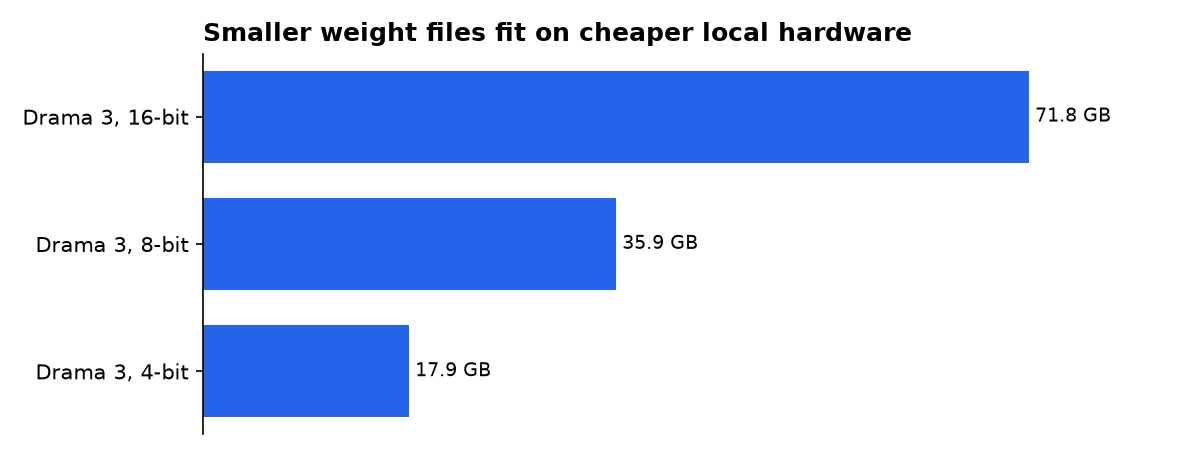
The lesson for Dessa is simple: Block’s M4 Max statement cannot be checked from a laptop specification alone. The missing number is Dessa’s model size, followed by its precision and runtime memory use. Until Block publishes those, the local-running claim remains a company capability statement rather than a reproducible deployment target.
What should voice-agent tests measure?
Voice agents need tests for both conversation and answers. A useful test would measure how quickly the system reacts to an interruption, whether it stops after a correction, and whether background speech makes it answer by mistake. It should report typical results and slower cases, not only selected recordings.
Accuracy matters as much as cadence. An agent that sounds calm and empathetic can still give false information. Moshi’s published work included factual question-and-answer tests, while Block has not yet released comparable controlled results for Dessa. (arxiv.org)
Safety testing also needs to address voice imitation and emotional influence. Block’s decision to seek outside safety researchers is a constructive access step, but the scope, test terms, and findings are not public. Independent evaluation should examine whether the system exaggerates confidence, mishandles distress, or impersonates people too convincingly. (block.xyz)
What we could not verify?
Block has not made public Dessa’s architecture, parameter count, model files, training-data duration, language mix, consent process, evaluation protocol, latency figure, or commercial terms. Block could settle those questions with a technical report, model card, benchmark methodology, and downloadable or testable release.
It is also not public whether Dessa’s apparent emotional responses remain reliable across unfamiliar accents, noisy rooms, long sessions, or sensitive conversations. Outside safety researchers with access, and later independent evaluators, could establish that through repeatable tests rather than selected recordings.

