

FuturPulse analysis · 25 October 2026
AI agent swarms are useful when each agent has a narrow job and a clear handoff; otherwise they multiply review, messaging and model-use costs. On 25 October 2026, Reason Network shipped version 0.12.13, while LearnHarness shipped version 0.3.7. Harp’s latest listed release, version 0.1.3, arrived on 21 October.
At a glance
- Reason Network gives agents three core coordination tools:
list_team,send_messageandask_user. - Reason Network messages can carry up to 10 text files, with a combined 512 KB limit.
- Harp version 0.1.3 shows two usage-limit rings per provider: a 5-hour window and a weekly limit.
- LearnHarness version 0.3.7 added provider sign-in paths for GitHub Copilot and Grok without manually entering an API key.
- Augment’s published SWE-bench example warns that an 80-agent run can hit model-provider rate limits.
What is agent swarm mode?
Agent swarm mode means several AI agents, software systems that can use tools and take actions, divide work and pass results between one another. It is not one product feature or one standard. In practical systems, the “swarm” may be agents that hand off a customer request, coding sessions that exchange messages, or specialised workers that generate competing solutions.
Haystack’s 26 November 2024 guide describes a lightweight pattern based on routines and handoffs. A routine combines instructions with the tools required to carry them out. A handoff switches control to another agent when the task needs a different role.
The important distinction is between parallel work and coordination. Four agents researching separate files can save time. Four agents discussing the same ambiguous request can create more context to read, more tool calls to check and more conflicts for a person to settle.
When does a swarm help instead of hurt?
A swarm helps when the work can be split without repeated negotiation. Good fits include independent research tasks, separate code areas, or candidate solutions that can be tested against the same acceptance rule. The agents need a shared definition of done before they start.
It hurts when every worker needs the same changing context. Each extra conversation can add tokens, the chunks of text a model reads and bills by, plus waiting time. Haystack’s own agent guidance says an agent uses tools, memory and planning to work through a goal; putting several agents around one goal adds state that somebody must keep consistent.
Use a single agent first when the task is linear:
- Read one repository, make one change and run one test suite.
- Draft one answer that needs one source of truth.
- Perform one action that needs a person’s approval.
Use a small group when tasks are genuinely separate:
- One agent investigates the problem while another prepares tests.
- Several agents create candidate patches, then a fixed test harness rejects failures.
- A specialist must request a fact from another specialist’s live session.
The published Augment SWE-bench agent illustrates the trade-off. Its evaluation mode can create multiple candidate solutions and use an LLM-based majority-vote selector, but its authors warn that larger runs take longer, cost more and can trigger provider rate limits. The project’s example configuration used 10 shards with eight processes each, or 80 agents in parallel.
How do Reason Network, Harp and LearnHarness differ?
Reason Network, Harp and LearnHarness address three different swarm problems. Reason Network is a communications layer between coding-agent sessions. Harp is a human-control interface for many local coding sessions. LearnHarness is a teaching application where several agents share a learner model and a persistent knowledge graph.
| Project | Main job | Where coordination happens | Best fit |
|---|---|---|---|
| Reason Network | Connect agents across people and computers | Peer-to-peer messages, inboxes and approval requests | A team whose coding agents need to ask one another focused questions |
| Harp | Show many coding-agent sessions in one sidebar | A person sees working, waiting and completed sessions | One developer supervising several Claude Code or Codex sessions |
| LearnHarness | Teach and practise against a learner’s evolving understanding | A shared graph of propositions and reasoning chains | Long-running learning, rather than a general software-delivery swarm |
Sources: Reason Network’s product page, Harp’s README, and LearnHarness’s product page.
Reason Network is the closest of the three to a conventional agent swarm. Its software runs one daemon, a small background service, on each computer. The project says teammates’ agent sessions can be discovered by repository, branch and status, then contacted through an MCP server, a standard connection layer for model tools.
Reason Network’s published interface gives agents list_team, send_message, ask_user and, where a message cannot be pushed, check_inbox. That is valuable for a specific blocked question. It is less useful for open-ended group debate, because each message still needs a recipient, context and an answer to become work.
Harp does not claim to make agents collaborate. It makes the operator’s coordination burden visible. Harp’s documentation says its sidebar marks Claude Code and Codex sessions as working, waiting for the user or done. That makes it a better choice for parallel personal work than a messaging mesh is.
LearnHarness uses multiple agents differently. LearnHarness says teaching and practice sessions share a graph of claims and reasoning chains. This is coordination through stored learner context, not agents negotiating tasks in a team chat. It suits learning because continuity matters more than raw parallelism.
What does coordination cost look like?
Coordination cost is the work required to decide who acts, share the right context, inspect results and resolve disagreement. It is not only model price. It also includes person-time, tool permissions, notifications and the chance that two agents make incompatible changes.
OUR CALCULATION
FuturPulse counted the minimum human decision points described by each project for a typical first task: starting or joining the system, assigning the work, monitoring it and approving or correcting a result. This is a published-feature comparison, not a benchmark or a measured time test.
| Project | Human decision points | What drives the count |
|---|---|---|
| Reason Network | 4 | Join, identify a target session, send or receive work, and approve sensitive requests. |
| Harp | 2 | Start separate sessions, then respond when a session signals it needs attention. |
| LearnHarness | 3 | Set a learning goal, choose a provider and model, then inspect the adaptive lesson path. |
Our calculation from the published workflow descriptions for Reason Network, Harp and LearnHarness.
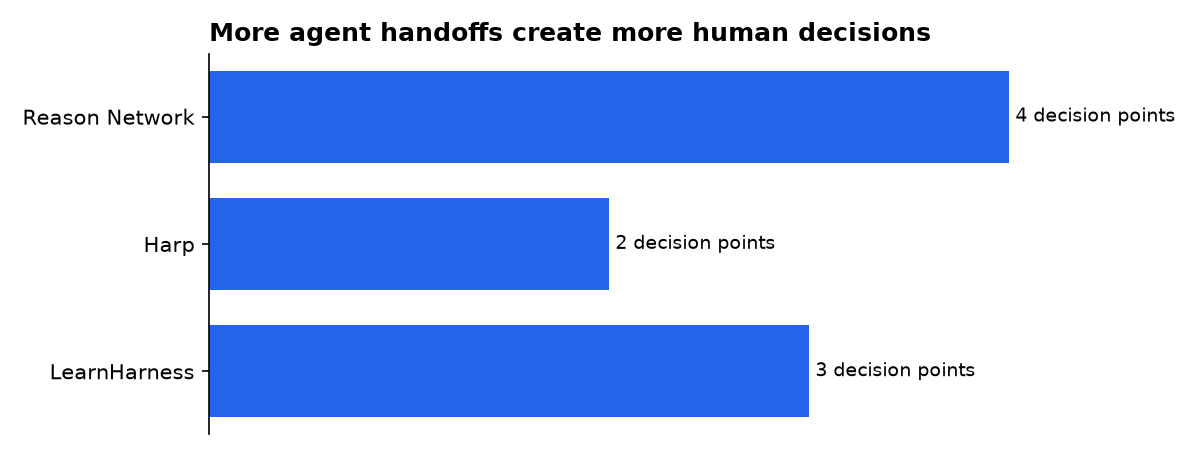
These figures do not mean Harp is “better” than Reason Network. They measure different things. Harp lowers the cost of supervising independent local sessions. Reason Network accepts more coordination overhead because it can bridge agents across teammates and machines.
Reason Network also puts hard limits around one part of that overhead. Its README sets a message attachment limit of 10 text files, with a maximum of 256 KB per file and 512 KB total. That limits accidental bulk context sharing, but it does not decide whether a request was worth sending.
What shipped versus what was promised?
The recent releases show a shift away from vague “collective intelligence” claims toward concrete coordination machinery: visible limits, provider connections, session addresses and debugging controls. The timeline below separates the promise from the feature that actually shipped.
26 November 2024
Promise: Haystack presented OpenAI Swarm-style routines and handoffs as lightweight techniques for building and orchestrating multi-agent systems. The practical promise was flexible control transfer, rather than a fixed chain of agents.
21 October 2026
Shipped: Harp version 0.1.3 made its Claude and Codex limit rings work after installation without an extra tool. The release also retained a “needs you” state when another background agent completed a tool action.
25 October 2026
Shipped: LearnHarness version 0.3.7 added GitHub Copilot and Grok sign-in options. The release says subscription usage is kept distinct from API-priced usage and does not silently fall back to API keys.
25 October 2026
Shipped: Reason Network version 0.12.13 added a Hermes conversation address, changed the session rule to one task per session and introduced local debug logging for dropped or relayed connections.
The timeline matters because swarm reliability is usually less about adding another agent than removing an ambiguous handoff. Harp clarifies when the person must intervene. LearnHarness stores the context needed for the next lesson. Reason Network defines who receives a message and when a person must approve it.
Which setup should a small team choose?
Choose Reason Network when several people already use different coding agents and need direct, bounded communication between live sessions. Its peer-to-peer design and encrypted relay fallback are aimed at team connectivity. Treat the visible repository, branch and busy-or-idle state as collaboration metadata that your team should decide to share deliberately.
Choose Harp when one person runs several coding tasks and loses time finding the session that needs an answer. Its sidebar and usage rings are operational controls. The project says Harp reads Codex session logs and Claude Code status-line data, while fetching nothing and reading no credentials.
Choose LearnHarness when the target is a learning outcome. Its system plans lessons from a learner’s present understanding, asks for reasoning and uses a persistent graph across sessions. It is not a substitute for an engineering swarm that creates patches or deploys services.
A government experiment makes the operational point plainly. DEFRA’s AI Agent Swarm Spike is described as an experimental investigation, not a production platform. It requires Python 3.13.7 or later, Amazon Bedrock access and prepared data from a scraper notebook before the swarm notebook can run.
How can teams keep a swarm under control?
Start with two agents and one evaluator. The evaluator can be a test suite, a structured rubric or a person. Add a third worker only when a repeated bottleneck is visible and its output can be checked independently.
- Give each agent one deliverable. “Find the authentication bug” is weaker than “identify the failing request path and cite the file and line.”
- Use a shared artifact, not endless chat. A test result, issue comment or structured file gives later agents less prose to interpret.
- Set a stop rule. Stop after one accepted patch, a fixed number of candidates or one unresolved conflict.
- Keep approvals human-owned. GitHub says users remain responsible for reviewing and approving work performed by Copilot’s agentic features.
GitHub’s current Copilot documentation describes an agent that can research a repository, propose a plan, edit files, run tools and prepare work for review. That workflow is a useful baseline. A swarm should earn its extra complexity by improving on that one-agent loop, not merely by doing the same work in parallel.
What we could not verify?
No published source here gives a like-for-like benchmark showing that Reason Network, Harp or LearnHarness completes the same task faster or cheaper than one agent. No public price schedule establishes the total model cost of their typical workflows. Providers, project maintainers and independent reproducible evaluations could settle those questions.
Reason Network’s documentation describes encrypted peer-to-peer communication, but an outside audit would be needed to independently verify every deployment’s security properties. Harp’s release notes describe local usage-limit display, but they do not establish whether those indicators prevent users from hitting all provider limits. LearnHarness describes local storage and provider requests, but its public material does not quantify learning outcomes against a control group.
Sources

