
Yes, you can try Haru-4B now: call Higurashi’s Japanese demos at 050-5444-3154 or 050-5444-3155, or run the browser demo locally with an NVIDIA GPU and about 12 GB of memory. The local route needs Haru’s code, a compatible installation and a voice clip; the published instructions do not require an account.
At a glance
- Higurashi released Haru-4B on 13 November 2026 as a pretrained research base model.
- Haru processes incoming audio, outgoing audio and text at 7.5 frames per second, with each frame covering about 133 ms.
- Higurashi reports 65.2 ms of median end-to-end latency on an Apple M1 Max test system before audio framing.
- The live phone demo is Japanese-only in the published numbers: one line uses a male voice and the other uses a female voice.
- Haru-4B is not a dependable factual assistant and does not follow instructions like a finished assistant.
Can you try Haru-4B now?
Yes. The quickest route is a phone call, while the browser route requires a local installation. Higurashi’s repository contains the web demo, offline inference code and an Apple Silicon implementation.
For the phone test, call 050-5444-3154 for the Japanese male voice or 050-5444-3155 for the Japanese female voice. Gigazine reported that both numbers were available on 16 November 2026. The report does not describe an account or software requirement, but the calls are Japanese demos rather than general multilingual access.
For the browser test, follow Higurashi’s Haru repository. With an NVIDIA GPU holding about 12 GB of memory, install the Python package and start python -m haru.server --hf-repo higurashi-ai/Haru-4B. Then open the direct local URL http://localhost:8998.
A browser can access a microphone only on localhost or over HTTPS, according to the repository. To share the page with another person, the same instructions support a public HTTPS link through the Gradio sharing option. The traffic then passes through Gradio’s share servers.
The local demo does not ship with a voice clip. Upload or record clean speech from one speaker, lasting between 3 seconds and 3 minutes, and use only a voice you have permission to use. The model uses that clip as a reference for its spoken output.
What does a Haru-4B full-duplex demo test?
A Haru-4B demo tests whether a voice model can listen and speak at the same time. Full-duplex means both sides can produce audio simultaneously, as in a phone call. That differs from the usual assistant pattern of speaking, waiting and then hearing a reply.
Haru-4B’s model card says each frame combines user audio, model audio and model text in one language-model position. The practical test is whether Haru retains your words when you begin talking during its answer.
Higurashi describes the system as continuous speech-to-speech rather than a chain of separate speech recognition, text generation and speech synthesis systems. That architecture explains the intended interaction, but it does not prove that every conversation will feel natural.
Which sounds show that the demo is working?
Listen first for a short acknowledgment that does not take over the conversation. Backchannels are small spoken cues such as “mm-hm”, “right” or “I see”. A useful acknowledgment should fit the speaker’s pace rather than cut across a useful sentence.
Next, test a real interruption. Start with a question, let Haru answer, then change the premise during its reply. A successful exchange should show that the model hears the new point while speaking, then adjusts or yields the floor.
Listen for four separate behaviours:
- Timing: A reply or acknowledgment arrives during the conversational moment, rather than after a long silent gap.
- Floor control: The model stops, continues or talks over you in a way that fits the exchange.
- Comprehension: Its next thought reflects the interruption instead of continuing a stale answer.
- Audio stability: Overlapping voices remain understandable rather than becoming clipped or broken.
Higurashi says Haru learned backchannels, interruptions and turn-taking from real-world speech. That is a training claim, not an independent score. A live demo is useful because these behaviours are audible and difficult to judge from a single-turn voice clip.
How should you test an interruption?
Use the same short script across several attempts. Ask an open question, wait until the reply develops and interrupt with a correction. Repetition helps distinguish a stable behaviour from one lucky exchange.
- Ask: “Tell me how you would plan a weekend trip.”
- Interrupt with: “Actually, make it a day trip with no car.”
- Listen for whether Haru notices the changed constraint before finishing its first answer.
- Speak quietly over it with “yes” or “okay” and see whether it treats that backchannel as a command to stop.
A fair test needs headphones. Haru’s repository recommends wired headphones and a wired microphone, and says Bluetooth devices add 100 ms or more. That connection delay can make a responsive model feel slow or hide the model’s own timing.
Do not score truthfulness from a voice demo. Haru-4B’s model card describes it as a pretrained base model that is not a reliable source of facts and does not follow instructions like an assistant. Score timing, listening and speech behaviour separately from factual accuracy.
Does Haru-4B’s latency claim survive a demo?
Higurashi reports 65.2 ms of median end-to-end latency on a MacBook with Apple M1 Max hardware. The test used int8 weights and wired audio equipment, and excluded audio framing from the total.
The model processes audio at 7.5 frames per second, with each frame representing about 133 ms of speech, according to Higurashi’s technical post. That frame duration describes the system’s time resolution. It does not, by itself, prove that every live interaction adds a full 133 ms of waiting.
| Stage in Higurashi’s M1 Max test | Reported median time | What a listener may notice |
|---|---|---|
| Microphone to app | 5.3 ms | Usually not noticeable on its own. |
| One model step | 34.2 ms | The central inference delay per frame. |
| Socket and handoff | 4.1 ms | Transfer overhead inside the application path. |
| Output wait | 13.3 ms | Timing margin before playback. |
| App to headphones | 8.1 ms | Final delivery delay to the listener. |
Source: Higurashi’s technical post of 13 November 2026. The figures are the company’s measurement, not an independent benchmark.
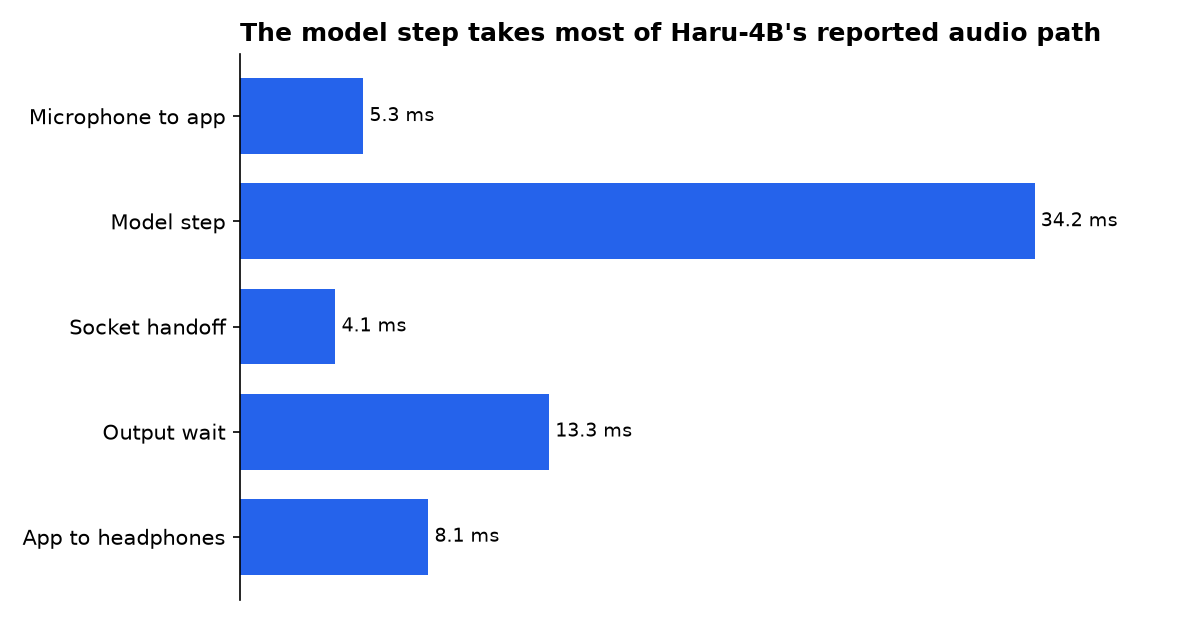
For a listener, the useful question is not only the reported total. Ask whether replies and acknowledgments consistently arrive before the exchange feels turn-based. If a demo feels smooth with wired equipment but hesitant through Bluetooth, the connection is part of the result.
How is Haru-4B different from ZONOS3-Mini?
Haru-4B and ZONOS3-Mini target different voice tasks. Haru-4B is published as an audio-to-audio, full-duplex dialogue base model. Zyphra publishes ZONOS3-Mini as a text-to-speech model, where text and a speaker reference produce audio.
ZONOS3-Mini’s listing identifies 43 languages. That makes its published use case prepared text and voice generation. The listing does not establish that it offers Haru’s live loop of hearing an incoming frame while emitting its own.
Judge a ZONOS3-Mini sample for pronunciation, speaker similarity and sound quality. Judge a Haru call first for timing, interruption handling, overlap and recovery after a changed question. A comparison between the two is therefore a comparison of different product decisions, not a head-to-head benchmark.
What hardware does the local demo need?
The simplest published local path uses an NVIDIA GPU with about 12 GB of memory, according to Higurashi’s repository. That is a setup suggestion, not a promise that every system with that capacity will reach the same latency.
| Model | Published role | Published weight files | Planning estimate |
|---|---|---|---|
| Haru-4B | Full-duplex spoken dialogue | 10.5 GB safetensors | About 10.5 GB at 16-bit weights; 5.3 GB at 8-bit; 2.6 GB at 4-bit, before runtime overhead. |
| ZONOS3-Mini | Text-to-speech | 0.8 GB safetensors | Roughly 0.8 GB of memory with a modest context cache. |
Source: Haru-4B’s model listing and ZONOS3-Mini’s model listing. The memory estimates are arithmetic from published file sizes, not hardware benchmarks.
Haru’s weights are published as bfloat16, while the model listing reports about 10.5 GB of safetensors files. Quantisation reduces the weight footprint, but runtime memory also depends on the implementation and conversation context.
Apple Silicon users have another route. The Haru repository includes an MLX implementation and a native macOS app. The same repository also documents GPU serving through vLLM-Omni for users who need multiple concurrent conversations.
A separate Haru-4B GGUF conversion runs only with speech.cpp 0.11.0 or later. Its layout is not compatible with llama.cpp, LM Studio or Ollama. That matters because a GGUF filename alone does not guarantee compatibility with every local AI application.
What can the model actually do?
Haru’s published design uses three synchronized streams: incoming user audio, outgoing model audio and model text. Higurashi says the streams are combined in a shared language model, allowing listening and speaking to proceed together.
The model uses a 64-dimensional continuous audio representation for each frame and generates that representation with a small MLP head in one sampling step, according to the model card. Readers do not need those implementation details to try the demo, but they explain why the model is built around short, repeating audio updates.
Haru lists English, Spanish, Portuguese, German, French, Chinese, Japanese, Russian and Korean as its primary languages. Higurashi says its training data spans more than 160 languages and more than 40 million hours of speech. Those are training-data descriptions, not guarantees of equal quality in every language.
The model also supports character prompts and reference audio. The prompt changes the character setup, while the reference clip guides the voice. Do not use another person’s voice without permission.
What did Higurashi release?
Higurashi released Haru-4B on 13 November 2026 with model weights, inference code and demos. The repository’s latest listed release commit is 0.1.1, dated 13 November 2026, according to GitHub.
Released: FastDialogueSidon’s repository documents a model for separating two speakers and restoring their audio into aligned dialogue streams.
Released: Higurashi’s English launch post introduced Haru-4B as a pretrained base model trained on more than 40 million hours of speech across more than 160 languages.
Planned: Higurashi’s Japanese technical post describes work on native two-channel fine-tuning, a model above 100 billion parameters and a full-duplex system that can accept video input. The post gives no release date for those projects.
Available: Gigazine reported that the Japanese phone demo was available by this date. A phone call demonstrates interaction flow, but it is not a controlled latency benchmark.
An earlier report claimed that Haru supported six languages and used a non-standard licence. That report conflicts with the primary model listing, which identifies nine primary languages and an Apache 2.0 licence. The primary listing is the better guide for deployment decisions.
What should a good Haru demo include?
A useful clip should contain more than a friendly monologue. It should include ordinary speech, a brief overlap, an interruption and a correction that changes the answer. The recording should also identify whether it uses wired audio, Bluetooth or a telephone network.
For multilingual testing, repeat the same prompt in at least two of Haru’s listed languages. Test a short backchannel in one language, then switch at a natural boundary. Keep the prompts and microphone setup consistent so the result is easier to compare.
Separate natural timing from voice imitation. A reference clip can make a voice familiar, but familiarity can make a weak conversation seem more convincing. Test whether the model understands the interruption before judging how closely it resembles the reference voice.
What we could not verify?
No public controlled comparison establishes whether Haru-4B handles interruptions better than ZONOS3-Mini. The two models are published for different tasks, and a fair comparison would need identical microphones, conditions, prompts and scoring.
Higurashi has not published a release date for the planned model above 100 billion parameters, native two-channel fine-tuning or video-capable full-duplex system. Those remain research directions rather than available Haru features.
There is no public guarantee that a local installation will match the reported M1 Max latency. Hardware, quantisation, audio drivers and connection type can change the result. The most useful next test is a repeatable live comparison across several devices.
Sources
- Higurashi technical blog: Haru-4B launch, 13 November 2026
- Hugging Face: higurashi-ai/Haru-4B model card
- GitHub: higurashi-ai/Haru inference code and demo guidance
- Hugging Face: Zyphra/ZONOS3-Mini model card
- Higurashi Japanese technical blog: roadmap and architecture
- Gigazine: Haru-4B telephone-demo report, 16 November 2026
- The Open Weights: early Haru-4B coverage, 12 November 2026

