

FuturPulse analysis · 15 October 2026
On 15 October 2026, AI coding rankings should stop naming one winner: OpenRouter lists GLM 5.3 Flash at $5.50 per 1,000 heavy agent steps, versus $160 for GPT-5.6 Sol, despite similarly large advertised contexts.
At a glance
- Our calculation from listed prices puts 1,000 heavy agent steps at $5.50 for Z.ai GLM 5.3 Flash.
- The same workload costs $10.00 for MiniMax M2.5 and $160.00 for OpenAI GPT-5.6 Sol.
- GLM 5.3 Flash lists a 1,048,576-token context, while MiniMax M2.5 lists 204,800 tokens.
- RULER found that only half of tested long-context models maintained satisfactory results at 32,000 tokens.
- No comparable public tool-reliability score is established here for the three price options.
What should AI coding rankings measure?
AI coding rankings need at least four columns: task performance, cost, usable context and tool reliability. A benchmark score measures success on a defined test. It does not tell a buyer how much an agent run costs, whether it keeps track of a repository, or whether its calls to a test runner and file system work reliably.
One current leaderboard presents benchmark scores, context windows, prices and speed together. That is useful discovery data. But it still leaves the buyer with a false choice if a coding score becomes the headline and operational trade-offs become filters.
A coding agent is not simply a model that writes a function. It reads files, decides what to change, calls tools, interprets errors, revises code and sends a pull request. Those stages have different failure modes. A strong answer to a one-shot coding prompt can still be a poor choice for a long, costly repair loop.
How much does each coding model cost?
For teams choosing between the three models in recent coding-rankings coverage, Z.ai GLM 5.3 Flash is the cheaper listed option under all three example workloads. The figures below are FuturPulse calculations from OpenRouter list prices, not a vendor contract quote or a performance test.
Tokens are the chunks of text a model reads and bills by. The calculation assumes one chat turn uses 1,000 input tokens and 500 output tokens. A retrieval-augmented generation, or RAG, answer uses 8,000 input tokens and 500 output tokens. A heavy agent step uses 30,000 input tokens and 2,000 output tokens.
| Concrete option | Listed input / output price | 1,000 chat turns | 1,000 RAG answers | 1,000 heavy agent steps | Advertised context | Tool reliability column | Evidence tier |
|---|---|---|---|---|---|---|---|
| Z.ai GLM 5.3 Flash | $0.15 / $0.50 per million tokens | $0.40 | $1.45 | $5.50 | 1,048,576 tokens | No comparable published score in this comparison | B — marketplace-listed price and claim |
| MiniMax M2.5 | $0.27 / $0.95 per million tokens | $0.74 | $2.64 | $10.00 | 204,800 tokens | No comparable published score in this comparison | B — marketplace-listed price and claim |
| OpenAI GPT-5.6 Sol | $4.00 / $20.00 per million tokens | $14.00 | $42.00 | $160.00 | 1,050,000 tokens | No comparable published score in this comparison | B — marketplace-listed price and claim |
Evidence tiers: A means an original vendor page verifies the figure. B means a marketplace or independent publisher states the figure. C means a ranking claim lacks enough public method or source detail to use in a buying decision. The three listed prices are Tier B because this comparison uses marketplace data, not direct vendor billing pages.
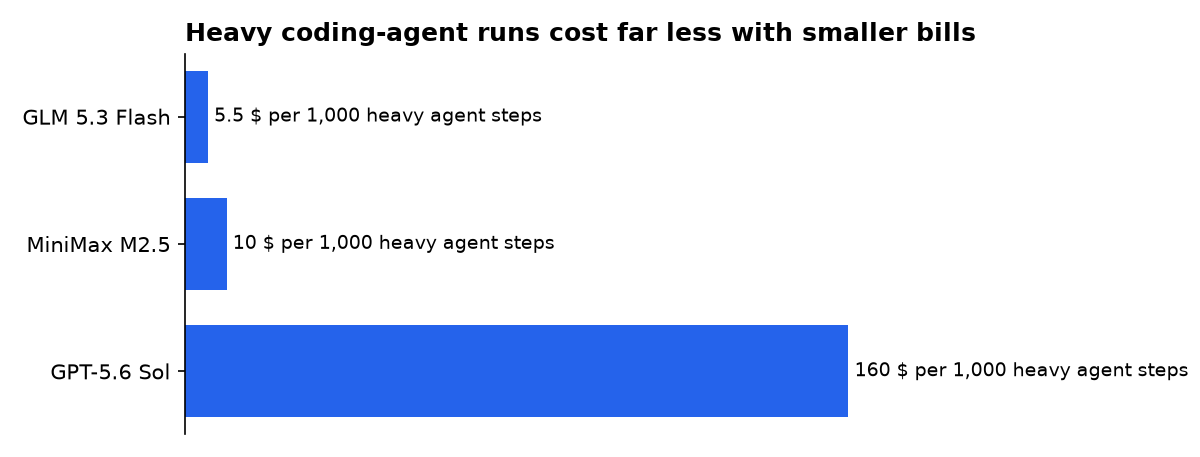
The difference matters because agent workflows repeat. That is not proof that the cheaper model completes the same work. It is the reason cost must remain visible beside a coding score.
Do not treat these totals as a monthly bill. Real spending changes with prompt size, output length, retries, caching, provider routing and discounts. A ranking page can show a blended price, but buyers should estimate their own traces before committing a production workflow.
Does a million-token context mean it works?
No. A context window is the maximum text a model can accept, not a promise that it will reason accurately over every part of it. GLM 5.3 Flash and GPT-5.6 Sol list about 1.05 million tokens of context, while MiniMax M2.5 lists 204,800 tokens. That makes the first two better suited on paper to large repositories and long logs.
But the RULER research paper found a sharp warning for buyers: nearly all tested models lost substantial accuracy as context length increased. The authors wrote that only half of the evaluated systems sustained satisfactory performance at 32,000 tokens, despite claimed windows of 32,000 tokens or more.
That result does not measure these three current models. It establishes the buying rule: call the number “advertised context,” then separately test effective context on your own repository. Ask the model to trace a dependency across files, locate a past decision, apply a change and explain the affected tests.
Long context also changes the bill. A 30,000-token agent prompt is already the cost assumption in the table. A repository-wide task can be larger, and the expensive model’s input rate becomes more important as the prompt grows. The practical question is not “which model has the biggest window?” It is “how much code can it use correctly before it starts missing relevant details?”
What does tool reliability need to measure?
Tool reliability should measure whether an agent completes a controlled sequence of actions without unsafe or pointless detours. It is distinct from code generation. An agent can write a plausible patch, then fail by editing the wrong file, ignoring a failed test, looping on the same command or claiming success after a tool error.
HumanEval’s evaluation harness makes one part of this distinction clear: generated code must execute against tests, and outcomes include passed, timed out or failed. The project also warns users not to execute untrusted generated code outside a robust security sandbox. That is functional correctness, not a complete measure of agent-tool reliability.
A useful tool-reliability column would report a fixed task suite, the exact tools available, retry limits, timeout rules and human intervention rate. It should separate “tool call was syntactically valid” from “tool call moved the task forward.” It should also report how often an agent leaves the repository in a clean, testable state.
- First-pass completion: the share of tasks finished without human rescue.
- Recovery: the share of real tool failures that lead to a correct next action.
- Waste: repeated commands, irrelevant edits and avoidable token spending.
- Safety: prohibited file changes, secret exposure and unsandboxed execution attempts.
Until a leaderboard publishes those conditions, label tool reliability as “not comparable,” not as zero. A missing score is not evidence that a model cannot use tools. It is evidence that a buyer cannot responsibly compare the models on that dimension.
Why are benchmark leaders not automatic winners?
Benchmarks answer narrower questions than a purchase decision. Sonar’s code-quality leaderboard ranks models by pass rate and adds issue density, cognitive complexity, vulnerabilities, bugs and code smells. That is valuable because it looks beyond whether code merely runs.
Yet static-analysis results do not price an agent loop or establish repository memory. A model can generate code with fewer flagged vulnerabilities but still cost too much for routine fixes. Another can be economical for classification and test drafting, then require escalation for complex architectural changes.
Traictory’s coding page places GPT-5.6 Sol at 63.9%, but the displayed number alone does not describe the workload, token budget, tool setup or review burden. It is a ranking signal, not a procurement answer. The source page should always travel with the score.
General reasoning scores can be even less direct. GPQA measures 448 difficult multiple-choice questions in science. That can indicate reasoning under pressure. It cannot show whether an agent can safely refactor an application, use a package manager or recognise that a failing test comes from an unrelated environment problem.
Beware rankings that supply a single composite result without a reproducible method. One code-generator roundup awards GitHub Copilot X 56 out of 60 across six editorial categories. It can be read as opinion, but it is Tier C for buying because the weighting and repeatable task evidence are not enough to compare it with measured model data.
What should teams buy and test first?
Teams with high-volume, repeatable coding tasks should start with GLM 5.3 Flash for a bounded pilot. Its calculated $5.50 per 1,000 heavy agent steps makes mistakes cheaper to inspect. Give it narrow permissions, a test sandbox and work that can be checked automatically.
Choose MiniMax M2.5 when its 204,800-token listed window covers the task and the extra $4.50 per 1,000 heavy steps is acceptable. It is the middle cost option here. Its shorter advertised context means teams should avoid assuming it will handle an entire large repository in one pass.
Use GPT-5.6 Sol only after a head-to-head trial shows that its output reduces enough human review or retry work to justify the $160 heavy-step estimate. The premium is not irrational if it avoids expensive engineering time. It is irrational if the comparison consists only of a leaderboard score.
What the reader should actually do?
- Pick 20 recent engineering tickets with known acceptance tests.
- Run each model with the same repository snapshot, tools and budget cap.
- Record completed tickets, human review minutes, retries and token costs.
- Test long-context retrieval separately from short bug fixes.
- Keep the cheapest model that meets your quality and safety threshold.
Judge the result at the pull-request stage, not by lines of code. Research covered by Ars Technica found that AI coding agents increased generated code and pull requests, while longer review work absorbed much of that gain. The buyer’s outcome is merged, maintainable software.
What we could not verify?
No directly comparable public tool-reliability score was available for Z.ai GLM 5.3 Flash, MiniMax M2.5 and OpenAI GPT-5.6 Sol in the marketplace comparison used here. The missing facts include common tool permissions, retry policy, timeout settings, sandbox design and human intervention rates. The model vendors, or an independent evaluator publishing a repeatable agent suite, could settle those questions.
We also could not treat advertised context as verified effective context for any of the three options. A vendor evaluation that publishes retrieval, multi-file reasoning and tool-use results at increasing repository sizes would make the context column useful as more than a capacity label. Until then, buyers should test it with their own code and keep ranking, cost, context and reliability separate.
Sources
- OpenRouter model listings and prices
- AY Automate LLM Leaderboard 2026
- RULER: What’s the Real Context Size of Your Long-Context Language Models
- OpenAI HumanEval evaluation harness
- Sonar LLM Leaderboard for Code Quality Security
- Traictory Best AI Models for Coding
- GPQA: A Graduate-Level Google-Proof Q&A Benchmark
- Saltmarch ranking of AI code generators
- Ars Technica on AI coding agents and review work

