
For academic research, Consensus is the strongest starting point because it searches a the public record of more than 200 million scholarly papers before producing cited summaries; for repeated analysis of public sources, DeepSeek V4 Pro is the lowest-cost option in the comparison table at $1.88 per 1,000 retrieval answers. Consensus describes its retrieval-first approach here.
At a glance
- Use Consensus, Elicit, Semantic Scholar, or a similar scholarly tool to find papers before asking an AI to summarise them.
- Use a long-context model when you already have reports, transcripts, PDFs, or spreadsheets that need structured extraction.
- DeepSeek V4 Pro has the lowest listed retrieval-answer cost in this comparison, at $1.88 per 1,000 requests.
- Consensus says it searches more than 200 million scientific and academic papers and includes citations in every response.
- Georgetown University Library advises researchers not to rely on one discovery tool, because any single system can miss relevant evidence.
What is the best AI for research?
The best AI for research depends on where you are in the job. If you need peer-reviewed evidence for a dissertation, literature review, grant application, or technical claim, begin with a tool that retrieves identifiable papers. If you already have the material, use a general model to organise, compare, extract, or explain it.
That distinction matters because a fluent answer is not evidence. A model can produce a convincing explanation without showing where its facts came from. A research workflow should therefore separate discovery, source checking, extraction, interpretation, and writing.
Consensus positions itself as an AI search engine for scientific and academic research. It says it searches more than 200 million documents, retrieves relevant papers before generating prose, and attaches citations to each response. Its published description says its ranking process considers textual relevance, publication recency, citation count, and journal signals. Consensus explains its search and ranking process in its product documentation.
That makes Consensus a sensible first choice for a focused question such as “Does intervention X improve outcome Y?” It is less suitable as the only tool for a broad investigation, a proprietary document collection, or a task requiring detailed extraction from many full-text files. Search results still need human review, especially when a conclusion depends on study design, population, or a narrow definition.
For academic discovery, the choice does not stop at Consensus. Georgetown University Library lists Consensus, Elicit, Semantic Scholar, Research Rabbit, scite, Scholarcy, and other tools with different roles. Its guide describes Elicit as a system that searches papers and citations while extracting and synthesising information, while Semantic Scholar provides brief summaries of papers’ objectives and results. Georgetown University Library’s guide sets out those research-tool roles.
Think of these products as different parts of a reading process. A scholarly index helps you find a starting the public record. A citation-mapping product can reveal related work. An extraction tool can turn repeated fields, such as sample size or outcome measure, into a comparison table. A general model can then help explain the result in plain English.
How much does model cost change research?
Cost matters when a team runs many document-grounded requests. Tokens are chunks of text a model reads or writes. A short chat prompt uses relatively few tokens, but a workflow that repeatedly sends reports, PDFs, meeting transcripts, and source extracts can use far more.
The table uses three repeatable usage profiles: a chat turn with 1,000 input and 500 output tokens; a retrieval-augmented answer with 8,000 input and 500 output tokens; and an agent step with 30,000 input and 2,000 output tokens. The figures show estimated cost per 1,000 requests, not a consumer subscription price. OpenRouter’s listed token rates and the resulting calculations are published in its model directory.
| Concrete option | Listed context | List price per M tokens | Our cost: 1,000 retrieval answers | Best fit | Evidence tier |
|---|---|---|---|---|---|
| DeepSeek V4 Pro 0423 | 1.05M | $0.21 input / $0.42 output | $1.88 | Large source packs on a tight budget | Verified listing: price and context |
| Pareto 26.10 Preview | 1.05M | $0.80 input / $3.20 output | $8.00 | Research and agent workflows where preview risk is acceptable | Preview listing: price and context |
| Thinking Machines Inkling | 524K | $0.95 input / $4.05 output | $9.62 | Text, image, or audio work within a smaller context window | Verified listing: price and context |
| Nous Hermes 3 405B Instruct | 131K | $1.00 input / $1.00 output | $8.50 | Structured prompts and function calling with shorter files | Verified listing: price and context |
| Nous Hermes 3 70B Instruct | 131K | $0.70 input / $0.70 output | $5.95 | Cheaper structured analysis when 131K tokens is enough | Verified listing: price and context |
The calculation excludes platform fees, retries, cached-input discounts, batch discounts, and free-tier limits. Context is the maximum amount of text a model can accept in one request. A larger context window may reduce the need to split a document set, but it does not prove that the model will interpret every source correctly.
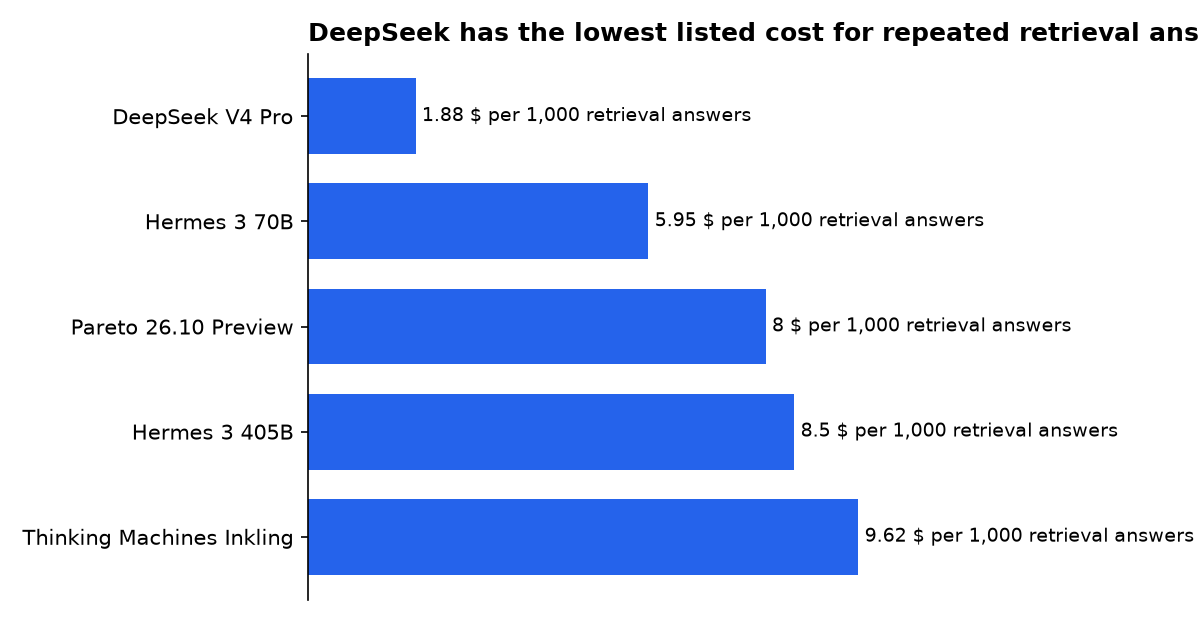
For the retrieval profile, DeepSeek V4 Pro costs $1.88 per 1,000 answers, compared with $5.95 for Hermes 3 70B and $8.00 for Pareto 26.10 Preview. The gap becomes meaningful when a team repeats the same extraction task across many source packs. It matters less when someone runs a handful of prompts for one assignment.
Price should not decide the purchase alone. A low-cost model can be a useful extraction engine if the team already has a clean source set and a checked schema. It is a weaker fit when the task requires independent discovery, judgement about source quality, or a defensible claim about what the literature says.
Before building a workflow around a long-context model, test it on a known document set. Give it a spreadsheet of facts you can check. Ask for page references, quotations, and a list of uncertain fields. Then measure not only whether it returns an answer, but how quickly a reviewer can identify a mistake.
Which AI is most reliable for research?
The most reliable AI for research is the one that keeps its answers close to inspectable sources. For academic questions, that usually means a retrieval-first service rather than a general chatbot asked to answer from its internal training data.
Consensus says it retrieves papers before it produces an AI-generated synthesis. It also says each response includes citations and that its design is intended to avoid invented references. Its own documentation identifies source misreading as the remaining failure mode: a response can cite a real paper yet summarise it incorrectly. That limitation is important because a real citation does not automatically validate the sentence attached to it.
The practical response is source checking. Open the cited paper. Confirm that it studies the relevant population, measure, date range, and outcome. Read the methods and limitations rather than relying only on a title, abstract, or AI-generated synopsis.
Thesify makes a similar case in its academic-research workflow guide. It says general-purpose AI can help with brainstorming but should not be the basis for literature review or source selection. The guide advises researchers to verify citations, compare summaries against original papers, and check whether a claim is supported by the evidence. Thesify’s guide describes verifiability as a core criterion for research tools.
Reliability is therefore a process, not a badge. A useful product reduces the work needed to find and inspect evidence. A risky product obscures that evidence behind polished prose, vague citations, or claims that cannot be reopened later.
Use general models for tasks where the risk is contained. They can help define terms, turn notes into questions, propose a spreadsheet structure, group themes, or prepare a first outline. Do not let them decide which study settles a disputed issue, whether a correlation is causal, or whether a source applies to your decision.
Is ChatGPT the best AI for research?
ChatGPT is not the best single AI for research because it is a general-purpose assistant rather than a dedicated scholarly index. It can be useful for topic development, search planning, explanations, and structured drafting. It should sit beside a source database rather than replace one.
Georgetown University Library says logged-in ChatGPT users can search the web, but it also tells researchers to look up claims and sources to verify their credibility. The library places ChatGPT in the early idea-development stage, while describing specialist research tools as products intended to discover and synthesise scholarly output.
That is a useful division of labour. Ask a general assistant to help turn a broad topic into search concepts, alternative terminology, dates, populations, or likely counterarguments. Then take those terms into a research database or scholarly discovery tool, where the resulting papers can be examined directly.
A librarian’s February 2026 assessment distinguishes ChatGPT Deep Research from Gemini Deep Research by workflow rather than by a controlled accuracy score. It characterises Gemini as presenting a structured research plan for approval before work begins, while ChatGPT often asks clarifying questions and adapts its direction during the investigation. Christopher Bell’s comparison is useful as a practitioner’s trial guide.
That comparison should not settle a procurement decision. Different tasks reward different behaviour. A team that needs a fixed scope may prefer a plan-first process. A team exploring an unfamiliar market may value follow-up questions and changing lines of inquiry. In both cases, the answer still needs source-level checking.
For formal academic work, use a scholarly tool when the output depends on peer-reviewed literature. For a business brief, public-policy scan, or product investigation, use a general assistant only after defining what types of source count as evidence. A company blog, academic paper, regulatory filing, and news report can each be useful, but they do not carry the same weight.
Which AI is best for research writing?
The best AI for research writing writes from a source set you have already checked. The model can make a draft clearer, reorganise an argument, or expose missing links in the reasoning. It should not become the last person responsible for bibliography accuracy.
ResearchPal presents itself as a research-and-writing workspace with paper discovery, literature reviews, document analysis, PDF chat, and citation tools. It says its PDF answers include source references and page numbers, and it advertises a free plan. Those are product claims, so researchers should test them against documents they know before relying on an output for submission. ResearchPal describes its research, PDF, writing, and citation features on its homepage.
A good writing workflow begins with a fixed evidence pack. This can be a folder of papers, a table of extracted findings, a set of approved documents, or a list of quotations with page references. The model should receive the evidence pack and a clear instruction not to add uncited claims.
- Draft from a bounded source set. Give the model only material that has passed an initial relevance and quality check.
- Require traceability. Ask for a source link, paper title, or page reference after each factual statement.
- Check the high-risk details. Verify quotations, dates, sample sizes, units, definitions, and causal language against the original work.
- Separate prose from citation management. Validate every bibliography entry before treating it as final.
- Preserve disagreement. Ask the model to identify conflicting findings and limitations rather than flattening them into a single answer.
Writing support is most useful after the evidence is organised. A model can turn a dense evidence table into a readable outline, but it cannot make weak evidence strong. It can also suggest transitions and headings, yet it cannot decide whether a gap in the literature is a genuine finding or simply a search failure.
For literature reviews, keep discovery and writing distinct. First collect papers. Then screen them. Then extract relevant details into a table. Only after that should the model draft a synthesis. This sequence makes it easier to spot where a sentence came from and where a conclusion has outrun the evidence.
How should a team build a research workflow?
A strong workflow assigns different tools to different decisions. Georgetown University Library warns against relying on one discovery system because researchers can miss important information. That is not an argument for collecting every possible source; it is an argument for checking whether one tool’s results leave obvious gaps.
- Frame the question. Define the geography, period, population, decision, and evidence standard before searching.
- Plan the search. List synonyms, related concepts, exclusions, and likely counterarguments. Use a general model to brainstorm terms, not to settle the answer.
- Find a starting the public record. Use a scholarly database, specialist index, or curated document collection that fits the question.
- Screen the evidence. Review dates, methods, limitations, conflicts of interest, source type, and relevance to the actual decision.
- Extract consistently. Use a table with the same fields for every source: author, date, population, method, finding, limitation, and location in the original document.
- Use AI on bounded tasks. Ask a model to populate candidate fields, summarise a selected paper, cluster themes, or compare documents against your schema.
- Draft with citations. Make every major factual statement traceable to a paper, filing, dataset, interview, or document page.
- Audit the conclusion. Ask a second reviewer or tool to look for omitted evidence, unsupported inferences, and claims that sound stronger than the sources allow.
This process is slower than asking one chatbot for a report. It is also more useful when the work affects a grade, a budget, a medical choice, a public statement, or a product decision. The aim is not to eliminate judgement. The aim is to make judgement visible and easier to challenge.
Teams should also define what they will store. Keep the question, search terms, source list, inclusion rules, extracted data, prompts, model outputs, and final edits. That record lets another person reproduce the work, find a missing source, or update the conclusion when new evidence appears.
Security belongs in the workflow as well. Georgetown’s Center for Security and Emerging Technology notes that AI and machine-learning systems can be attacked at different points in their deployment pipeline, including through poisoned data and software supply-chain weaknesses. CSET’s analysis explains why data provenance and system security need attention.
Do not upload confidential material merely because a tool can accept files. Check your organisation’s privacy rules, retention terms, access controls, and data-handling requirements first. For sensitive research, separate publicly shareable source material from internal records and use approved systems for the latter.
What should you actually do?
Students and academics: start with a scholarly discovery tool. Use Consensus for focused evidence-backed questions, then open the papers yourself. Use a general model later to explain concepts, organise notes, or draft from a checked evidence set.
Literature-review teams: combine discovery with structured comparison. Georgetown’s guide identifies Elicit as a tool for finding papers and extracting key information, while Semantic Scholar supports paper discovery and concise summaries. Build a table before you write prose.
Analysts with large internal document sets: measure model cost against the number of repeated requests you expect to run. DeepSeek V4 Pro has the lowest listed retrieval cost in the table, but test it on known files and require citations or page references for every extracted claim.
Writers: use a tool such as ResearchPal or a general model only after you have selected the underlying sources. Treat generated citations as leads to verify, not as finished bibliography entries. Make the model show its work whenever it converts evidence into a conclusion.
Everyone: prioritise traceability over eloquence. The best report is not the longest output or the smoothest summary. It is the report whose crucial claims can be reopened, inspected, challenged, and defended.
What could we not verify?
No source reviewed here establishes a single controlled accuracy ranking for DeepSeek V4 Pro, Pareto 26.10 Preview, Thinking Machines Inkling, Nous Hermes 3 405B Instruct, and Nous Hermes 3 70B Instruct on the same real research tasks. The available pricing and context data does not prove which model reads papers most accurately, follows citations best, or makes the fewest extraction errors.
We could not verify an independent comparison of these models’ handling of confidential uploads, uptime, free access, data retention, or performance at peak demand. Those questions require current provider terms, institutional review, and repeatable tests using the organisation’s own documents.
We also could not verify a universal winner for every research-writing task. Research quality depends on the source the public record, the question, the reviewer’s subject knowledge, and the checking process. A vendor feature list can show what a product claims to do; it cannot replace a trial against work your team already understands.
Sources
- OpenRouter model directory — https://openrouter.ai/models
- Consensus: Welcome to Consensus — https://consensus.app/home/blog/welcome-to-consensus/
- Thesify: Best AI Tools for Academic Research in 2026 — https://www.thesify.ai/blog/best-ai-tools-academic-research
- Georgetown University Library: AI Tools for Research — https://guides.library.georgetown.edu/ai/tools
- ResearchPal homepage — https://researchpal.co/
- Christopher Bell: AI research tools assessment — https://christopherbell.substack.com/p/the-best-ai-research-tools-recommended
- Georgetown CSET: Hacking Poses Risks for Artificial Intelligence — https://cset.georgetown.edu/article/hacking-poses-risks-for-artificial-intelligence/

