

Kolibri-1 launched on 3 October 2026 with 78.1 billion total parameters, 3.46 billion active per token, Apache 2.0 weights and a 1 million-token maximum context. Aleph Alpha’s model card makes it a credible self-hosted German-English option, but production readiness depends first on memory, operations and independent testing.
At a glance
- Kolibri-1 has 78,103,074,560 total parameters, but activates 3,457,573,120 parameters for each token.
- Aleph Alpha says the model supports up to 1 million tokens, while recommending 262,144 tokens or less for efficient complex serving.
- The official FP8 release needs about 78 GB for model weights; that rules out ordinary laptops and most single consumer GPUs.
- Aleph Alpha publishes a vLLM serving plugin for reasoning parsing, tool calls and an OpenAI-compatible local API.
- Aleph Alpha reports that 21.3% of pre-training tokens were German, a more concrete bilingual claim than “German capable.”
What is Kolibri-1, exactly?
Kolibri-1 is an open-weight language model from Aleph Alpha, a German developer. “Open weight” means an organisation can download the trained numerical files and operate them itself. It does not mean the training code, data or full recipe is necessarily open.
Aleph Alpha’s technical report describes Kolibri-1 as an English-German mixture-of-experts, or MoE, Transformer. An MoE keeps many specialist neural networks in memory, then routes each token, the short text chunks the model reads and bills by, through only a subset.
That distinction explains the two parameter figures. The company publishes 78.1 billion total parameters and 3.46 billion active parameters per token. The first figure describes the full model stored in memory; the second better indicates how much expert computation a normal token triggers.
Kolibri-1 has 50 layers, 384 selectable experts and one shared expert per layer, according to Aleph Alpha’s launch technical detail. Each token uses six selectable experts. This is why it can seek lower serving compute without becoming a small model in memory.
Why is Kolibri-1 different for German?
Kolibri-1’s strongest differentiator is not its nationality. It is a bilingual training and tokenisation design aimed at German and English from the start. Aleph Alpha says German accounted for 21.3% of its pre-training tokens, while translation represented 6% overall.
That matters because German compounds can become expensive when an English-first tokenizer breaks them into too many pieces. A tokenizer is the rulebook that turns written language into tokens. More tokens mean more processing steps, shorter effective context and often a larger bill on hosted systems.
The technical report says Kolibri’s vocabulary contains 128,000 entries and uses a method called UniBPE. Aleph Alpha claims this gives the best German compression among the tokenizers it compared, while retaining competitive English efficiency. The claim is vendor research, not an independent audit.
The underlying direction is credible. Research on subword units found that splitting rare words into smaller meaningful pieces improved English-German translation performance, while later work showed that probabilistic segmentation can improve robustness. The 2016 subword study and the 2018 unigram-tokenisation paper support the general approach, but neither validates Kolibri-1’s specific result.
For a German public-sector, legal or industrial deployment, this is a useful reason to test Kolibri-1. It is not a reason to skip a pilot. A procurement team should run its own German contracts, forms, manuals and abbreviations through the model before deciding that token efficiency translates into better answers.
Can the 1 million-token context be used?
Yes, but the 1 million-token figure is a ceiling, not the sensible default. The official model card lists 1,048,576 tokens as the context maximum and recommends serving at 262,144 tokens or less for efficient handling of complex tasks.
Context is the text a model can consider during one request. A million tokens can hold a large collection of reports, source files or records. It does not guarantee that every detail will be found, weighed correctly or cited faithfully.
Aleph Alpha says 40 of Kolibri-1’s 50 layers use a 512-token sliding window, while every fifth layer uses full attention across the available text. That design tries to control the cost of long prompts by reserving full-document processing for fewer layers.
For production, begin at the recommended 262,144-token threshold or lower. Measure latency, memory use and answer quality on real work. Large-context demonstrations often conceal a simpler issue: a long prompt may still contain conflicting instructions, missing evidence or irrelevant material.
Retrieval-augmented generation, or RAG, can be more dependable for many business systems. RAG retrieves a smaller set of relevant internal passages before generating an answer. A benchmark study of RAG systems found that models still struggle with rejecting bad evidence, combining information and handling false context.
Is the sovereign claim meaningful?
It is meaningful as a deployment and supply-chain claim, not as a magic compliance stamp. Aleph Alpha says its teams built the model in Germany and trained it on infrastructure in Germany and Finland under European and German law.
The Apache 2.0 licence gives a buyer broad rights to use, modify and redistribute the weights under its terms. The model card lists Apache 2.0, which is clearer for commercial self-hosting than a model with a bespoke licence. Your organisation still owns the security, logging, access control and update process after installation.
“Sovereign” is therefore most useful when it means the operator controls where prompts, documents and generated text reside. It does not prove an application complies with the EU AI Act, the GDPR, sector rules or a customer contract. Those obligations depend on the use case and the surrounding system.
Aleph Alpha also positions Kolibri-1 for abstention: declining to answer when supplied evidence cannot support a response. The company says it trained the model with abstention data and its Merlin-Arthur protocol. That is important for RAG, but should be evaluated with redacted and misleading internal documents.
The Merlin-Arthur research paper reports lower incorrect-answer rates under insufficient context in its experiments. The paper is useful evidence that abstention can be trained. It is not independent proof that Kolibri-1 will refuse safely in every regulated workflow.
What hardware does Kolibri-1 need?
Kolibri-1 is not a practical laptop model. Aleph Alpha lists an approximately 78 GB FP8 model footprint and names a minimum of two 80 GB A100 GPUs, two H100 SXM5 GPUs, or one H200, B200 or B300 GPU.
FP8 is an eight-bit floating-point number format used to reduce memory use. The released package is designed around it, although some parts remain in BF16, a 16-bit format. This setup reduces weight storage, but a production server needs additional memory for the context cache, requests and runtime overhead.
The following table separates released facts from FuturPulse arithmetic. Our calculation assumes exactly 78.1 billion parameters and only counts the raw parameter values. It is not a benchmark, and it is not a claim that the model will run in that amount of installed GPU memory.
| Concrete option | Exact weight figure | What it means for a buyer | Evidence tier |
|---|---|---|---|
| Published FP8 Kolibri-1 weights | ~78 GB | Vendor’s stated model footprint; suitable for data-centre GPU planning, not a complete serving budget. | Tier A: vendor model card |
| BF16 raw weights | 156.2 GB | Our calculation at 2 bytes per parameter; illustrates why higher precision needs multi-GPU or large-memory hardware. | Tier B: FuturPulse calculation |
| 8-bit raw weights | 78.1 GB | Our calculation at 1 byte per parameter; close to the official FP8 footprint, before runtime overhead. | Tier B: FuturPulse calculation |
| 4-bit raw weights | 39.1 GB | Our calculation at 0.5 bytes per parameter; no official Kolibri-1 4-bit production configuration is stated here. | Tier B: FuturPulse calculation |
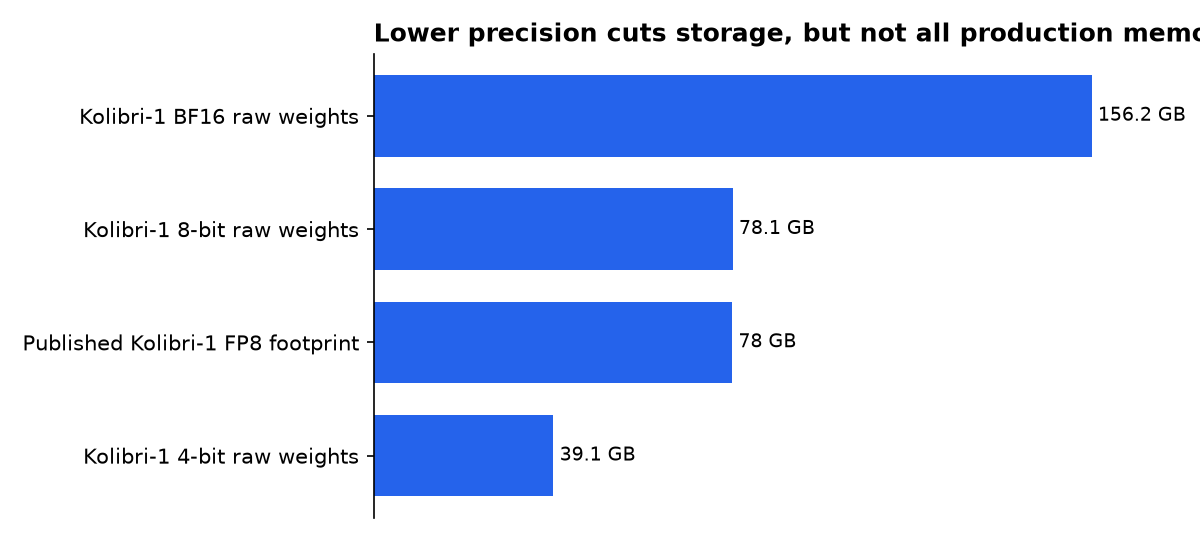
Tier A is a traceable vendor statement. Tier B is FuturPulse arithmetic derived from the published parameter count. Neither tier substitutes for a capacity test with your prompt lengths and concurrent users.
Can a team deploy Kolibri-1 today?
Yes, an experienced platform team can deploy it today, but the official path is narrow. Aleph Alpha’s public inference plugin supports vLLM 0.29 and supplies Kolibri-specific reasoning and tool-call parsers.
The published command uses an FP8 key-value cache, a memory store for prior tokens that speeds generation. The same repository says thinking is enabled by default and can be disabled through reasoning_effort: "none" or enable_thinking: false. That offers a useful cost-versus-quality control, but it also adds behaviour your application must test.
Tool calling is available. It means the model can emit a structured request for external software, such as a search service, database query or internal workflow. Treat it as untrusted input: restrict tool permissions, validate arguments and keep an audit trail.
A sensible production pilot should include:
- German and English task sets drawn from real, permitted business material.
- Redacted-context tests, designed to check whether the model abstains instead of guessing.
- Long-document tests at several context sizes, not only at the maximum.
- Tool-call failure tests, including malformed arguments and blocked actions.
- Memory, latency and concurrency measurements on the exact GPU configuration you plan to buy.
How do Kolibri-1’s scores affect a purchase?
They support shortlisting, not buying. Aleph Alpha reports an 87.5 score on German AIME 2025, 81.3 on German GPQA Diamond and 85.9 on LiveCodeBench v6. These are strong published results, but the comparison remains company-run.
The company also reports 64.5 on LongBench Pro and 68.3 on AA-LCR, its long-context measure. Those figures are useful because Kolibri-1 is claiming both reasoning and very long context. They do not reveal response times on your hardware, factual accuracy in your field or the rate of costly tool mistakes.
Watch the benchmark labels closely. Some figures use translated German tasks, some are public benchmarks and some are Aleph Alpha’s internal customer-proxy suites. Internal proxies may be relevant to the stated industry, but outside buyers cannot reproduce them without the data and evaluation method.
The stronger purchasing question is narrower: does Kolibri-1 beat your existing model on your German-English tasks while meeting a defined service level If the answer is not measured, the benchmark winner is not yet your production winner.
What should a buyer actually do?
Choose Kolibri-1 for a controlled pilot if you need self-hosted German-English reasoning, can run roughly 78 GB of model weights, and value Apache 2.0 licensing. Its parameter count is verified: 78.1B total and 3.46B active per token. Its bilingual design is concrete enough to deserve a serious German-language evaluation.
Do not choose it merely because the active count looks like a 3B model. The MoE saves computation per token, but it does not remove the full-memory requirement. Do not choose it solely for the 1 million-token headline either; begin with a context size that your infrastructure can serve reliably.
For a regulated organisation, make the first gate operational rather than rhetorical. Ask whether you can host the weights, protect prompts, govern tool access, test updates and document failures. If not, sovereignty shifts operational responsibility to a team that is not yet ready.
What we could not verify?
No public independent benchmark suite yet settles Kolibri-1’s real-world quality against the latest competing German-English models under identical hardware, prompts and serving settings. Aleph Alpha’s published scores are valuable, but an outside laboratory or customer evaluation could settle that question.
Public information does not establish a fixed per-token cloud price because Kolibri-1 is distributed as weights rather than sold with a published inference tariff. A hosting provider, systems integrator or a buyer’s own capacity model would need to turn GPU, power and utilisation costs into a deployment price.
Nor is there public evidence that any particular deployment is automatically compliant with the EU AI Act or GDPR. That outcome depends on the application, data, risk classification, human controls and operator documentation. Regulators, counsel and the deploying organisation can settle those terms for a specific use case.
Sources
- PRIMARY SOURCE: Aleph Alpha Kolibri-1 model card
- PRIMARY SOURCE: Aleph Alpha launch post, “Kolibri Has Landed”
- PRIMARY SOURCE: Aleph Alpha, Kolibri technical report
- PRIMARY SOURCE: Aleph Alpha inference plugin repository
- PRIMARY SOURCE: Neural machine translation with subword units
- PRIMARY SOURCE: Subword regularization and unigram segmentation

