
FuturPulse analysis · 31 October 2026
As of 31 October 2026, OpenAI’s GPT-6 Luna costs $0.10 per million input tokens and $0.50 per million output tokens, below xAI’s Grok 4.7 at $2 input and $6 output. At the higher end, Grok 4.7 matches GPT-6.1 Sol on input price and costs less for output, but the models are not equivalent products.
At a glance
- OpenAI’s GPT-6 Luna standard rate is $0.10 input and $0.50 output per 1M tokens.
- xAI’s Grok 4.7 standard short-context rate is $2 input and $6 output per 1M tokens.
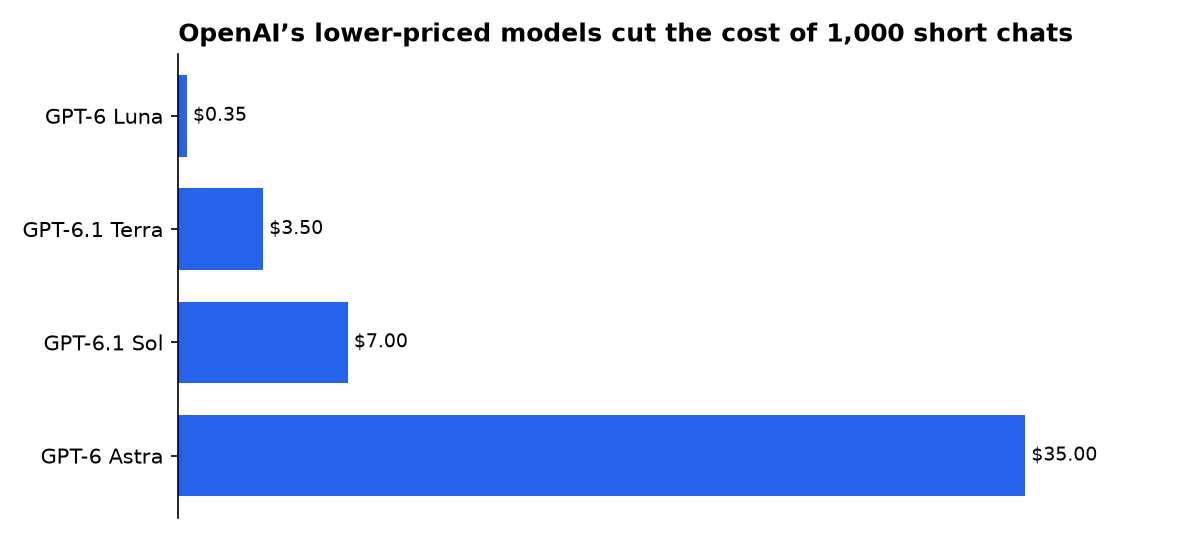
- For a 1,000-input, 500-output chat turn, our calculation puts GPT-6 Luna at $0.35 per 1,000 requests and Grok 4.7 at $5.00.
- xAI applies its long-context rate to every token once a Grok prompt reaches 200,000 tokens.
- OpenAI Batch halves listed GPT-6 token rates, while xAI lists a 20% Batch discount for Grok 4.7.
What does OpenAI cost versus xAI?
For ordinary API text generation, OpenAI offers a far cheaper floor. GPT-6 Luna costs one twentieth of Grok 4.7’s input rate and one twelfth of its output rate. That does not mean it is a substitute for Grok 4.7 in every product: xAI positions Grok 4.7 as its model for code, chat and agentic tool calling, while OpenAI sells four flagship price tiers. xAI’s model page lists Grok 4.7 with a 500,000-token context window. (developers.openai.com)
Tokens are the chunks of text a model reads and bills by. Input tokens are your prompt, instructions and conversation history. Output tokens are the generated answer. Output is usually the larger cost in a long answer, code-generation or agent workflow.
| Model | Input per 1M tokens | Output per 1M tokens | Cached input | What the price means |
|---|---|---|---|---|
| OpenAI GPT-6.1 Sol | $2.00 | $10.00 | $0.10 | Same headline input price as Grok 4.7, but higher output price. |
| xAI Grok 4.7 | $2.00 | $6.00 | $0.50 | Lower output price, but cached input costs more than GPT-6.1 Sol. |
Source: OpenAI API pricing and xAI API pricing. The table compares published rates, not answer quality, speed or tool reliability.
How much does a normal chat workload cost?
OUR CALCULATION: A 1,000-input, 500-output request costs $0.00035 with GPT-6 Luna and $0.005 with Grok 4.7. Multiplied by 1,000 requests, that becomes $0.35 and $5.00 respectively. The calculation assumes every input token is uncached, uses standard global rates, and excludes search, files, images and other tools. It applies the published OpenAI price card and xAI price card.
| Model | Input tokens per turn | Output tokens per turn | Cost per 1,000 requests | Best use |
|---|---|---|---|---|
| GPT-6 Luna | 1,000 | 500 | $0.35 | High-volume simple text work |
| GPT-6.1 Terra | 1,000 | 500 | $3.50 | Middle-cost OpenAI routing tier |
| GPT-6.1 Sol | 1,000 | 500 | $7.00 | OpenAI premium text tier |
| GPT-6 Astra | 1,000 | 500 | $35.00 | Highest-priced OpenAI flagship tier |
| Grok 4.7 | 1,000 | 500 | $5.00 | xAI’s current general-purpose model |
The useful distinction is not simply “OpenAI versus xAI.” OpenAI’s own menu spans a 100-fold input-price range, from GPT-6 Luna to GPT-6 Astra. Grok 4.7 lands between GPT-6.1 Terra and GPT-6.1 Sol on this short-chat calculation. That makes it cheaper than OpenAI’s Sol tier, but much dearer than Luna for tasks where a lower-cost model is sufficient. (developers.openai.com)
How much does OpenAI cost to use?
OpenAI API use is usage-based, not a single monthly API fee. On the current standard card, GPT-6 Luna begins at $0.10 per million input tokens and $0.50 per million output tokens, while GPT-6 Astra is $10 input and $50 output. Your bill depends on model selection, output length, cache hits, service tier and tools. OpenAI also lists Batch, Fast and Ultrafast rates separately. (developers.openai.com)
ChatGPT subscriptions are a different consumer product from the API. A ChatGPT plan does not convert an application’s API usage into a fixed monthly cost. Product teams should budget API calls from measured token logs rather than dividing a consumer subscription price across users.
Which AI API is the cheapest?
Between these two vendors’ current text cards, OpenAI GPT-6 Luna is the cheapest published standard option at $0.10 per million input tokens and $0.50 per million output tokens. xAI’s lowest listed current text option is Grok Build 0.1 at $1 input and $2 output below its long-context threshold, while Grok 4.7 is $2 and $6. That makes OpenAI cheaper for raw token volume, although “cheapest” cannot establish which model produces an acceptable result for a specific task. xAI’s card supplies the threshold and Grok Build rates. (developers.openai.com)
Use a small evaluation set before moving production traffic. Send real support questions, documents or code tasks through both candidates. Compare task accuracy, refusal behaviour, latency and the token count needed to get a usable answer. A lower rate can lose its advantage if it needs repeated retries or much longer prompts.
How do caching and long context change the bill?
Prompt caching is reused model work. It can reduce the charge for repeated instructions or shared conversation history, but it is not free context. OpenAI charges GPT-6.1 Sol $0.10 per million cached input tokens against $2 for ordinary input, and also publishes separate cache-write rates for 30-minute and 12-hour retention. OpenAI’s caching guide explains that cache writes and cache reads are billed differently. (developers.openai.com)
xAI’s standard Grok 4.7 rate is $2 input, $0.50 cached input and $6 output below 200,000 prompt tokens. Once a prompt reaches that threshold, the published rate becomes $4 input, $1 cached input and $12 output for all tokens in that request. That step change matters for document-heavy retrieval systems, because one oversized prompt can double the token bill. xAI states that long-context rates apply to every token after the threshold is reached. (docs.x.ai)
Do Batch, regional and tool fees alter the result?
Yes. OpenAI’s Batch prices cut GPT-6 Luna to $0.05 input and $0.25 output per million tokens, half its standard rate. xAI lists a 20% Batch discount for Grok 4.7, which reduces its published standard short-context prices to $1.60 input and $4.80 output by calculation. Batch is useful for backfills and overnight jobs, not an interactive chat where users expect an immediate reply. (developers.openai.com)
Regional choices can also erase part of a saving. xAI’s US regional endpoint bills token usage at 1.1 times global rates, a 10% premium. OpenAI says eligible regional-processing endpoints also carry a 10% uplift, and its FedRAMP endpoints gain the same uplift on 1 November 2026. OpenAI’s pricing page states the effective date. (developers.openai.com)
Tools are separate costs. OpenAI lists web search at $10 per 1,000 calls, plus retrieved content tokens at model rates. xAI lists web search at $5 per 1,000 calls and code execution at $5 per 1,000 calls. An agent that searches repeatedly can therefore cost more in tool use than in its short generated answer. xAI’s tool table and OpenAI’s tool table set out those meters. (developers.openai.com)
What has changed from earlier price claims?
The current cards differ sharply from comparison pages built around the GPT-5.6 and Grok 4.5 generation. The dated timeline below separates historical claims from the rates a buyer can see now. A third-party historical price tracker can be useful for spotting changes, but a live vendor card remains the invoice-level reference. The llm-prices project publishes dated price-history fields for this purpose. (github.com)
-
30 July 2026 — shipped naming change
OpenAI says “Priority processing” was renamed Fast mode. That is a service-tier label change, not evidence of a lower rate: Fast prices are higher than Standard prices on the current card. OpenAI’s pricing page records the date and the current schedules. -
8 July 2026 — historical third-party claim
Solvimon’s earlier comparison says Grok 4.5 launched at $2 input and $6 output per million tokens. The current xAI card instead centres on Grok 4.7, so buyers should not rely on that older lineup as a current catalogue. The comparison page preserves the Grok 4.5 claim. -
21 September 2026 — current xAI model-card update
xAI’s models page says it was last updated on this date and identifies Grok 4.7 as the model for code and general work. The shipped state is therefore a public Grok 4.7 API price card, not a future launch promise. xAI’s model catalogue records the update. -
22 September 2026 — earlier OpenAI baseline
A prior FuturPulse comparison used GPT-5.6 Luna at $0.20 input and $1.20 output. The current OpenAI card now lists GPT-6 Luna at lower published standard rates, showing why old calculator results need a date label. The September comparison records the earlier GPT-5.6 figure. -
1 November 2026 — promised charge change
OpenAI says a 10% FedRAMP endpoint uplift starts on this date. As of 31 October 2026, that charge is scheduled for tomorrow rather than already billed. OpenAI’s API pricing page gives the future date.
Which provider should a product team choose?
Choose OpenAI GPT-6 Luna when the task is routine and token volume dominates the budget. Its headline rate makes it the clear cost floor in this two-vendor comparison. Move upward only when an evaluation shows a material quality gain for your actual workload.
Choose xAI Grok 4.7 when its model behaviour, 500,000-token context or xAI-specific tools justify a higher base cost than OpenAI’s lowest tier. Its $6 output rate is attractive beside GPT-6.1 Sol’s $10 rate, but OpenAI’s cached-input rate for Sol is lower. The correct routing rule can therefore change between fresh prompts and repeat-heavy sessions.
Teams using both APIs can avoid hard-coding a single provider. TensorZero describes support for both OpenAI and xAI through a common gateway, which is one way to measure real cost and run controlled routing tests. That operational layer has its own deployment work; it does not make vendor pricing identical. (github.com)
What we could not verify?
Neither vendor publishes a neutral, task-by-task quality score that makes GPT-6 Luna, GPT-6.1 Sol and Grok 4.7 directly interchangeable. Only a buyer’s own evaluation can settle whether a cheaper response meets a product’s accuracy, safety and latency requirements.
OpenAI’s current pricing card displays short- and long-context columns, but the public page excerpt does not state the token threshold that moves a flagship request between them. OpenAI could settle that with a published threshold. xAI is clearer for Grok models: its pricing page names the 200,000-token long-context threshold.
Enterprise discounts, committed-spend terms and negotiated support packages are not public list-price items. OpenAI or xAI sales teams, and a customer’s signed order form, would settle those terms.
Sources

