
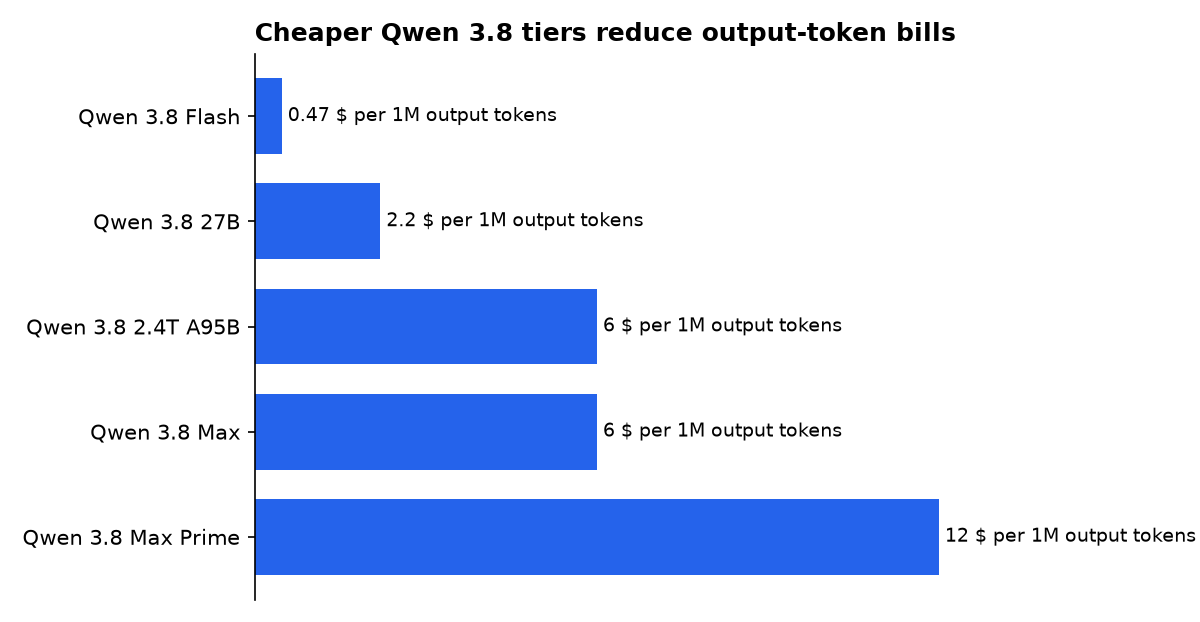
On 28 October 2026, Qwen 3.8 API list prices range from $0.15 input and $0.47 output per million tokens for Qwen3.8 Flash to $4 input and $12 output for Qwen3.8 Max Prime. The widely repeated Qwen3.8 Max rate is $2 input and $6 output, but reseller cache charges differ.
At a glance
- Qwen3.8 Flash costs $0.15 per million input tokens and $0.47 per million output tokens on OpenRouter’s current catalog.
- Qwen3.8 Max and Qwen3.8 2.4T A95B each list at $2 input and $6 output per million tokens through OpenRouter.
- Qwen3.8 Max Prime costs $4 input and $12 output per million tokens, double the Max list rate.
- RuAPI lists Qwen3.8-Max cache reads at $0.43 per million tokens, while another reseller lists $0.3089.
- Qwen3.8 27B lists at $0.035 input and $2.20 output per million tokens, making it unusually cheap for input-heavy workloads.
What is the Qwen 3.8 API price?
For the flagship-style Qwen3.8 Max tier, the clearest current reference price is $2 per million input tokens and $6 per million output tokens. Tokens are the chunks of text a model reads and bills by. That rate applies to new prompt text and generated answers, not necessarily to repeated prompt material.
“Qwen 3.8” is not one API product. It names a family that includes the lower-cost Flash model, the open-weight 27B model, the 2.4T A95B model, Qwen3.8 Max (0902), and the higher-throughput Max Prime tier. Picking “Qwen 3.8” without a full model ID can turn a $0.47-million-output-token plan into a $12 plan.
Which Qwen 3.8 model costs least?
Qwen3.8 Flash is the least expensive current Qwen3.8 hosted option in the OpenRouter catalog, at $0.15 per million input tokens and $0.47 per million output tokens. Qwen3.8 27B has cheaper input at $0.035, but its $2.20 output rate makes it a different bargain: cheap for reading, less cheap for long answers.
| Concrete option | Input / 1M | Output / 1M | Context | Evidence tier | Best cost fit |
|---|---|---|---|---|---|
| Qwen3.8 27B | $0.035 | $2.20 | 1M tokens | A — provider catalog | Very input-heavy prompts with restrained answers |
| Qwen3.8 Flash | $0.15 | $0.47 | 1M tokens | A — provider catalog | High-volume chat, extraction and short agents |
| Qwen3.8 2.4T A95B | $2.00 | $6.00 | 1M tokens | A — provider catalog | Use only when the large model’s result justifies it |
| Qwen3.8 Max (0902) | $2.00 | $6.00 | 1M tokens | A — provider catalog | Multimodal flagship work at standard Max pricing |
| Qwen3.8 Max Prime | $4.00 | $12.00 | 1M tokens | A — provider catalog | Cases where the separate higher-throughput SKU matters |
Evidence tier A means a provider has published a live price page. It does not mean Alibaba Cloud has published the same price directly. The table excludes cache rates because OpenRouter’s public model listings do not show one consistently for every Qwen3.8 SKU.
How much is Qwen3.8 Max cached input?
There is no single verified Qwen3.8 Max cached-input price across API sellers. RuAPI lists $0.43 per million cached input tokens alongside $2.16 input and $6.456 output. Its page says an account price can be lower, so that is a gateway price rather than a universal Qwen price.
TuneRouter lists $0.3089 per million cached tokens, with $1.5444 input and $4.6332 output. ChineseModels.ai lists a higher $0.4478 cache rate, paired with $3.58 input and $10.75 output. These are real public offers, but they are not interchangeable quotes for the same billing account.
| Seller or source | Input / 1M | Output / 1M | Cached input / 1M | Evidence tier | How to use it |
|---|---|---|---|---|---|
| OpenRouter model catalog | $2.00 | $6.00 | Not listed for this comparison | A — provider catalog | Use as the cleanest public baseline for Max pricing |
| RuAPI | $2.16 | $6.456 | $0.43 | A — reseller price page | Specific to RuAPI billing and access terms |
| TuneRouter VastLLM | $1.5444 | $4.6332 | $0.3089 | A — reseller price page | Lowest published Max quote in this table |
| ChineseModels.ai | $3.58 | $10.75 | $0.4478 | A — reseller price page | Higher-price route; test the exact upstream before committing |
| API Cost Check | $2.00 | $6.00 | $0.25 | B — third-party tracker | Useful cross-check, but its page labels Qwen’s official check pending |
| Wealth Engine analysis | $2.00 | $6.00 | $0.25 | B — reported rate | Do not treat as an Alibaba Cloud invoice quote |
The useful finding is the spread. The lowest published reseller input rate here is $1.5444, while the highest is $3.58. That difference matters at scale. It can also reflect routing, currency settlement, commercial discounts, regional access, taxes, and the reseller’s margin rather than a changed Qwen base rate.
What does a million tokens mean in dollars?
Output is the expensive side of Qwen3.8 Max. At OpenRouter’s $2 input and $6 output list rate, one million input tokens plus one million output tokens cost $8 before any tool, storage, image, retry or tax charges. An application that generates long answers will pay more than its prompt size suggests.
FuturPulse calculated the estimates below from the current OpenRouter list rates. The assumptions are fixed: a chat turn uses 1,000 input and 500 output tokens; a retrieval-augmented generation, or RAG, answer uses 8,000 input and 500 output; and an agent step uses 30,000 input and 2,000 output. RAG means the application adds retrieved material to the prompt.
| Model | Chat turn | RAG answer | Agent step | Calculation evidence |
|---|---|---|---|---|
| Qwen3.8 27B | $1.14 | $1.38 | $5.45 | FuturPulse calculation from listed rates |
| Qwen3.8 Flash | $0.39 | $1.44 | $5.44 | FuturPulse calculation from listed rates |
| Qwen3.8 2.4T A95B | $5.00 | $19.00 | $72.00 | FuturPulse calculation from listed rates |
| Qwen3.8 Max (0902) | $5.00 | $19.00 | $72.00 | FuturPulse calculation from listed rates |
| Qwen3.8 Max Prime | $10.00 | $38.00 | $144.00 | FuturPulse calculation from listed rates |
Flash is cheaper for ordinary chat. The surprise is the agent-step column: Qwen3.8 27B and Qwen3.8 Flash land at nearly the same cost because 27B’s much lower input price is offset by its higher output price. A team should measure its own input-to-output ratio before choosing either.
Is Qwen3.8 Max cheaper than OpenAI?
It depends on the OpenAI model and on whether cache reuse is available. OpenAI lists GPT-6 Luna at $0.10 input, $0.50 output and $0.01 cached input per million tokens. That puts Qwen3.8 Flash close on output price but above it on fresh input.
Qwen3.8 Max’s $2 and $6 OpenRouter rates match the input price of OpenAI’s GPT-6.1 Sol, but GPT-6.1 Sol lists $10 output and $0.10 cached input. That makes Max cheaper for output-heavy work at those published rates, while the comparison becomes less favorable where prompt-cache reuse dominates.
Do not treat price alone as a capability ranking. Qwen3.8 Max (0902) accepts text, images and video according to its catalog page, while Qwen3.8 27B is described as a vision-language model with a separate price structure. The lower-cost choice can be wrong if it lacks the mode, context behaviour, tool calls or response quality your product requires.
Why do Qwen3.8 prices conflict?
The conflict is mostly a seller comparison problem, not proof that one model has six official list prices. Resellers can use different upstream routes, currencies, fee structures, volume discounts and cache policies. A published price also can change after a tracker’s last refresh.
The $2, $6 and $0.25 trio appears widely on trackers. But API Cost Check explicitly marks Qwen3.8 Max’s official-price check as pending. That label is important: it makes the tracker useful as a comparison tool, not proof of a direct Alibaba Cloud tariff.
There is another naming problem. AI Cost DB lists Qwen3.8 27B (Medium) at $0.50 input, $3 output and $0.10 cache read. That does not match the OpenRouter 27B offer because the service tier and route are not established as the same endpoint. Model-family names are not sufficient billing identifiers.
Should you self-host Qwen3.8 instead?
Self-hosting does not remove the need to read pricing and license terms. Qwen’s open Qwen3.8-2.4T-A95B weights are distinct from the hosted Qwen3.8 Max service. The public discussion around the checkpoint says the hosted Max service retains features including vision input and a 1M-token default context that the downloaded model does not necessarily provide.
A Hugging Face discussion quotes the Qwen model card’s distinction between Qwen3.8-Max and Qwen3.8-2.4T-A95B. That is evidence of a product split, not a benchmark of either option. Teams that need the hosted model’s multimodal features should not budget against an open-weight deployment as if it were the same service.
Digital Applied reported that Qwen3.8-Max entered general availability on 3 August 2026 and described the $2 and $6 rate as reported rather than Alibaba-listed at launch. Its later update says the large open-weight checkpoint arrived on 8 August. Those dates explain why many price pages repeat an early number without an Alibaba Cloud rate card beside it.
What should API buyers actually do?
Start with Qwen3.8 Flash if your job is chat, extraction, classification or short responses. Its $0.15 input and $0.47 output rate delivers the lowest verified hosted price in this Qwen3.8 comparison. Move to a Max-class model only after an evaluation shows a material quality or multimodal gain.
- Need the lowest ordinary API bill: choose Qwen3.8 Flash, then cap output length.
- Send huge prompts but short replies: price-test Qwen3.8 27B, because its input rate is $0.035 per million tokens.
- Need the Max family: treat $2 input and $6 output as a public benchmark, then obtain a written quote from the exact seller.
- Expect cache hits: ask the provider what counts as a cache hit, how long it persists and whether cache writes carry a separate fee.
- Plan a large migration: run a one-week shadow test and compare invoice tokens, answer quality, latency and failures.
For any Qwen3.8 Max production contract, require the model ID, input rate, output rate, cache-read rate, currency, data-processing location and price-change notice in writing. A headline $2 and $6 rate is useful. It is not the same thing as your final bill.
What we could not verify?
Alibaba Cloud’s current public Qwen pricing page for each Qwen3.8 model, including a universal cached-input tariff, was not established here. A direct Alibaba Cloud price card or an account-level quote would settle whether the $2, $6 and $0.25 figures apply unchanged to every region and endpoint.
Public reseller pages also do not settle cache eligibility, cache lifetime, image-token pricing, video-token pricing, taxes, throughput guarantees or volume discounts. The API provider that will process the request can settle those terms. Buyers should treat any price without those conditions as a starting point, not a procurement commitment.
Sources
- OpenRouter model catalog
- OpenRouter: Qwen3.8 27B
- RuAPI: Qwen3.8-Max pricing
- TuneRouter VastLLM: Qwen3.8 Max pricing
- ChineseModels.ai: qwen3.8-max pricing
- API Cost Check comparison
- AI Cost DB comparison
- OpenAI API pricing
- Hugging Face Qwen discussion
- Digital Applied Qwen3.8 Max release analysis
- Wealth Engine Qwen3.8 Max analysis

