

FuturPulse analysis · 22 October 2026
On 15 October 2026, Mistral AI released Timestral, a forecasting family topped by a 209M-parameter checkpoint. Mistral says it leads three public zero-shot benchmarks, but no public head-to-head result proves it beats TimeGPT-2.1 or an LLM workflow. Its clearest advantage is local numerical forecasting, not chat.
At a glance
- Timestral-209M accepts up to 32,768 historical steps, useful when a series has long seasonal or operating cycles.
- Timestral returns 21 quantiles for every forecast step, so it supplies a likely range rather than only one prediction.
- Mistral ships four Timestral sizes from 5M to 209M parameters, creating a real speed-versus-accuracy choice.
- Mistral reports 10 ms for Timestral-5M and 140 ms for Timestral-209M on its stated eight-thread server CPU test.
- Nixtla’s TimeGPT quickstart uses timegpt-2.1 by default, but its cited public materials do not state its parameter count.
What did Mistral release?
Timestral is a time-series foundation model, meaning a model pre-trained to forecast sequences of measurements. It is built for sales, energy load, web traffic and sensor readings. Unlike a general large language model, it consumes numerical histories and returns the next numerical values.
The Timestral-209M model card says the largest checkpoint handles univariate and multivariate data. Multivariate means it can forecast related signals together, such as temperature, pressure and vibration from one machine.
Mistral’s inference repository also supports past-only and known-future covariates. A covariate is an extra input that may explain a forecast, such as yesterday’s weather or next week’s factory schedule. Known-future inputs can improve a forecast without exposing the future target value itself.
Why does Timestral beat an LLM workflow?
Timestral does not have a published benchmark showing that it beats every LLM-based forecasting workflow. The defensible claim is narrower: Timestral replaces the part where a workflow asks a general text model to reason over a long numeric sequence. It supplies a dedicated forecast distribution directly.
Mistral says Timestral-209M ranks first among pre-trained zero-shot entries on GIFT-Eval, TIME and fev-bench. Zero-shot means the model forecasts a new series without training its weights on that series first. That can remove a model-selection and retraining step when a team needs a credible baseline quickly.
The “LLM workflow” still has a useful role after forecasting. Mistral describes a setup where Timestral watches sensor streams, while an agent searches maintenance records and drafts an explanation. That split is practical: use the numerical model for the prediction, then use text tools for diagnosis, reports and operator questions.
The catch is simple. Benchmark leadership is a vendor claim about selected public tasks, not a guarantee for your promotions, inventory policy or equipment faults. A seasonal-naive baseline, which repeats the last comparable period, can still win on a business series if the data is stable and clean.
How small is the 209M model in practice?
Mistral declares 0.2 billion parameters for Timestral-209M, while the published safetensors file is 0.8 GB on disk. By our calculation from the declared parameter count, weights alone occupy about 0.4 GB at 16-bit precision. That is a memory estimate, not a measured server requirement.
The comparison below is useful because it separates downloadable file size from runtime weight precision. It is not a hardware benchmark. Real memory use rises with the input history, forecast horizon, Python runtime and framework overhead.
| Buyer option | Weights-only memory | What the figure means | Evidence tier |
|---|---|---|---|
| Timestral-209M at 16-bit | 0.4 GB | Our calculation from 0.2B declared parameters × 2 bytes. | Tier A: primary model card; FuturPulse arithmetic |
| Timestral-209M at 8-bit | 0.2 GB | Our calculation from 0.2B declared parameters × 1 byte. | Tier A: primary model card; FuturPulse arithmetic |
| Timestral-209M at 4-bit | 0.1 GB | Our calculation from 0.2B declared parameters × 0.5 bytes. | Tier A: primary model card; FuturPulse arithmetic |
The model card is the source for the parameter declaration and published file; the memory figures are FuturPulse calculations, based on weight precision only.
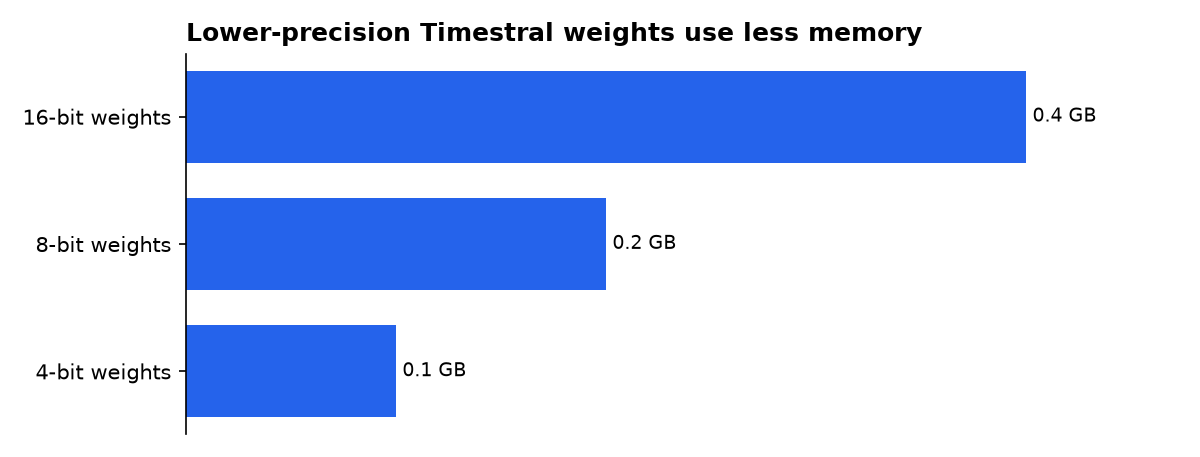
For a local deployment, this matters more than the phrase “209M parameters” suggests. The model’s 0.8 GB published file is portable enough for ordinary servers. But a buyer should test quantized versions against the original forecast quality before treating the 8-bit or 4-bit estimates as production settings.
How does Timestral compare with TimeGPT?
Timestral and TimeGPT are both foundation-model approaches to forecasting, but the verified buying facts differ. Timestral provides downloadable weights and standalone inference code. Nixtla’s documented TimeGPT path starts with an API key and its Python client.
Nixtla’s quickstart identifies timegpt-2.1 as the default forecast model. It shows a 12-month example and says users should provide a continuous timestamp sequence with numeric targets. That is an accessible API route for a team that wants fewer model-serving decisions.
Nixtla’s public SDK repository describes TimeGPT-2.1 as a production forecasting and anomaly-detection model. It also says its earlier TimeGPT training collection contained more than 100 billion public data points. That statement is useful context, but it is not a disclosed parameter count for TimeGPT-2.1.
- Choose Timestral first if local execution, inspectable weights and CPU inference are non-negotiable.
- Choose TimeGPT first if you prefer an API-led Python workflow and do not need a disclosed local checkpoint.
- Do not select either from parameter counts alone. TimeGPT’s parameter count is not stated in the cited official material, so no honest like-for-like parameter comparison is available.
A third-party repost of Mistral’s announcement repeats the 209M claim, but it adds no independent measurement or TimeGPT comparison. That is Tier C corroboration, not evidence that should change a procurement decision.
Can both models handle holidays and promotions?
Yes, both approaches can use information outside the target series, but the buyer must provide that information in a usable form. Timestral calls these past-only or known-future covariates. TimeGPT documentation calls them exogenous variables, meaning external drivers.
Nixtla’s holiday guide shows TimeGPT using holiday flags for both historical data and future dates. It also states that TimeGPT automatically generates standard calendar features. A retailer can therefore supply a promotion calendar or holiday indicators rather than hoping the model infers a one-off event.
Timestral’s known-future covariates solve the same core problem. A planned shutdown, a published holiday or a weather forecast is known before the outcome arrives. Put that into the forecast input; do not expect zero-shot weights to know your next price change or local event.
This is where a human-designed workflow still matters. Neither model turns correlation into causation. If a company asks, “What would happen if we cut price?”, it needs a tested intervention design, not merely a forecast conditioned on a price column.
Do Mistral’s benchmark claims settle the choice?
No. Mistral says its 209M checkpoint ranks first on GIFT-Eval, TIME and fev-bench among the listed pre-trained, zero-shot models. The company also says its 28M model beats Chronos-2 on GIFT-Eval and TIME. Those are meaningful vendor claims, but buyers should reproduce the decision on their own held-out history.
Latency is also workload-specific. Mistral reports its 5M model forecasts one day from three weeks of 15-minute history in 10 ms. The company reports 140 ms for the 209M model on an eight-thread server CPU. Those figures do not tell a retailer’s batch time for thousands of products or a utility’s speed for many signals.
TimeGPT’s performance materials make a different operational promise. Nixtla’s scale guide says distributed forecasting can reduce compute time by 10–100x, depending on the dataset and cluster. That is a framework-level claim, not a direct model-speed test against Timestral.
Which Timestral size should a buyer pick?
Start with the smallest Timestral model that clears your backtest target. Mistral publishes four checkpoints: 5M, 28M, 123M and 209M parameters. The family shares one architecture and inference interface, which makes a size trial less disruptive than changing model families.
- Timestral-5M: use it for high-volume scoring, edge-like CPU limits or a fast first baseline.
- Timestral-28M: use it when the smallest model misses important patterns but latency still matters.
- Timestral-123M: test it when related signals or complex cycles justify more capacity.
- Timestral-209M: use it when the extra accuracy survives a backtest and 140 ms vendor latency fits the service budget.
An unofficial Timestral explainer describes a web demo and an API credit system, but Mistral’s official announcement and model card do not establish those terms. Treat those product details as Tier C until Mistral publishes a pricing or service page.
What should a forecasting team actually do?
Run Timestral-5M, Timestral-28M and Timestral-209M against your current baseline first. Use identical historical cutoffs and the same forecast horizon. Keep the simplest model if its error and uncertainty ranges meet the operational target.
Then run TimeGPT-2.1 through its API on the same data. Include the calendar, promotion, weather or schedule columns that are genuinely known at forecast time. Compare the full cost: engineering effort, data handling, request latency, runtime control and forecast quality.
Use Timestral when your buyer requirement is local numerical inference with published weights. Use TimeGPT when an API-managed workflow is the better fit. Use an LLM only around either forecaster for explanation, retrieval and action planning, not as a substitute for the forecast test.
What we could not verify?
No public material cited here gives TimeGPT-2.1’s parameter count, its model-file size, or a benchmark table directly matched against Timestral-209M. Nixtla could settle those points by publishing an architecture card, weight details or a controlled comparison.
Mistral has not published a public price sheet for Timestral inference, a universal hardware-memory requirement, or an independent benchmark audit in the material cited here. Mistral could settle those questions with a service pricing page, reproducible evaluation code and workload-specific serving guidance.
No public evidence here proves that Timestral beats a properly engineered language-model workflow on a common production dataset. A buyer can settle that only with a shared backtest, including the same covariates, cutoffs, horizon and business metric.
Sources
- Mistral AI — Timestral-209M model card
- Mistral AI — Introducing Timestral
- Mistral AI — Timestral inference repository
- Nixtla — TimeGPT SDK repository
- Nixtla — TimeGPT-2.1 quickstart
- Nixtla — Holidays and special dates guide
- Nixtla — Distributed forecasting guide
- Timestral.org — What Is Timestral
- SPKE — repost of Introducing Timestral

