
FuturPulse analysis · 3 October 2026
Best AI for math on 3 October 2026 is a stack: use Photomath’s $0 Basic plan for scanned homework, Wolfram|Alpha Pro at $5 a month when billed annually for symbolic steps, and BootLoops for research calculations that need certified error bounds.
At a glance
- Photomath Basic costs $0 and includes step-by-step explanations for ordinary school problems.
- Wolfram|Alpha Pro costs $60 annually, equivalent to $5 a month, and adds step-by-step solutions.
- GeoGebra’s calculators are free for graphing, geometry, 3D work and symbolic algebra.
- ChatGPT Go costs $8 a month in the United States, but it should explain and draft rather than act as the final calculator.
- BootLoops 1.0 contains 49 tool packages with self-tests and verification protocols for quantitative science.
The important distinction is between a fluent answer and a checked result. A large language model, or LLM, predicts useful text from patterns. It can explain a substitution or suggest a method. It does not automatically prove that its arithmetic, assumptions and units are right.
That matters more as the task moves from algebra to statistics, engineering or theoretical physics. The best choice is therefore not one app. It is a workflow that gives each tool a narrow job, then makes a second system check the result.
Which AI should you use for each maths job?
For most students, Photomath or Wolfram|Alpha is the better first stop than a general chatbot. Photomath is built around photographed questions and worked steps. Wolfram|Alpha is a computational engine, meaning it calculates rather than returns web links, according to Wolfram|Alpha’s own explanation.
Use a general LLM when the hard part is language. It can translate a dense word problem into variables, propose a study plan, or explain why a derivative rule applies. Then pass the actual expression to a dedicated calculator, computer algebra system or statistics package.
For geometry, a graph is often more valuable than another paragraph. GeoGebra’s free Calculator Suite combines algebra, geometry and 3D tools, while its separate CAS Calculator can solve equations, factor expressions and find derivatives and integrals. That makes it the practical free visual companion to an AI explanation.
- Middle and high school homework: scan with Photomath, then redo one step yourself.
- Calculus and symbolic algebra: use Wolfram|Alpha or GeoGebra CAS to check the expression.
- Graphs and geometry: use GeoGebra, because you can inspect the shape rather than trust prose.
- Statistics with a real dataset: use a reproducible software workflow, not a chat response alone.
- Physics or research maths: ask an LLM to plan, but send the computation to certified or independently checked tools.
What should a buyer actually pay for?
The decision table below separates a product’s listed price from claims that need stronger evidence. “Vendor-verified” means the price or feature is stated on the operator’s own page. “Executive or publisher claim” means a company or editorial page asserts a capability without publishing a reproducible accuracy test. “Untraceable” means a number should not decide a purchase.
| Concrete option | Exact listed figure | Best use | Weakness to plan around | Evidence tier |
|---|---|---|---|---|
| Photomath Basic | $0 | Photo-based school maths and readable worked steps. | It is not a proof checker or a research computing environment. | A — vendor-verified price |
| Photomath annual plan | $69.99 per year | Extra visual aids and “how” and “why” prompts. | The paid upgrade does not turn an image reader into an independent verifier. | A — vendor-verified price |
| Wolfram|Alpha Basic | $0 with sign-in | Quick computational checks without step-by-step working. | It does not include the detailed solution feature. | A — vendor-verified price |
| Wolfram|Alpha Pro, annual billing | $60 per year | Symbolic steps, practice problems and more computation time. | It still needs sensible input and a human check of the modelled problem. | A — vendor-verified price |
| ChatGPT Go | $8 per month in the US | Explaining methods, reformulating word problems and drafting code. | Its answer is not a certificate of numerical correctness. | A — vendor-verified price; capability must be checked per task |
| GeoGebra calculators | $0 for non-commercial users | Graphs, dynamic geometry, 3D visualisation and CAS exploration. | Commercial use needs a separate licence arrangement. | A — vendor-verified price and licence terms |
A lower price does not mean a weaker learning tool. It usually means the tool has a more limited job. The sensible purchase is the smallest option that lets you inspect the maths, not merely receive an answer.
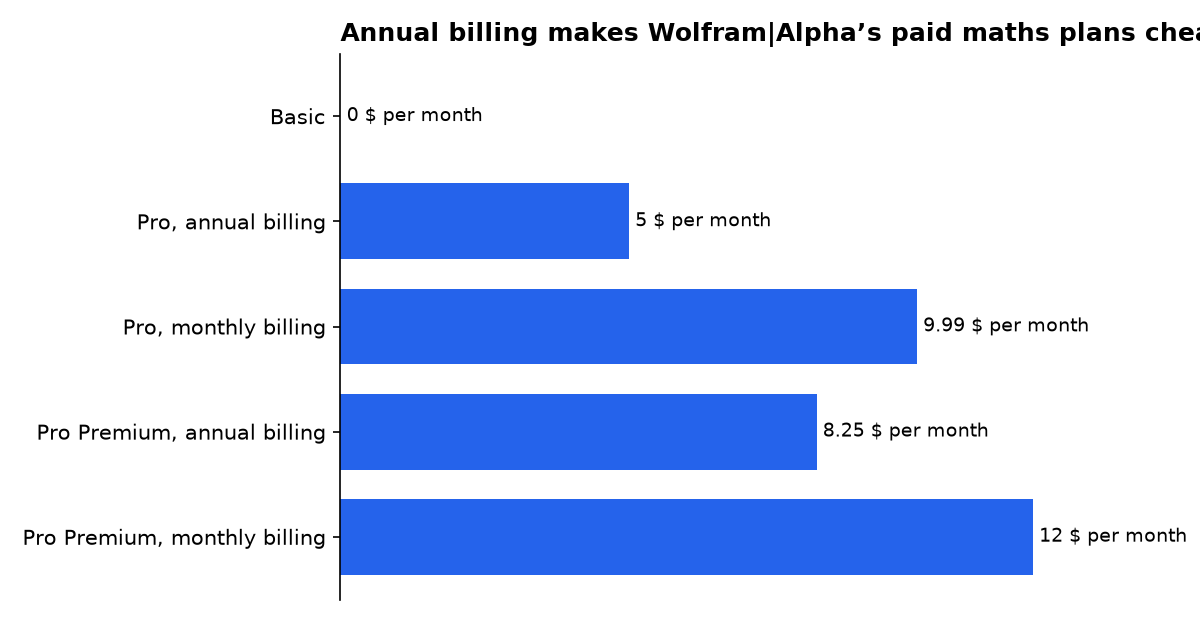
Wolfram|Alpha’s paid choices show why billing details matter. Pro is $5 monthly on annual billing or $9.99 month-to-month; Pro Premium is $8.25 monthly on annual billing or $12 month-to-month. Annual billing is cheaper only if you expect to use the service for the full year.
Is free AI enough for maths homework?
Yes, free tools are enough for a large share of routine homework, if you use them to check rather than copy. Photomath lists its Basic tier at $0, including step-by-step explanations. GeoGebra says its software and web services are free of charge for non-commercial users, which usually includes students and teachers.
A free workflow can be simple. Photograph the question in Photomath, reconstruct the solution on paper, then plot the result in GeoGebra if the problem involves a function or shape. If the two outputs conflict, stop and find the missing condition instead of voting for the nicer explanation.
Do not treat “free” as permission to skip checking. Photo tools can misread a minus sign, exponent, interval bracket or handwritten variable. Chatbots can accept a poorly stated question and then solve the wrong problem with impressive confidence.
Several comparison pages describe large amounts of testing, but their results should not be treated as an industry benchmark. AI Tutor says it spent more than 100 hours testing apps, while ApexVision says it tested 10 tools for 60 hours. Neither page publishes a complete, independently rerunnable test set in the material cited here.
Should ChatGPT or Gemini be your maths solver?
Use a chatbot as a tutor and coordinator, not as the authority that signs off a calculation. That price buys access to a general assistant, not a guarantee that each mathematical answer has been verified.
A good prompt asks for assumptions before calculation. Tell the model to define symbols, preserve units, show an independent check and state where a calculator should take over. Those requests improve the audit trail, but they do not replace it.
There is a technical reason for caution. A paper submitted on 29 September 2026 found that 13 base transformer models reliably followed only 1.4 to 3.6 lines of a reference chain in its task. That is not a score for school algebra, but it is a useful warning: long, apparently coherent reasoning can exceed what the base model actually tracks.
The same preprint reports that a task-trained rank-8 LoRA, a small adapter added to a frozen model, raised Qwen3-8B from 15.5% to 99% exact accuracy on its 24-line chain task. The result is promising research, not a consumer product recommendation, and it reinforces the central rule: tool use and verification can matter more than picking a chatbot by brand.
When should an LLM call certified tools?
An LLM should call a specialised tool when the cost of a wrong answer is higher than the inconvenience of checking it. That threshold arrives quickly in physics, financial modelling, published research, safety calculations and statistical inference. “Certified” here means the tool carries a proof, an error bound or a completeness check, rather than merely producing a plausible decimal.
BootLoops 1.0 describes itself as a model-independent harness for precision quantitative science. Its repository says its tools cover certified quadrature, recurrence proofs, ball arithmetic and exhaustive enumeration with completeness certificates. Ball arithmetic represents a value with a proven error radius, so hidden rounding and truncation uncertainty is less likely to disappear from the final answer.
That is a different category from an AI homework app. BootLoops is not a one-click replacement for learning calculus. It is a collection of scientific instruments and protocols that an agent can drive, with tests that define what an acceptable result must pass.
BootLoops says a fresh installation can run self-tests across 49 packages, though three stop with named errors when required data is not included. That sort of explicit failure is useful. A system that tells you what it could not validate is safer than one that quietly returns a polished answer.
What is best for physics and statistics?
For introductory physics, start with the same stack: let an LLM unpack the wording, use a graphing or symbolic tool for the maths, and perform a units check yourself. A numerical answer without dimensions is not a finished physics answer. If the problem uses measured data, preserve the dataset and the calculation steps.
For classroom modelling and technical coursework, MATLAB is a conventional paid option rather than an AI tutor. MathWorks lists an individual standard annual licence at $940, excluding tax, while students may already have access through a campus-wide licence. That is a professional software decision, not an economical answer for occasional homework.
For statistics, require reproducibility. Save the data, transformations, random seed where relevant and the exact model specification. An LLM can help write or explain a script, but it should not be the only record of how a confidence interval, forecast or model comparison was produced.
For advanced mathematical physics, start from a toolchain designed to report uncertainty. BootLoops says its toolkit can use convergent methods with certified error bounds where possible, and state statistical error bars where sampling remains necessary. That is the standard a research calculation should aim for, even if you use different software.
How do you check an AI maths answer?
The fastest reliable check is usually not another chat prompt. Use a different representation of the same maths. Substitute the claimed answer back into the original equation, estimate its size, graph it, or calculate it with a second system.
- Algebra: substitute the solution into the original equation and test excluded values.
- Calculus: differentiate an antiderivative, or compare a numerical approximation at one sensible point.
- Geometry: draw the construction and inspect whether the stated relationship survives movement.
- Statistics: check sample size, units, missing-data treatment and whether the conclusion outruns the data.
- Physics: check dimensions before deciding that a decimal result is meaningful.
Choose a tool that exposes intermediate work. Wolfram|Alpha Pro says it supports uploads in more than 60 formats and offers downloadable results, while GeoGebra exposes equations, graphs and tables side by side. Visible working is not proof, but it makes errors easier to locate.
What should you actually do?
Students should begin with the free pair: Photomath for reading a question and GeoGebra for seeing the maths. Pay for Wolfram|Alpha Pro only if step-by-step symbolic work is a regular need. Use ChatGPT Go if you need help framing questions and explanations, but never make it the final checker.
Teachers should use an LLM to generate variants, explanations and prompts, then validate every answer with a calculator or symbolic system before distribution. Geometry lessons should use interactive visual tools. Statistics lessons should save code and data, because students need to see how results can be reproduced.
Researchers and engineers should reverse the default. Begin with the formal solver, statistical package or certified workflow. Use the LLM to orchestrate, document and review the work. If an answer could change a design, paper, diagnosis or financial decision, require an independent numerical check or a certificate.
What we could not verify?
No public, independently reproducible league table establishes one AI as the best solver across arithmetic, proofs, statistics, geometry and physics. Rankings that cite testing often publish a verdict without releasing the full problem set, scoring rules, raw outputs and model versions needed to reproduce it.
We also could not verify a public accuracy rate that compares current consumer math apps on the same advanced problems. Vendors could settle that with versioned benchmark sets, disclosed failure cases and independent reruns. Schools and research groups could do better still by publishing the checks that matter in their own courses and fields.
The practical answer remains clear: buy the explanation layer only when it helps you learn, and use certified or independently checked computation whenever being confidently wrong would cost more than a few extra minutes.
Sources
- Photomath pricing and plan features
- Wolfram|Alpha Pro pricing
- Wolfram|Alpha FAQs
- GeoGebra calculators and downloads
- GeoGebra licence terms
- OpenAI announcement of ChatGPT Go worldwide availability
- BootLoops 1.0 repository
- “Transformers Stop Thinking Too Early, and a Tiny LoRA Fixes It”
- MathWorks pricing and licensing
- AI Tutor’s math app comparison
- ApexVision’s maths tool comparison

