

FuturPulse analysis · 21 October 2026
DeepSeek upgraded DeepSeek V4.1 Flash to V4.1-Flash-1017 on 17 October 2026. The new checkpoint raised DeepSWE v1.1 from 74.2 to 77.0, but its dedicated OpenRouter listing costs more than the previous V4.1 Flash listing. The naming trap is that deepseek-flash now silently serves 1017.
At a glance
- DeepSeek’s official API alias
deepseek-flashnow serves DeepSeek-V4.1-Flash-1017, while legacy V4 Flash aliases are also routed to it. - DeepSeek reports a 42.3 result on Terminal-Bench 4.0, up from 31.2 for the September V4.1 Flash checkpoint.
- OpenRouter lists V4.1 Flash 1017 at $0.15 per million input tokens and $0.60 per million output tokens.
- Our calculation puts 1,000 medium agent steps at $5.70 through the listed 1017 route, versus $2.22 for the earlier V4.1 Flash listing.
- The published 1017 weights total 510.3 GB on disk, so this is not a casual local-model download.
What changed in DeepSeek V4.1 Flash 1017?
DeepSeek V4.1 Flash 1017 is a post-training refresh, not a new architecture family. DeepSeek’s model card calls it a minor update and says it improves reasoning, coding, tool-using agents and visual benchmarks. It also claims shorter task runtime and shorter outputs.
The important limitation is that DeepSeek did not publish a percentage reduction for either runtime or output length. The change is therefore real as a vendor claim, but the size of the claimed token saving remains unquantified. That distinction matters because output tokens, including hidden reasoning in supported modes, are often the costly part of an agent workflow.
The version label means “the 17 October checkpoint,” not a separate premium tier. DeepSeek’s current API quick-start page says deepseek-flash is served by V4.1-Flash-1017. It also says retired deepseek-v4-flash and deepseek-v4-flash-vision-exp requests now go to 1017 at Flash billing.
deepseek-flash changed model behavior on 17 October. Treat this as a production model upgrade, even if no code or model string changed.
How much did the benchmark results improve?
DeepSeek V4.1 Flash 1017 improved on every directly comparable result in DeepSeek’s release table. The largest practical jump is Terminal-Bench 4.0, a test of terminal-based technical work, where the score rose from 31.2 to 42.3. DeepSeek ran that test with the Claude Code harness.
| Benchmark | September V4.1 Flash | V4.1 Flash 1017 | Change | What it measures | Evidence tier |
|---|---|---|---|---|---|
| HLE, without tools | 36.8 | 42.6 | +5.8 | Hard multidisciplinary reasoning without external tools. | Vendor-published result |
| Terminal-Bench 4.0 | 31.2 | 42.3 | +11.1 | Finishing technical tasks in a command-line environment. | Vendor-published result |
| DeepSWE v1.1 | 74.2 | 77.0 | +2.8 | End-to-end software-engineering tasks. | Vendor-published result |
| ProgramBench | 20.3 | 29.1 | +8.8 | Programming work beyond a single short code answer. | Vendor-published result |
| Automation-Bench v1.0.6 | 54.8 | 60.5 | +5.7 | Multi-step business and software workflows using tools. | Vendor-published result |
| Chartography, with tools | 78.9 | 83.0 | +4.1 | Working with charts when tools are available. | Vendor-published result |
The official release table also puts 1017 at 68.2 on NL2Repo-Bench and 35.4 on Agents’ Last Exam. These are useful signals for coding agents and computer-use workflows, but they are still DeepSeek’s published runs. They should guide a short-list, not replace testing on your repository, tools and prompts.
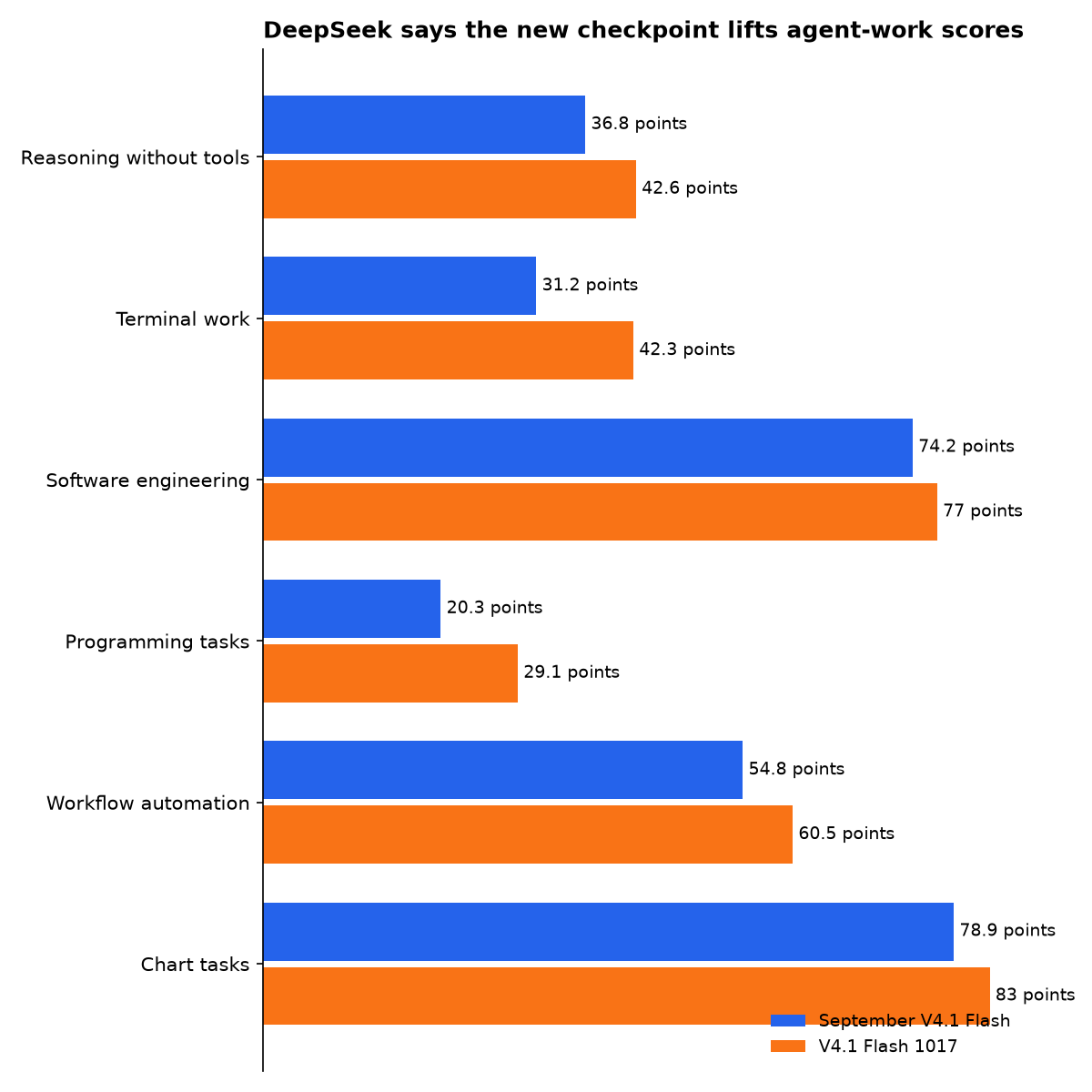
There is one benchmark-reading rule worth keeping: do not compare harness-dependent results as though they were raw model IQ. DeepSeek states that it used Claude Code for Terminal-Bench 4.0 and Mini-SWE-V2 for DeepSWE v1.1. The model, prompts, tools, time limits and agent loop can all influence the result.
AI Release Tracker’s listing records the 42.3 Terminal-Bench 4.0 score and 77% DeepSWE score, but it also shows why a buyer should be cautious: published benchmark rankings combine lab figures and outside tracking, rather than a single independently replicated test suite.
Is V4.1 Flash 1017 cheaper than V4.1 Flash?
No, not if you select the separately named 1017 route in the current OpenRouter catalogue. OpenRouter’s listed prices show earlier V4.1 Flash at $0.05 per million input tokens and $0.38 per million output tokens. The 1017 listing is $0.15 input and $0.60 output.
This appears to conflict with DeepSeek’s statement that API pricing is unchanged. It does not necessarily mean either page is wrong. DeepSeek is describing its own Flash alias and billing; OpenRouter is a marketplace with separately listed model routes and provider economics. Price claims need a provider name attached to be meaningful.
Tokens are the chunks of text a model reads and writes. Input tokens are the prompt, prior conversation and attached text. Output tokens are the response, including any billable reasoning or tool-oriented work. Output usually drives the bill for agent tasks because it costs more per million tokens.
| Concrete API option | Input price | Output price | Context | 1,000 chat turns | 1,000 agent steps | Evidence tier |
|---|---|---|---|---|---|---|
| DeepSeek V4.1 FlashOpenRouter listing | $0.05/M | $0.38/M | 1,048,576 tokens | $0.24 | $2.22 | Marketplace price + our calculation |
| DeepSeek V4.1 Flash 1017OpenRouter listing | $0.15/M | $0.60/M | 1,048,576 tokens | $0.45 | $5.70 | Marketplace price + our calculation |
| DeepSeek V4.1 Flash batchOpenRouter listing | $0.05/M | $0.15/M | 1,048,576 tokens | $0.12 | $1.80 | Marketplace price + our calculation |
| DeepSeek V4 Flash 0423OpenRouter listing | $0.09/M | $0.18/M | 1,048,576 tokens | $0.18 | $3.09 | Marketplace price + our calculation |
| DeepSeek V4 Flash Vision ExpOpenRouter listing | $0.22/M | $0.65/M | 1,048,576 tokens | $0.54 | $7.76 | Marketplace price + our calculation |
Our cost calculation uses three fixed request profiles from the published list prices: a chat turn uses 1,000 input and 500 output tokens; a retrieval-augmented answer uses 8,000 input and 500 output tokens; an agent step uses 30,000 input and 2,000 output tokens. The table’s agent column is the important one for coding workflows because long prompts and generated actions dominate the bill.
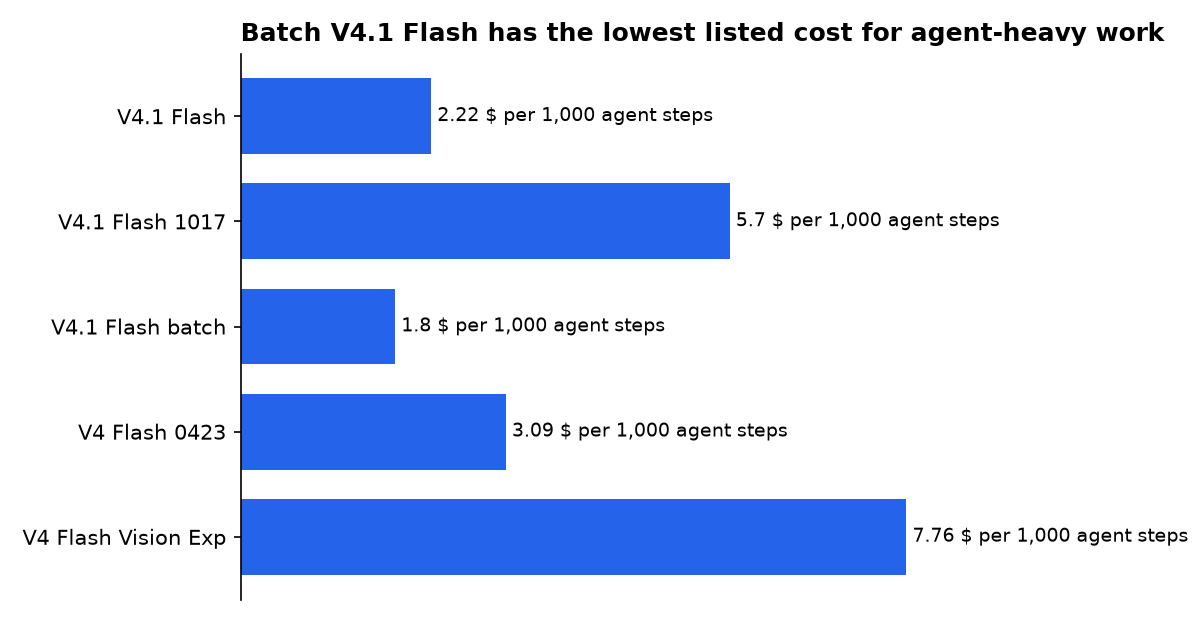
That does not settle the real cost question. If 1017 completes the same job with materially fewer generated tokens, it can narrow or erase its higher listed rate. But DeepSeek has not published the percentage saving, so a buyer cannot calculate the break-even point from official information alone.
Does shorter output make 1017 more efficient?
Possibly, but the answer is not public yet. DeepSeek says DeepSeek V4.1 Flash 1017 reduces output length and task time. A shorter response can save money because the 1017 OpenRouter output rate is $0.60 per million tokens, four times the $0.15 batch output rate listed for V4.1 Flash batch.
For a simple break-even example, 1017’s $0.60 output rate is about 58% higher than the $0.38 output rate listed for the older V4.1 Flash route. It would therefore need to generate substantially fewer output tokens on equivalent work to beat that earlier route on output cost. Your actual result depends on thinking effort, tool loops, retries and how much context you send.
An eesel review cites an anecdotal claim of roughly 20% fewer tokens at each reasoning effort. That is not a controlled public benchmark, and it is not a DeepSeek-published percentage. Treat it as a test hypothesis, not a purchasing fact.
- Log prompt tokens, completion tokens, tool calls and wall-clock time before switching.
- Run a matched set of real tasks through your current route and the 1017 alias.
- Measure success rate first, then cost per completed task.
- Keep a model version pin or rollback route for tasks where output format matters.
What does the 1017 naming trap mean?
The naming trap is that the name developers type is not the checkpoint name they receive. DeepSeek says deepseek-flash now maps to DeepSeek-V4.1-Flash-1017, and legacy V4 Flash names remain accepted but route to the same newer checkpoint. A codebase can therefore move from the September V4.1 Flash behavior to 1017 without changing its configuration.
DeepSeek’s change log says this update also reached the official web and app products. That makes the suffix useful when discussing test results, but less useful as a durable production pin. Ask any provider whether its model ID refers to a fixed snapshot or a moving alias.
Third-party model catalogues can make this more confusing. ModelsLab lists an explicit 1017 model ID and a $0.15 input, $0.60 output rate. Those figures match the OpenRouter 1017 listing, but they are a reseller’s route, not proof of DeepSeek’s own direct billing terms.
Can you run DeepSeek V4.1 Flash 1017 locally?
You can obtain the weights under an MIT licence, but most individuals should not plan to run the full release locally. DeepSeek’s published Hugging Face entry labels the model as 763B parameters. The earlier V4.1 Flash card describes a mixture-of-experts design with 552B backbone parameters and 16B active parameters during decoding.
Those figures are not contradictory. “Active parameters” describes the subset used for one token in a sparse mixture-of-experts model. It does not mean the full checkpoint fits into 16B parameters of memory. The full weight package and its serving cache still determine the hardware burden.
| Full 1017-weight scenario | Exact figure | What it means | Evidence tier |
|---|---|---|---|
| Published safetensors on disk | 510.3 GB | Download and storage alone exceed most workstation SSD space. | Published file total |
| Weights at 16-bit precision | 1,526.4 GB | Raw parameter arithmetic, before runtime memory and context cache. | Our calculation |
| Weights at 8-bit precision | 763.2 GB | Still a data-centre-scale memory requirement for the full model. | Our calculation |
| Weights at 4-bit precision | 381.6 GB | A compression estimate, not a tested minimum hardware specification. | Our calculation |
Our arithmetic assumes 763.2 billion declared parameters, multiplied by 2 bytes at 16-bit precision, 1 byte at 8-bit precision and 0.5 byte at 4-bit precision. It excludes the KV cache, the memory that stores prior-token attention state, plus framework overhead and extra capacity needed for usable context.
DeepSeek’s September V4.1 Flash card recommends a 1 million-token context window and describes compression methods intended to reduce that cache. That helps serving economics, but it does not make a full 510.3 GB checkpoint a laptop deployment.
Which DeepSeek V4.1 Flash option should you buy?
Choose the route, not the headline. DeepSeek V4.1 Flash 1017 is the sensible starting point for tool-using coding and workflow experiments because its published benchmark gains are clear. It is not automatically the lowest-cost option through every intermediary.
| Your job | Concrete choice | Why | Evidence tier |
|---|---|---|---|
| Existing DeepSeek direct API app | Test deepseek-flash now |
The alias already routes to 1017, so validate changed outputs and tool behavior. | Vendor API statement |
| Low-cost overnight generation | Compare V4.1 Flash batch at $1.80 per 1,000 agent steps | The listed batch output rate is lower than the listed 1017 route. | Marketplace price + our calculation |
| Interactive coding agent | Trial 1017 against your current model | DeepSeek reports higher Terminal-Bench, DeepSWE and automation scores. | Vendor-published result |
| Full local deployment | Do not assume a workstation fit | The published weight package is 510.3 GB before runtime memory needs. | Published total + our calculation |
For a second independent signal, Artificial Analysis lists 1017 at 45 on its Intelligence Index, with 208.7 output tokens per second in its reported setup. Those results are useful for broad comparison, but they are not a substitute for testing your chosen provider, which may use different infrastructure and precision.
What we could not verify?
DeepSeek has not published the exact percentage reduction in task runtime or output tokens for DeepSeek V4.1 Flash 1017. It also has not published a provider-neutral cost-per-completed-task figure that would establish whether shorter output offsets higher reseller token rates. DeepSeek could settle both questions with matched workloads, token totals and configuration details.
There is also no public independent reproduction covering the full set of claimed 1017 benchmark gains. Data Phoenix notes that gap, while accurately separating DeepSeek’s own figures from outside evidence. Benchmark maintainers, hosted providers and enterprise users could settle it by releasing repeatable runs with disclosed harnesses, prompts and model routes.
Sources
- DeepSeek API change log
- DeepSeek API quick-start and model alias notes
- DeepSeek-V4.1-Flash-1017 model card
- DeepSeek-V4.1-Flash model card
- OpenRouter model catalogue and list prices
- AI Release Tracker model page
- Artificial Analysis model profile
- ModelsLab 1017 route listing
- eesel builder review
- Data Phoenix release coverage

