
On 27 August 2026, Z.ai’s GLM Flash Latest launched as a moving model alias with no fixed price. For a business starting AI now, use Mistral’s Timestral-209M for numeric forecasts or Datalab’s Indra OCR for document intake before giving a general-purpose agent authority to act. (openrouter.ai)
At a glance
- Mistral AI Timestral-209M accepts up to 32,768 historical time steps and forecasts up to 1,024 more in one pass. (huggingface.co)
- Datalab Indra OCR downloads about 76 MB on first use and runs on CPUs rather than requiring a GPU. (huggingface.co)
- Z.ai GLM 5.3 Flash, the current target shown for the alias, lists $0.0399 per million input tokens and $0.0784 per million output tokens. (openrouter.ai)
- The GLM Flash Latest name can route to a model with up to 1,048,576 tokens of context, but the actual model and bill can change. (openrouter.ai)
Which AI model should a business choose first?
The first choice should match the job, not the widest model capability. A forecasting model predicts a measured series, such as daily sales. Optical character recognition, or OCR, turns a scanned invoice into usable text. A general-purpose model reads instructions and drafts, classifies, or calls software tools.
That division matters because a business can measure whether a narrow model improved a process. Compare a forecast with actual demand. Compare extracted fields with the invoice. Those checks are simpler than judging an agent that searched, wrote, chose a tool, and changed a record.
| Concrete option | Buy or deploy it for | Exact published limit or footprint | What it should not decide alone | Evidence tier |
|---|---|---|---|---|
| Mistral AI Timestral-209M | Demand, staffing, cash-flow, inventory, and other time-series forecasts. | 32,768 historical steps; 1,024 forecast steps; 0.2 billion parameters. | Whether to place a purchase order, change a price, or approve spending. | PRIMARY MODEL CARD |
| Datalab Indra OCR | Turning PDFs, scans, forms, and images into markdown, text, or structured JSON. | About 76 MB on first run; about 210 ms per page on four CPU cores. | Payment release, contract approval, or handwritten-data decisions without review. | PRIMARY PROJECT README |
| Z.ai GLM Flash Latest | Supervised summaries, triage, drafting, and controlled tool workflows after inputs are clean. | Up to 1,048,576 tokens of context; no fixed alias price. | Unreviewed actions in accounting, hiring, customer commitments, or production systems. | PLATFORM LISTING; MUTABLE ALIAS |
| Claims of a fully autonomous business agent | None until its model version, permissions, cost basis, and evaluation method are written down. | No verifiable figure supplied for a safe autonomy threshold. | Everything that changes money, rights, records, or customer commitments. | UNTRACEABLE RUMOUR OR UNSPECIFIED CLAIM |
The table separates a published product limit from an operational promise. A model’s input limit is not a guarantee that a business workflow is accurate, compliant, or safe.
Where does Timestral-209M fit?
Mistral AI Timestral-209M fits before an agent when the business already has ordered numbers: sales by day, stock by week, call volume by hour, or cash receipts by month. The model supports one series or several related series, plus known future inputs such as a planned promotion or holiday. (huggingface.co)
Its output includes 21 quantiles, which are forecast ranges rather than one falsely precise answer. That gives a planner a low, middle, and high case. The sensible use is to send those scenarios to a human dashboard, not directly to an ordering system. (huggingface.co)
By our calculation from the published 0.2-billion-parameter checkpoint, Timestral-209M’s weights alone need about 0.4 GB at 16-bit precision. That falls to about 0.2 GB at 8-bit precision and about 0.1 GB at 4-bit precision; the published safetensors weights total 0.8 GB on disk. These are file-based estimates, not hardware tests. (huggingface.co)
The main warning is also practical: forecasting does not repair messy history. A series with missing sales, changed product codes, or unexplained stockouts needs cleaning and a baseline comparison first. The model card reports benchmark scores, but those results do not establish accuracy for a particular company’s calendar, products, or sales process. (huggingface.co)
Can Indra OCR prepare business records?
Datalab Indra OCR is a useful first AI layer for paper-heavy work because it converts documents before another system tries to reason over them. It can output markdown, plain text, or JSON with text boxes and page layout. That makes it suitable for invoice queues, intake packets, archived reports, and searchable internal records. (huggingface.co)
The published project says its default download is about 76 MB, split between 30 MB of networks and 46 MB of language models. It also says the main Latin recognizer has about 1.25 million parameters, while the standard model set totals 7.3 million parameters. (github.com)
Indra OCR is not a claim that every document can be trusted automatically. Datalab says complex tables, handwritten pages, degraded scans, and some scripts are weak areas. Its documented handwriting result is 25.2% on the cited OmniParseBench handwriting tests, so a company should route handwriting and low-confidence fields to review. (github.com)
Commercial terms also need attention. The project says its code is Apache 2.0, while the weights use a modified OpenRAIL-M license; it describes free use for startups under $20 million in funding or revenue, with restrictions on competing with Datalab’s API. That is a licensing check for procurement, not an implementation detail to skip. (huggingface.co)
When should GLM Flash Latest run an agent?
Z.ai GLM Flash Latest should run an agent only after the business has narrowed the task, tested the output, and restricted what the workflow can change. The listing says the alias always redirects to the latest GLM Flash family model. That means a successful test today does not pin the exact model behavior or price for a later run. (openrouter.ai)
The alias accepts text, images, and video, then returns text. It can route to models with as much as 1,048,576 tokens of context, meaning it can read a very large set of the public record in one request. Long context is useful for review, but it does not turn the output into verified business evidence. (openrouter.ai)
For a stable price test, pin the concrete GLM 5.3 Flash endpoint rather than the Latest alias. OpenRouter lists $0.0399 per million input tokens, $0.0784 per million output tokens, and $0.03 per million cached-input tokens for that named model. Tokens are the chunks of text a model reads and bills by. (openrouter.ai)
Those rates are low enough to make supervised pilots realistic. They are not a complete agent budget. Tool calls, retrieval systems, retries, logging, human review, and the consequence of a wrong action still determine the real cost.
How is AI used in businesses?
AI is used in businesses most safely when it removes a clear bottleneck: reading incoming documents, forecasting a repeated measure, sorting requests, or drafting a response for review. Indra OCR can make source files searchable and structured. Timestral-209M can turn a clean historical series into a forecast range. GLM Flash can then explain the numbers or draft a follow-up without becoming the system of record. (huggingface.co)
The order is important. First, preserve the original invoice or source report. Second, extract fields with confidence data. Third, calculate or forecast. Fourth, let a language model summarize the result for a person. The human remains responsible for approvals, exceptions, and anything that affects customers or money.
How do the costs change as work grows?
A small business can test hosted document processing without immediately building its own service. Datalab’s published pricing lists a free tier at $0 plus usage, a Launch plan at $25 per month, and a Team plan at $400 per month. The same page says the free tier includes up to $20 of one-time hosted API credit. (datalab.to)
| Datalab hosted plan | Exact monthly plan price | Published rate limit | Best decision use |
|---|---|---|---|
| Free | $0 plus usage | 25 requests per minute | Check whether extracted invoice and form fields are useful. |
| Launch | $25 per month | 400 requests per minute | Run a steady, small document workflow. |
| Team | $400 per month | 400 requests per minute | Production teams needing the listed BAA and DPA options. |
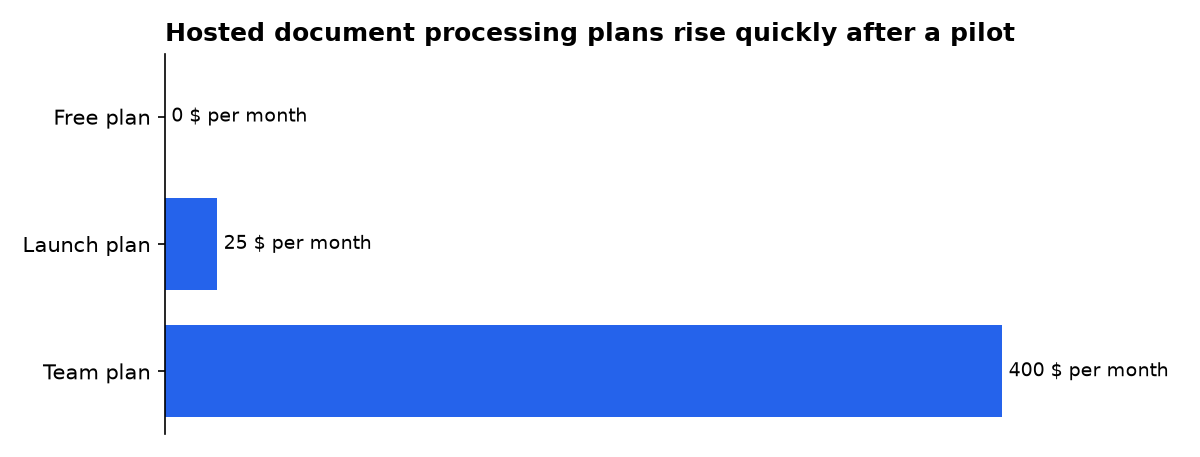
The chart does not include API usage charges, which the pricing page bills separately. It shows the decision point: test with a small workload, then pay for a higher operational limit only after staff can show that the extracted records or forecast alerts save more time than they create in review work. (datalab.to)
How should a small business pilot this?
A useful pilot has one source, one measurable output, and one person who can reject errors. Do not begin with a broad instruction such as “automate operations.” Begin with a narrow process that already has a manual answer to compare against.
- Choose one decision-support task. Examples include next-week staffing, invoice-field extraction, or daily lead sorting.
- Keep the original workflow. Run the AI output alongside the existing spreadsheet or review queue.
- Record failures. Tag missing fields, bad forecasts, unclear prompts, and incorrect tool suggestions.
- Set a stop rule. Do not let the system send payments, change customer records, or commit stock automatically.
- Pin versions for evaluation. A moving alias is convenient for exploration, but it weakens repeatable testing.
For Indra OCR, the current package release shown on PyPI is version 1.1.2, released on 20 October 2026. For a repeatable pilot, record that package version, the document sample, the review rules, and the results before upgrading. (pypi.org)
Datalab’s project changelog also says its recent release added model caching behavior and updated model files. That is normal software maintenance, but it reinforces the need to rerun a small acceptance set after upgrades. (github.com)
What we could not verify?
No public figure establishes the forecast accuracy of Timestral-209M on an individual company’s sales history. A business can settle that only by comparing its forecasts against held-out actual results over a stated period.
No public fixed price exists for GLM Flash Latest itself, because the alias bills at the price of the model that serves each request. OpenRouter or Z.ai could settle future cost certainty by publishing a version-pinned contract price for the alias. (openrouter.ai)
There is also no public safety threshold at which a general-purpose agent should approve payments, alter contracts, or change customer records without review. The practical next step is simple: deploy Timestral-209M or Indra OCR on one measurable workflow first, then add GLM Flash only as a supervised explanation and routing layer.
Sources

