
FuturPulse analysis · 6 November 2026
Claude Animated Shorts is a free MIT-licensed skill for making 55-to-70-second vertical cartoon story videos with Three.js inside Remotion, rather than an AI video generator. Its published Bridge example runs for 67 seconds, uses a 2D-character-in-3D-world look, and calls for a local Node, Python, FFmpeg and Remotion setup.
At a glance
- Claude Animated Shorts targets vertical stories lasting 55 to 70 seconds, not quick generated clips.
- The published Bridge composition is 1,080 by 1,920 pixels at 30 frames per second before its 2K export step.
- The skill says its temporary Remotion bundle can copy about 1.3 GB of public assets, so free disk space is a real requirement.
- TypingMind lists 95 bundled files for the skill, including templates, scripts, reference images and instructions.
- Our list-price calculation puts 1,000 long Claude Haiku 4.5 agent steps at $40 through OpenRouter, against $400 for Claude Fable 5.
What is Claude Animated Shorts?
Claude Animated Shorts is a Claude Code skill named cartoon-3d-short. The repository describes a workflow that turns a researched story into a narrated, vertical animation with stylised 2D character cards, a painted Three.js world, sound effects and an original score. It does not claim to generate moving footage from a text prompt.
The important distinction is architectural. Three.js creates the scene: objects, lights, cameras, depth and post-processing. Remotion turns that programmed scene into an editable video composition with a fixed frame count and export process. Three.js documents the basic split as scene, camera and renderer, while Remotion’s renderer exports a selected composition through its command line.
That makes this a code-first animation system. A creator gets reproducibility and editable source files, but must accept the slower work of planning shots, correcting timing and rendering locally. It is closer to a small animation production pipeline than a one-click social-video tool.
What was promised, and what has shipped?
The public record shows a specific, working template rather than a broad platform launch. The skill’s promise is ambitious: a repeatable short-film pipeline. What is visibly shipped is a repository containing instructions, a Bridge template, audio tooling, style references and quality-assurance helpers.
31 October 2026
TypingMind’s listing dates the proven Bridge example to 31 October 2026. It promises a 55-to-70-second cartoon story format, a 30 fps vertical composition and a final 1,440-by-2,560 export. That is a defined delivery target, not a general claim that Claude can make any film.
31 October 2026
The published instructions specify a detailed sequence: research the story, write a script, create or generate a voice track, make word timings, construct shots, render stills, compare them, then export and inspect the final MP4. The same skill page says all reactions should land zero to three frames before the relevant spoken word.
6 November 2026
The GitHub repository currently ships the Bridge source, seven style reports, 38 full-size reference frames, 20 contact sheets and scripts for stills, side-by-side comparisons and frame checks. It also states that the code and documentation are MIT-licensed, while the reference frames are for style study only.
Assessment: the repository has shipped more than a prompt pack. It supplies a working template and a production checklist. It has not publicly demonstrated an automated service that removes the need for local rendering, editorial review or story research.
How do Three.js and Remotion divide the work?
Three.js handles the visual world. In the published Bridge setup, that includes town geometry, painted textures, fog, lighting, camera-relative sun placement, camera moves and a post-processing sequence with ink lines, lens blur, bloom and colour grading. The scene layer is where the distinctive 2D figures inside a 3D town are assembled.
Remotion handles time as frames. The short’s story.ts plan defines shot ranges, transitions, camera keys, impact shakes and depth-of-field changes. A fixed frame timeline matters because the skill aligns visual reactions with word-level narration timing, instead of leaving motion to a live browser animation loop.
That separation is the project’s best technical decision. Three.js is useful when the shot needs parallax, lighting and camera movement. Remotion is useful when a team must revise a line of narration, move a beat, regenerate one composition or render a final file deterministically. Remotion’s official tooling also supports previewing in Studio before export, rather than treating the first encoded file as the only review point.
Which pipeline should creators use for a short?
Use the full Three.js-plus-Remotion pipeline when the story depends on camera depth, repeatable characters and a consistent illustrated world. Use a simpler Remotion motion-graphics project when the point is a chart, captioned voiceover or product interface. Use neither as a substitute for story rights, fact-checking or an editor’s taste.
| Pipeline | Best fit | What the creator edits | Main constraint |
|---|---|---|---|
| Claude Animated Shorts | Narrated history or science stories with a recurring illustrated world | Script, word timings, shots, Three.js scene code and sound cues | Local rendering and a large temporary asset bundle |
| Remotion motion graphics | Explainers, product demos, captions and graphic layouts | React components, copy, graphics and frame timing | Less natural camera depth unless creators build it |
| Three.js-only web animation | Interactive web scenes or live browser experiences | Scene, interaction and browser animation loop | No built-in video production workflow |
The comparison reflects the published implementation. The Animated Shorts repository says it renders Three.js within Remotion; Three.js itself provides the scene-and-camera stack, while Remotion provides the composition export path. Remotion Studio provides a browser preview workflow, which is especially useful before a long final render.
Can Claude generate animated videos with this skill?
Claude can generate and revise the code, shot plan and production files used to render an animated video, but the published skill does not use an AI video generator. The final moving image comes from a programmed Three.js scene rendered through Remotion on the user’s computer.
That distinction changes what “generation” means. Claude can propose a script, organise shots and write scene code. It cannot safely replace the checks that the skill itself requires: reviewing still frames, correcting word timings, inspecting frame glitches and confirming that historical claims are true.
The workflow’s explicit QA stage is more serious than many social-video prompt packs. It calls for checks for black, white, frozen and pop frames, plus loudness and contact sheets. For a creator, this means the output can be audited. It also means a “make it viral” prompt is not a credible production plan on its own.
How much local hardware and storage does it need?
The repository requires Remotion with @remotion/three, Node, Python 3 and FFmpeg. It also warns that every Remotion bundle copies the public folder into the temporary directory, and that folder is about 1.3 GB. The practical implication is simple: set REMOTION_TMP to a drive with room before rendering.
The skill’s documented final command uses H.264 encoding and a 1.3333 scale factor to export a 2K vertical result. Remotion’s official render documentation confirms that the CLI can select a composition, output location and codec. The time needed to render is not publicly specified, so buyers should not assume the 67-second example exports in minutes.
Node should come from the project’s official distribution rather than an unknown binary source. Node.js directs users to its own domains for supported downloads and documentation. The repository does not publish a minimum Node version, minimum RAM figure or supported GPU list.
How much does Claude work cost for this workflow?
Rendering happens locally, but an agent still consumes model tokens: the chunks of text a model reads and bills by. OpenRouter list prices show very different costs between the named Claude options. Our calculation assumes one agent step equals 30,000 input tokens and 2,000 output tokens, repeated 1,000 times.
| Model route | Input and output list price | Estimated 1,000-step cost | What it changes |
|---|---|---|---|
| Claude Haiku 4.5 | $1/M input; $5/M output | $40 | Lowest listed model cost in this comparison |
| Claude Fable 5 batch | $5/M input; $25/M output | $200 | Half the listed non-batch Fable price |
| Claude Fable 5 | $10/M input; $50/M output | $400 | Highest listed cost in this comparison |
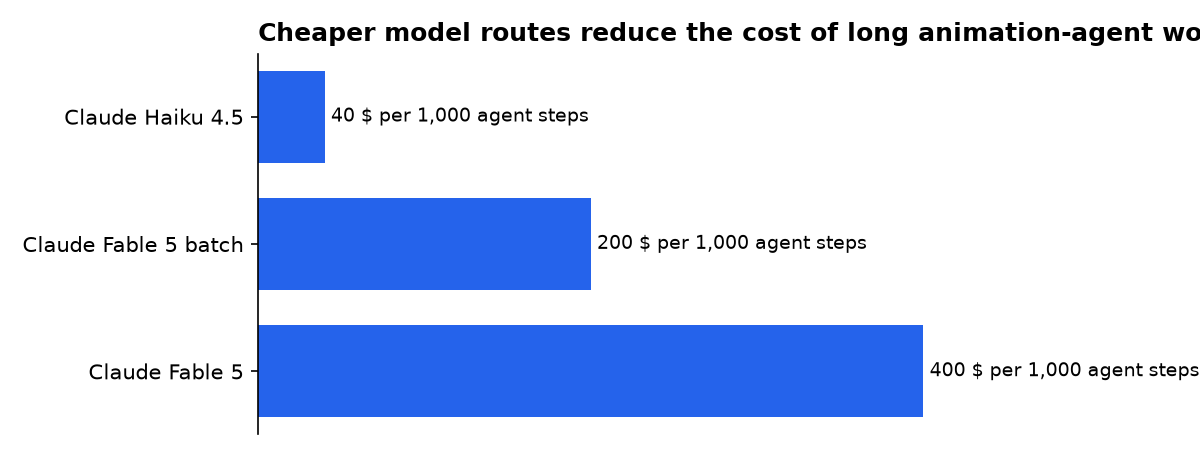
The figures are not a quote for producing one finished short. They are FuturPulse calculations from the listed per-million-token prices and the stated usage assumption. A short with fewer revisions can cost less; repeated visual audits, research and code rewrites can use more tokens.
How does it compare with motion-graphics skills?
Claude Animated Shorts is unusually prescriptive about a single visual grammar. It specifies a 55-to-70-second structure, no captions or labels in the video, one steady English voice, researched jokes and a detailed visual recipe. That focus is useful when a creator wants a story short with one recognisable look.
By contrast, Awesome Claude’s motion-graphics skill advertises 17 visual styles defined by values such as colours, easing curves, frame counts and avoid lists. That is a wider style library, but it is not the same as supplying a filmed story world, character system, sound pipeline and final-video QA process.
A separate project, reanimate, offers another useful contrast. It records a reference animation and compares a rebuilt version frame by frame, including timing and pixel differences. Claude Animated Shorts has its own stills and side-by-side review process, but does not publicly claim reanimate’s quantified match thresholds or browser-capture workflow.
What should a creator do before the first render?
Start with a real story, not the visual treatment. The skill’s published Bridge formula works because it has a physical cause and effect, then explains that effect through a familiar analogy. A short about a vague business claim will not become convincing merely because it has painted textures and ink outlines.
- Choose one factual event with a visible chain of cause and effect.
- Put the sources for claims at the top of the script before coding shots.
- Approve the narration before locking camera timing and generating sound.
- Copy the supplied template into a new composition rather than altering the Bridge source directly.
- Render still frames early and compare focus, colours, outlines and character scale.
- Run the final frame and audio checks before publishing.
The workflow’s strongest practical lesson is to lock picture timing before sound design. Its audio tooling generates effects, music, stems and cues from an event table. Later timing changes require the audio process to be run again, so loose editorial decisions become expensive at the end.
What we could not verify?
No public benchmark states how long Claude Animated Shorts takes to render on a specified CPU or GPU. The repository also does not publish minimum memory, supported operating systems, a minimum Node version, a test suite result or a reproducible render-time comparison against another pipeline.
The public pages also do not establish whether the style-reference material was licensed beyond the repository’s stated “style study only” condition. The project maintainer could settle hardware and support questions; rights holders could settle reuse permissions for any source visuals, scripts or voices.

