

Crouton Alpha is a free anonymous subagent preview released on 3 November 2026 with a 1,048,576-token context window. It is sensible for disposable, bounded work, but unsafe to depend on for confidential data or production commitments because its provider is unnamed, its benchmark score is absent, and the free preview can change.
At a glance
- Crouton Alpha lists 1,048,576 tokens of context and $0 input and output pricing during its stealth preview.
- Command Code lists Crouton Alpha as “not yet scored,” despite showing a 1M-token context window.
- Our calculation puts a 30,000-input, 2,000-output agent step at $0.0000 for Crouton Alpha, $1.0356 for GLM-5.3-Flash, and $1.9490 for DeepSeek Flash Latest.
- A previous stealth route, Ox Alpha, was later identified as Z.ai GLM-5.3-Flash, which is a reminder that a preview name is not a stable technical contract.
What is Crouton Alpha?
Crouton Alpha is an OpenRouter route named stealth/crouton-alpha, aimed at repeated agent work rather than a single final answer. An agent is software that lets a model take steps, such as reading a file, choosing a tool, and returning structured data. OpenRouter describes the model for coding, tool use, document analysis, and high-volume sub-tasks.
The useful distinction is “subagent.” A larger planner can decide what to do, then delegate narrow jobs: extract invoice fields, classify support tickets, summarize one document, or prepare a tool call. That design limits the damage from a weak answer because each result can be checked before the next step runs.
Crouton Alpha accepts text and multimodal inputs, according to its OpenRouter listing, but its output is text. Its published maximum output is 943,718 tokens. That unusually large ceiling is an API limit, not evidence that a task will remain accurate across an answer of that length.
Does a million-token context make it dependable?
No. A 1,048,576-token context window means the model can receive a very large request, not that it will faithfully use every part of it. Tokens are the chunks of text and media a model reads and bills by. A million tokens can cover many long documents, a code repository, or an extended agent transcript.
The context figure is still commercially useful. It can avoid splitting a large archive into smaller prompts, which can reduce engineering work and prevent a subagent from losing earlier instructions. But long context raises the value of verification: a mistaken extraction from the beginning of a large prompt can quietly drive every later tool call.
Crouton Alpha’s context is not unique among current agent options. OpenRouter’s catalog lists GLM-5.3-Flash and DeepSeek Flash Latest with the same 1,048,576-token context figure. The differentiator is therefore the preview’s $0 price, not a context capability unavailable elsewhere.
For safety, divide long-context work into stages. Give the subagent a source bundle, ask for a compact structured result, validate the result with code or business rules, and only then allow the next action. Do not give one anonymous endpoint an unrestricted repository, customer archive, and authority to deploy changes in the same run.
Can a free stealth model be trusted with data?
Not with data that would be costly to expose. OpenRouter identifies Crouton Alpha as a stealth model run by an anonymous third-party provider. That leaves customers unable to make a normal vendor assessment covering the operator, its security controls, incident process, data location, and contractual duties.
The listing says prompts and completions may be retained by the provider, while also saying they are not used for training. That is a narrower promise than “nothing is stored.” It should rule out passwords, production secrets, client files, regulated personal data, private source code, and documents under a non-disclosure agreement.
Reliability is also unknown. Command Code currently marks Crouton Alpha’s intelligence and coding indexes as “not yet scored”. That does not prove the model is poor. It means there is no published score on that page that a buyer can use to set an error budget or compare the route with a known alternative.
Identity speculation does not fix this. A 3 November 2026 news index calls Crouton Alpha a free stealth model, while public discussion has proposed possible makers. Until a company claims the route, those clues are untraceable rumours for a procurement decision. They should carry no weight in a security review.
Which million-context option should you choose?
The decision table compares three routes with the same listed context size. The costs are our calculation from OpenRouter’s published list prices, assuming no cached input. An “agent step” here means 30,000 input tokens and 2,000 output tokens, so it resembles a meaningful document or code task rather than a short chat message.
| Concrete option | Context | Cost per 1,000 agent steps | What the reader gets | Evidence tier | Buying decision |
|---|---|---|---|---|---|
| Crouton Alpha | 1,048,576 tokens | $0.0000 | Anonymous provider; free preview; no published score on Command Code. | A — vendor listing | Use for redacted tests and reversible sub-tasks. |
| Z.ai GLM-5.3-Flash | 1,048,576 tokens | $1.0356 | Named model with published OpenRouter price data. | A — vendor listing | Use when a named paid fallback is preferable. |
| DeepSeek Flash Latest | 1,048,576 tokens | $1.9490 | A moving “latest” alias, so the underlying release can change. | B — platform metadata | Use only if release drift is acceptable or pinned elsewhere. |
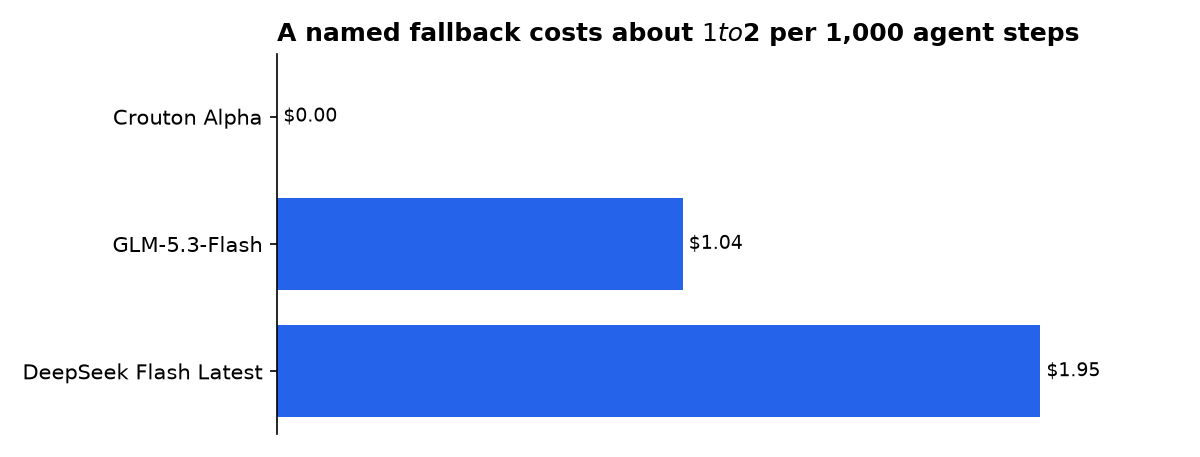
Crouton Alpha is the cheapest choice by definition during the preview. Yet the savings only matter if your work can tolerate replacement. A free model that vanishes during an incident can cost far more than $1.0356 per 1,000 steps if it blocks a customer workflow, delays a release, or forces emergency re-testing.
The table also separates evidence from marketing. A vendor-listed context length and price deserve an A tier because the platform publishes them. A score marked “not yet scored” is also decision-grade evidence, but it supports only one conclusion: capability has not been publicly established on that scorecard.
What does free access save in real work?
For a 1,000-input, 500-output chat turn, our calculation from OpenRouter’s list prices is $0.0000 for Crouton Alpha, $0.0750 for GLM-5.3-Flash, and $0.2708 for DeepSeek Flash Latest per 1,000 requests. That makes Crouton useful for trying workflows that would otherwise create a small but recurring experimentation bill.
The saving is real, but retrieval answers also need checks for missing citations, instruction injection, and unsupported claims.
OpenRouter prices can move. The published calculation block lists GLM-5.3-Flash at $0.03 per million input tokens and $0.09 per million output tokens, while a later OpenRouter measurement lists $0.0283 input and $0.0933 output. That is why the table uses explicit assumptions and should be recalculated before a large deployment.
Price is not the only capacity limit. A free model can be available one moment and constrained the next. A Command Code model registry explains that its command-line tool rejects unknown model IDs before a request runs; adopt the same discipline in your own agent. Check the chosen route before the workflow begins, then fail over cleanly if it disappears.
How should teams use Crouton Alpha safely?
Use Crouton Alpha behind a small, reversible interface. The right job has a clear input, a limited permission set, an output schema, and an automated check. The wrong job is open-ended authority: selecting vendors, editing production infrastructure, approving payments, or deciding what private material to disclose.
- Send redacted inputs. Replace names, account numbers, credentials, source code, and client text with placeholders.
- Constrain tools. Let the model request a search or draft a command, but require a separate policy check before any write action.
- Require schemas. Ask for valid JSON fields, then reject unknown fields and invalid values before another system uses them.
- Run a named fallback. Keep Crouton Alpha for cheap parallel work, but route failures or high-risk tasks to a known paid model.
- Log outcomes, not secrets. Record task type, pass rate, latency, and fallback rate without storing sensitive prompt content unnecessarily.
A useful rollout begins with fifty or more non-sensitive examples that already have correct answers. Measure whether the model returns valid structure, chooses permitted tools, and reaches the right result. Do not mistake a few impressive answers for reliability across a whole workflow.
The earlier stealth-model record supports this caution. Kingy AI says Ox Alpha was later confirmed as Z.ai GLM-5.3-Flash, and advises new integrations to use the named route rather than the retired preview identifier. The lesson is operational: a stealth alias is a trial access path, not an asset to embed deeply in a product.
Can Crouton Alpha run locally?
There is no published Crouton Alpha weight file or parameter count that would let a buyer plan a local deployment. Local operation would matter because it can keep data inside a controlled machine, but an anonymous hosted route is not the same product as downloadable model weights.
llama.cpp supports running compatible language and vision models locally and can expose an OpenAI-compatible server. That is useful for building a private fallback, but it does not make Crouton Alpha locally runnable. A local replacement needs its own weights, licence, hardware estimate, and accuracy testing.
For teams that need a local route, the software stack is moving quickly. llama.cpp version 0.8.0 was published on 28 October 2026 and added several model architectures and server changes. That release is infrastructure, not evidence about Crouton Alpha’s identity, quality, or portability.
What we could not verify?
Crouton Alpha’s maker, parameter count, training data, model weights, service-level agreement, regional processing terms, uptime commitment, benchmark results, and post-preview price are not publicly established. The unnamed provider or OpenRouter could settle those points by publishing a model card, a security and retention statement, stable commercial terms, and reproducible evaluation results.
Readers should actually use Crouton Alpha now for synthetic-data experiments, document tagging with redacted samples, and checked sub-tasks that can fail safely. Do not make it the only route for customer-facing automation. Keep a named fallback ready, and replace the stealth ID once its operator and final terms are public.
Sources
- OpenRouter: Crouton Alpha
- OpenRouter: model catalog and list prices
- Command Code: model catalog
- Command Code: available-models reference
- Kingy AI: Ox Alpha and GLM-5.3-Flash
- Kingy AI: latest AI news index
- ggml-org: llama.cpp repository
- ggml-org: llama.cpp v0.8.0 release

