
Tencent’s Hy4 launched on 4 November 2026 at $0.417 per million input tokens and $1.251 per million output tokens through OpenRouter’s Tencent Cloud route. It retains a 1,048,576-token context window, making it cheaper than Hy4 Preview but still far costlier than Z.ai’s GLM 5.3 Flash for routine agent steps.
At a glance
- Tencent Hy4 is listed at $0.417 per million input tokens and $1.251 per million output tokens under a 50% promotion.
- Tencent Hy4 and Z.ai GLM 5.3 Flash both list a 1,048,576-token context window.
- Our standard agent-step calculation puts Tencent Hy4 at $15.01 per 1,000 requests, versus $1.04 for Z.ai GLM 5.3 Flash.
- Tencent Hy4 Preview’s official open-weight release has 770 billion backbone parameters, with 49 billion activated for each token.
- Tencent’s published Hy4 Preview deployment recipe splits the FP8 model across eight parallel GPU shards.
What changed with Tencent Hy4?
Tencent Hy4 is the new API model, not a renamed Hy4 Preview checkpoint. OpenRouter lists Hy4 as released on 4 November 2026, with improved agentic and long-horizon productivity capability claimed by Tencent’s release description. The same listing says Hy4 adds visual understanding, while the earlier preview was presented as a text-generation model.
The price needs a caveat. OpenRouter displays a 50% discount beside Hy4’s $0.417 input and $1.251 output rates, and shows the undiscounted Tencent Cloud route at $0.834 and $2.501. That makes the $0.417 headline a current promotional rate, not a permanent price Tencent has promised.
Tokens are the chunks of text a model reads and bills by. Input tokens cover your prompt, files, chat history and tool results. Output tokens cover the model’s answer, code, plan or tool call. For agent systems, output matters because it costs about three times as much as Hy4 input at the current listed rate.
Hy4 is a current hosted model with a promotional API price. Hy4 Preview is Tencent’s earlier open-weight release, published on 28 August 2026. A benchmark or hardware claim about the preview should not be treated as a measured result for the new Hy4 service.
How much does Tencent Hy4 cost in practice?
For a modest chat exchange, Tencent Hy4 costs about $1.04 per 1,000 requests by our calculation. That assumes 1,000 input tokens and 500 output tokens per request. For a heavier agent step, it costs $15.01 per 1,000 requests under an assumption of 30,000 input tokens and 2,000 output tokens.
The comparison below uses each model’s listed ordinary input and output rates. It does not assume prompt-cache hits, because cached billing only applies when a provider recognizes reused material. Tencent Cloud’s official Hy4 Preview price table lists cache reads separately at $0.042 per million tokens, which shows why teams should measure caching instead of building a budget around it.
| Concrete option | Listed context | Input / output per 1M tokens | Chat cost per 1,000 requests | Agent-step cost per 1,000 requests | Best fit | Evidence tier |
|---|---|---|---|---|---|---|
| Tencent Hy4 | 1,048,576 tokens | $0.417 / $1.251 | $1.04 | $15.01 | Long-context agent evaluation where Hy4’s new capability is the reason to test. | Marketplace rate, verified |
| Z.ai GLM 5.3 Flash | 1,048,576 tokens | $0.0283 / $0.0933 | $0.07 | $1.04 | High-volume coding or agent work where cost is the first constraint. | Marketplace rate, verified |
| Tencent Hy4 Preview | 1,000,000 tokens | $0.834 / $2.501 | $2.08 | $30.02 | Open-weight evaluation, fine-tuning research or a controlled self-hosting project. | Vendor price page, verified |
FuturPulse calculation: chat equals 1,000 input plus 500 output tokens. Agent step equals 30,000 input plus 2,000 output tokens. Results multiply each model’s listed per-million rates by 1,000 requests. These are token-only estimates, excluding tool calls, search, storage, retries, infrastructure and human review.
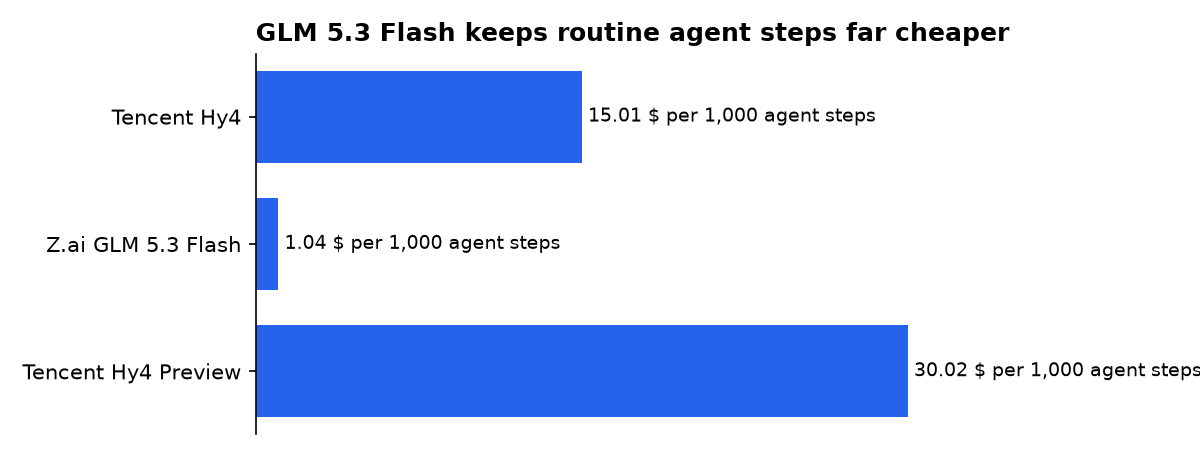
The biggest finding is not that Tencent Hy4 is inexpensive. It is that it costs roughly 14 times as much as GLM 5.3 Flash for the same assumed agent step. Hy4’s input rate is about 15 times higher, while its output rate is about 13 times higher. A team should therefore require a measurable quality gain before switching a production workflow from GLM 5.3 Flash.
Is the 1M-token context window useful?
Yes, but only for tasks that truly need it. Tencent Hy4’s listed 1,048,576-token context can hold large codebases, lengthy project histories or many retrieved files in one request. Z.ai GLM 5.3 Flash lists the same context length, so context size alone is not a reason to pay Hy4’s higher rate.
A context window is a capacity ceiling, not a quality guarantee. Tencent Cloud’s Hy4 Preview guidance separates a 1 million-token context from a 960,000-token maximum input and a 64,000-token maximum output. The missing space is needed for the model’s response and service overhead, so an application should not try to fill every request to the headline limit.
Long prompts also create a practical billing problem. If an agent resends a large repository or a long conversation every turn, the input bill rises fast. Structure the prompt with a stable prefix, send only changed files where possible, and log actual uncached versus cached token use.
Does Tencent Hy4 have proven performance gains?
There is no public independent benchmark result in the material reviewed here for the new Tencent Hy4 API release. Tencent’s detailed published evaluation applies to Hy4 Preview, not necessarily to today’s Hy4. That distinction matters because a new service name, model version and price are not proof that the underlying benchmark result transfers unchanged.
Tencent’s Hy4 Preview repository says 163 internal experts rated outputs on 203 engineering tasks. Tencent reports a 2.99 average score for Hy4 Preview, compared with 2.92 for GLM 5.3 and 2.94 for Kimi K3. The company also reports a 46.8% win rate against GLM 5.3, with 40.4% losses.
Those are useful signs for a trial, not a purchase order. The evaluators were internal, the tasks were chosen around Tencent work, and Tencent has not published an equivalent head-to-head score for the new Hy4 API against GLM 5.3 Flash. A buyer should run its own representative task set, including failed tool calls, awkward repositories and real approval rules.
Tencent also warns that Hy4 Preview can reason for longer than needed and over-verify its answers. That is a direct cost risk for agents. Longer chains and unnecessary checking can add output tokens, latency and extra tool use even when the final answer looks correct.
Can you download and self-host Hy4?
You can download and self-host Hy4 Preview, but Tencent has not published equivalent downloadable Hy4 weights on the sources examined here. The Hy4 Preview Hugging Face page lists an Apache 2.0 license, while Tencent’s repository says it released both standard and FP8-quantized preview weights.
The model is not a laptop deployment. Tencent describes the preview backbone as 770 billion parameters, with 49 billion active for each token through a mixture-of-experts design. A mixture-of-experts model stores many specialist networks, then routes each token through only some of them. That can reduce computation, but it does not remove the need to store enormous weight files.
By our calculation from the published weight files, the 1.56 TB safetensors release needs roughly 1.56 TB at 16-bit precision. A simplified 8-bit representation is about 780 GB, while 4-bit is about 390 GB. Those are weight-only arithmetic estimates, not measured hardware requirements; runtime memory also needs room for context, key-value cache and serving overhead.
The apparent parameter discrepancy is explainable. Tencent’s technical repository reports a 770B-parameter backbone and a native 10B multi-token-prediction layer. The published file total aligns with roughly 780B parameters at 16-bit storage. Buyers should ask vendors to state clearly whether a model-size claim includes auxiliary prediction layers.
Tencent’s recommended vLLM and SGLang recipes use tensor parallelism set to eight, splitting the FP8 model across eight GPU shards. That is a published serving configuration, not proof that eight cards are the absolute minimum. It does show that self-hosting belongs in a datacenter budget, not a desktop-software budget.
What is the best Tencent Hy4 buying decision?
Choose Tencent Hy4 for a tightly scoped evaluation if your work involves very long context, complex tool use or multimodal understanding, and you can define a task where a better result is worth a higher token bill. Start with a hard spending limit and compare completed-task quality, not attractive one-off demos.
- Choose Z.ai GLM 5.3 Flash when token cost and one-million-token context are the main requirements. Its listed agent-step cost is $1.04 per 1,000 requests in this comparison.
- Choose Tencent Hy4 when Hy4 wins on your actual long-horizon tasks by enough to justify a $15.01 agent-step estimate per 1,000 requests.
- Choose Hy4 Preview self-hosting only when open weights, control or fine-tuning matter more than the hardware and operations burden.
Do not compare Tencent Hy4’s discounted API rate with a self-hosting estimate as though they are interchangeable. The hosted price excludes your cluster purchase, operations and deployment risk. Self-hosting can make sense at large steady volumes, but that break-even point cannot be calculated from model weight size alone.
What we could not verify?
Tencent has not publicly established how long the 50% Hy4 promotion will last, whether the listed OpenRouter price applies across all regions, or what Hy4’s maximum input and output split is within its 1,048,576-token context. Tencent Cloud or OpenRouter could settle those questions with current regional billing and API-limit documentation.
There is also no public independent performance score here for the new Hy4 service against GLM 5.3 Flash or DeepSeek Flash Latest. Tencent can settle part of that gap by publishing reproducible evaluation prompts, outputs and methodology. Independent labs can settle the rest by testing identical agent tasks at controlled budgets.
Sources

