
On 23 November 2026, Apple’s FastFrames-L model on Hugging Face had 539 likes. It went up on 16 November, a week earlier.
The headline number is 45 ms per frame. That figure is real, but it comes from an eight-GPU node. This guide sets out what the model is, what the speed depends on, and what the licence lets you do with it.
At a glance
- What it is: a 14.3B text-to-video model from Apple ML Research. It is built on Wan2.1-T2V-14B and streams video one frame step at a time.
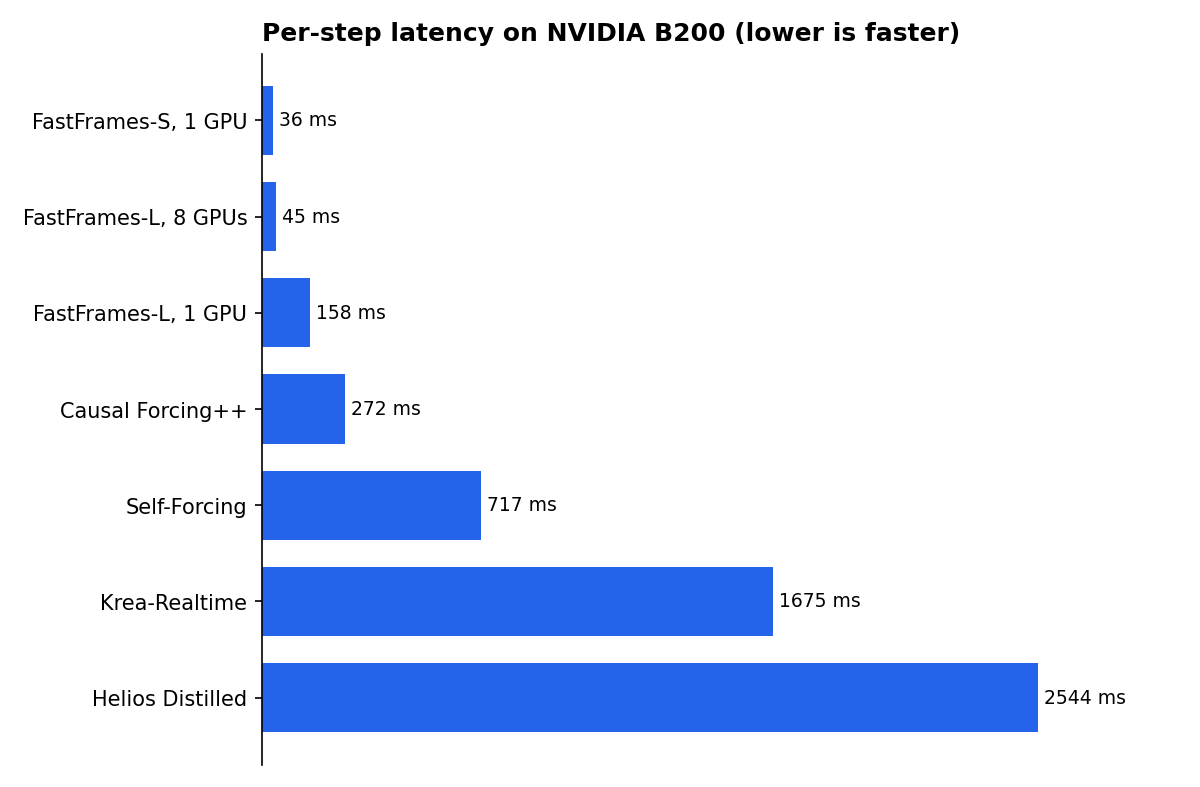
- The speed claim: 45 ms per frame step (one latent frame, four video frames) on eight NVIDIA B200 GPUs. On one B200, the paper reports 158 ms.
- The quality claim: a VBench Total of 84.44, against 84.42 for Krea-Realtime. Krea-Realtime takes 1,675 ms on one B200.
- The catch: the weights are for research only. Commercial use and product development are excluded.
- The smaller sibling: FastFrames-S (1.3B) reaches 36 ms on a single B200.
What is the FastFrames-L model?
FastFrames-L is the larger of two models released with the paper FastFrames, submitted to arXiv on 17 November 2026. The authors are Gene Chou, Guandao Yang, Fujun Luan, Lars Mescheder, Wei Dong, Stephan R. Richter and Vladlen Koltun.
It is an autoregressive video model. It does not render a whole clip at once. It produces one latent frame per step, and each latent frame becomes four video frames.
The base is Wan2.1-T2V-14B. Apple distilled it into a two-step causal model using the Causal Forcing++ recipe. It then trained a new pixel decoder and a KV-cache refiner on top.
The default text-to-video output is 832 × 480 pixels, 81 frames at 16 fps.
Why does latency matter more than fps here?
The paper argues that frames per second can mislead. A model can batch 30 frames in one second and claim 30 fps. You still wait a full second to see it react.
FastFrames measures something else. It counts the delay between a new input, such as a steering command, and the first frame that shows its effect. The target is 50 ms or less. The paper cites studies that put the human delay-detection threshold at about 50 to 60 ms.
That is why the work targets interactive uses. The paper names camera-conditioned and physics-conditioned generation. For a broader look at running video models yourself, see our guide to choosing a local video stack.
How does FastFrames-L reach 45 ms?
The paper’s abstract says decoding and cache updates take more than half of the latency in comparable models. FastFrames replaces both with light parts.
- A new pixel decoder. The usual Wan VAE decoder is dropped. In the 1.3B profile, the VAE took 147 ms per latent on a B200. The new pixel decoder took 1 ms.
- A KV refiner. Other models run an extra full pass to write a clean cache. FastFrames repairs the cache with a small network instead.
- Two DiT passes per step. Each frame step costs two DiT evaluations, plus the refiner, plus the decoder.
- Eight GPUs for the 45 ms figure. The eight-GPU mode needs one node with NVSwitch (NVLink multicast).
The pixel decoder is also cheaper to train. The paper puts a VAE decoder update at about 68 GB of peak GPU memory. Its own decoder needs about 5 GB.
What hardware do you need to run it?
The repository asks for Linux x86-64, an NVIDIA GPU and a CUDA 12.8-compatible driver. The tool uv installs Python 3.10 and PyTorch 2.9.1.
All published timings use B200 GPUs. Here is what the paper reports for FastFrames-L.
| Setup | Per-step latency | Responses per second |
|---|---|---|
| One B200, 480p | 158 ms | 6.33 |
| Eight B200 with NVSwitch, 480p | 45 ms | 22.2 |
| Eight B200, 720p | 116 ms | not reported |
The timings use batch size 1 and a full cache. They exclude text encoding, host transfer and display.
Plan for the download too. The fastframes-l folder is about 30.6 GB. Most of that is the 28.6 GB DiT file. You also need Wan2.1-T2V-14B for the text encoder and tokenizer. For generation only, the docs let you skip Wan’s own DiT weights.
How does it compare on VBench?
The paper scores every model on VBench with the same prompts and seeds. Latency is on one B200 unless stated.
| Model | Size | Latency | Total | Quality | Semantic |
|---|---|---|---|---|---|
| FastFrames-L | 14.3B | 45 ms (8 GPUs) | 84.44 | 85.48 | 80.29 |
| Krea-Realtime | 14.3B | 1,675 ms | 84.42 | 85.08 | 81.81 |
| FastFrames-S | 1.3B | 36 ms | 84.23 | 85.30 | 79.92 |
| Wan2.2 | 14.3B | 117,734 ms | 84.65 | 85.41 | 81.60 |
The overall score is level with Krea-Realtime. The semantic score is lower: 80.29 against 81.81. Semantic scores measure how well a video follows the prompt.
The paper says FastFrames-L matches Krea-Realtime’s visual realism while being 10 times faster. By our arithmetic, one GPU against one GPU gives 1,675 ms versus 158 ms, about 10.6 times. The eight-GPU figure is faster still, but uses eight times the hardware.
Wan2.2, a full-clip model, still has the top Total score in the table. It takes almost two minutes.
Can you use FastFrames-L commercially?
No. The weights use the Apple ML Research Model License. It allows research use only. It excludes commercial use and product development, and Apple may terminate it if you breach its terms.
The code uses the Apple Sample Code License. The LingBot camera-control parts follow CC BY-NC-SA 4.0, which is also non-commercial.
If you need video you can ship in a product, look at models with open licences. We covered that question in open video models that keep product footage in your control.
How can you try it?
The code is in the apple-aiml-research/ml-fastframes repository. It had 140 stars on 23 November. After uv sync and the checkpoint downloads, one script generates a clip.
uv run python scripts/generate.py --model ff-l --checkpoint-dir checkpoints \
    --prompt "A corgi surfing a wave at sunset" --seed 0 --output outputs/corgi.mp4
Without your own GPU, there is a community demo. The Space akhaliq/FastFrames-L was running on 23 November on shared ZeroGPU hardware. It is not an Apple service, and it will not match the paper’s B200 speeds.
The repository also ships an optimised LingBot 1.3B model for camera control. Apple says it is 16 times faster than the official version. For another local video option with fine control, see our piece on LTX 2.5 video-to-video.
What we could not verify
We did not run FastFrames-L. Every speed and score above comes from the paper and the repository documentation.
The documentation does not state a minimum GPU memory for one-GPU use. We could not confirm which consumer or older data-centre GPUs can run it, or how fast.
We did not time the community Space. Its latency on shared hardware is unknown to us.
VBench is one benchmark. It does not capture every kind of failure, and we did not compare clips side by side ourselves.
The project is a week old. Apple has published four checkpoints, including training intermediates. We saw no statement on future updates.
Sources
- FastFrames paper on arXiv (2611.23226): abstract, Table 1, Table 2 and method sections
- apple/FastFrames-L model card on Hugging Face (likes, base model, licence, file sizes)
- apple-aiml-research/ml-fastframes on GitHub (README, installation and inference guides, licence files)
- FastFrames project page
- akhaliq/FastFrames-L community Space

