
For symbolic maths, use Wolfram|Alpha for quick browser calculations, SymPy for inspectable code, and BootLoops for research work needing certificates. Wolfram|Alpha Pro costs $5 a month on annual billing. General chatbots can explain notation, but should not be the final calculator without a separate symbolic check.
At a glance
- Wolfram|Alpha Basic is free with sign-in, while Pro is $60 a year or $9.99 month-to-month.
- SymPy documents symbolic solutions for equations, inequalities, matrices, Diophantine problems and integrals.
- BootLoops 1.0 says its fresh-install test command covers 50 tool packages, with three named stops when required data is absent.
- A 29 September 2026 preprint raised Qwen3-8B from 15.5% to 99% exact accuracy on one 24-line reference-chain task after a task-specific adapter.
How does symbolic maths differ from AI chat?
Symbolic maths means manipulating exact expressions rather than predicting a likely sentence. A computer algebra system can factor a polynomial, differentiate an expression or solve an equation under stated assumptions. A language model can turn a word problem into notation and explain a method, but fluent prose is not a mathematical certificate.
SymPy’s solving guide lists exact algebraic work across equations, differential equations, matrices, inequalities and Diophantine equations. That is the useful dividing line: ask an AI assistant to clarify intent, then send the formal expression to a symbolic engine.
The strongest available warning about long language-model reasoning is narrow but striking. In a preprint submitted on 29 September 2026, Zehao Jin, Ruixuan Deng and Junran Wang found 13 base transformer models followed only 1.4 to 3.6 lines reliably in their reference-chain task. That is not a calculus benchmark, but it is evidence against treating a long chain of polished text as proof.
Which AI is good in mathematics?
Wolfram|Alpha is the best simple answer for typed symbolic maths when you want a web result, while SymPy is the better answer when you need code you can inspect and rerun. BootLoops is the specialist choice when a research calculation needs an error bound, a proof-like certificate or an independent validation route.
Wolfram|Alpha describes itself as a computational knowledge engine, rather than a web search engine. Its free tier is useful for checking results. Its paid plans add step-by-step solutions and more computation time, which matters if you are learning rather than merely checking an answer.
SymPy is less polished for a casual student, but its output can live in a notebook, a script or a version-controlled project. Its integral documentation also makes an important distinction: one routine may return a compact closed form, while its manual-integration tools can expose steps that resemble a human calculus method.
| Option | What it executes | Best use | Weakness to plan for |
|---|---|---|---|
| Wolfram|Alpha | Commercial computational engine | Fast typed checks, standard algebra and calculus | Step detail is a paid feature |
| SymPy | Open-source symbolic Python library | Reproducible equations, scripts and notebooks | Requires precise syntax and some programming comfort |
| BootLoops 1.0 | LLM-driven scientific-tool harness | Research calculations requiring explicit checks | Not a one-click homework solver |
| General chatbot | Natural-language generation | Translating prose, tutoring and planning | Its answer needs execution in another tool |
The table compares the job each system performs. It is not an accuracy league table, because the operators do not publish one shared, rerunnable symbolic-maths test across these products.
Is Wolfram|Alpha better than ChatGPT for symbolic math?
For a well-specified symbolic expression, Wolfram|Alpha is the safer final executor because it is built to compute. A chatbot is more useful before that point, when the problem arrives as unclear prose, a messy prompt or a request for explanation.
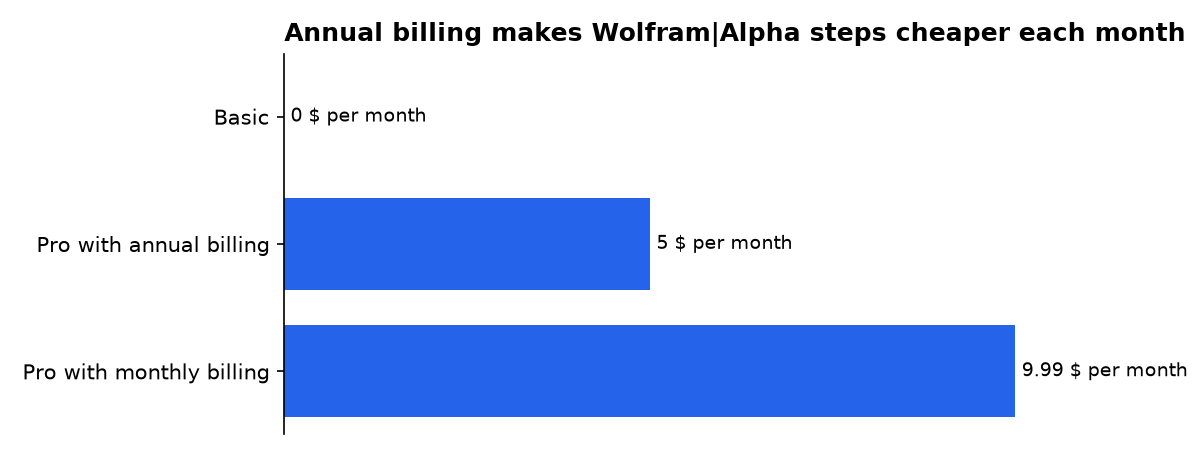
Wolfram|Alpha lists Basic at $0 with sign-in. It lists Pro at $5 a month when billed as $60 annually, or $9.99 on a monthly plan. Pro includes step-by-step solutions, practice problems and twice the standard computation time.
| Wolfram|Alpha plan | Listed monthly cost | What changes for symbolic maths |
|---|---|---|
| Basic | $0 | Gets computational answers, but not step-by-step solutions |
| Pro, annual billing | $5.00 | Adds steps and twice the standard computation time |
| Pro, monthly billing | $9.99 | Provides the same Pro-level maths features without annual billing |
The practical workflow is simple. Ask the chatbot to define variables and rewrite the problem. Put the resulting expression into Wolfram|Alpha or SymPy. Then substitute the result back into the original equation, especially when the question has domain restrictions, absolute values or square roots.
What is the best free AI for symbolic algebra?
SymPy is the strongest free choice for symbolic algebra if you can work in Python. It is not a conversational tutor, but it gives you a transparent route from expression to result and lets you preserve the exact input alongside the answer.
SymPy documents algebraic solvers for systems, inequalities and integer equations, alongside numerical routines when a closed form is unavailable. Its documentation warns that different problem types need different functions. That warning is valuable: “solve” is not one universal operation in mathematics.
For an indefinite integral, you must also check the mathematical convention. SymPy’s calculus tutorial says its indefinite integrals omit the constant of integration. A correct antiderivative without “+ C” can still lose marks in a class if you copy it without understanding the convention.
Can ChatGPT solve symbolic math reliably?
ChatGPT-like models can often solve routine symbolic problems, but the available evidence does not justify using them alone for high-stakes answers. Use one to explain or translate. Use a symbolic engine to calculate. Use substitution, differentiation or a second route to check the result.
The Qwen3-8B experiment shows both the promise and the limit. The authors report that a task-trained rank-8 LoRA, a small adapter attached while the base model stays frozen, lifted exact accuracy from 15.5% to 99% on their 24-line chain task. The same paper reports a longer-trained adapter reaching 50 lines, but this remains a research result for a constructed task, not a consumer maths-product score.
That distinction matters because a model can be right for the wrong reason. If it writes “therefore” between two lines, that is not a check. A symbolic tool can still be fed the wrong expression, so the user must inspect the translation from the original question.
Which AI can show steps for an integral?
Wolfram|Alpha Pro is the easiest browser option for guided steps, while SymPy can expose a more code-oriented derivation. Neither guarantees that its preferred route matches the method required by a teacher or textbook.
Wolfram|Alpha’s maths page says Pro unlocks step-by-step calculators for calculus, algebra, trigonometry and equation solving. The service also supports photo input in its mobile apps, but photography adds a separate risk: a misread minus sign or exponent can produce a perfectly worked solution to the wrong question.
SymPy’s manual integration tools can return steps for an integral and aim to resemble a hand calculation. The normal integration route may choose a different valid form, particularly when special functions offer a shorter representation. That makes SymPy useful for checking, but not a guarantee of classroom-style presentation.
Can AI prove a symbolic result is correct?
Most consumer maths AI cannot prove correctness in the strict sense. It can produce an answer, and sometimes a derivation, but a trustworthy research result needs a check suited to the claim: substitution, a residual, a known identity, a bound, exhaustive coverage or an independently reproduced result.
BootLoops describes a different model. Its tools cover recurrence proofs, certified quadrature, ball arithmetic and exhaustive enumeration with completeness certificates. Ball arithmetic carries a proven error radius with a value, which makes uncertainty explicit rather than hiding it behind a long decimal.
The BootLoops repository says a fresh validation command visits 50 packages and that three stop with named errors when their external data is missing. That is evidence of installation checks, not an independent accuracy ranking. Version 1.0 was released on 5 October 2026 under the MIT licence, according to its release page.
Who is making the maths-AI claims?
Wolfram Research has a direct subscription interest in showing that Wolfram|Alpha Pro adds useful learning features. Its own pricing page is therefore strong evidence for price and plan limits, but not an independent comparison against rivals.
Gauth’s editorial team sells Gauth Plus and ranks its own tool in a comparison that lists a $11.99 monthly plan and a $99.99 annual plan. Gauth’s published ten-problem battery is more specific than many rankings, but it is still an operator-run test rather than a neutral benchmark.
Mathos AI promotes its own equation solver as up to 17% more accurate than named alternatives. Mathos’s comparison page does not publish the full test set, scored outputs or rerunnable method behind that headline figure. It should not decide a purchase by itself.
AI Tutor says its experts spent more than 100 hours testing maths apps, while presenting affiliate-style product recommendations and prices. Its article is useful for identifying popular student products, but it is not a public symbolic-maths benchmark with test cases and error logs.
What we could not verify?
No public, independent benchmark currently establishes one winner across Wolfram|Alpha, SymPy, BootLoops and general chatbots on a shared set of symbolic algebra, calculus, assumptions and proof tasks. The missing evidence is not another opinion ranking. It is a public test suite with exact inputs, expected domains, tool versions and reproducible scoring.
We also could not verify a consumer product that turns the Qwen3-8B LoRA result into a broadly available symbolic-maths service. The paper’s authors, or an independent replication team, could settle whether that technique transfers from reference chains to real algebra and calculus workloads.
Sources

