

FuturPulse analysis · 18 October 2026
Nano Banana means Google’s image-model brand, named in late July 2025 when product manager Naina Raisinghani combined her nicknames “Naina Banana” and “Nano” for an anonymous LMArena codename.
At a glance
- Google’s technical name for the original Nano Banana model was Gemini 2.5 Flash Image, launched on 26 August 2025.
- Naina Raisinghani proposed the name at 2:30 a.m. because LMArena needed a public codename before the model’s release.
- “Nano” refers to Raisinghani’s personal nickname, linked to being short and liking computers, not to the model’s parameter count.
- Google expanded the label into Nano Banana Pro in November 2025 and Nano Banana 2 in February 2026.
- The original Gemini 2.5 Flash Image API model was scheduled to shut down on 2 October 2026, according to Google’s current pricing page.
What does Nano Banana actually mean?
Nano Banana is not a scientific term, a measure of image quality, or Google’s formal model identifier. It began as an intentionally silly public codename for a model that Google DeepMind had already technically named Gemini 2.5 Flash Image.
Google’s account of the naming is unusually specific. In late July 2025, the team had finished the technical name but needed an alias for LMArena, a public testing service where people compare two unnamed models and vote for the better result.
The name had a practical job. A model still under development could not appear there under the Gemini name without revealing its maker. A codename let Google collect early human feedback while keeping the model anonymous.
Raisinghani suggested “Nano Banana” during a late-night message exchange. Google says colleagues initially regarded it as nonsensical. That is the point many retellings miss: the phrase was not designed as a compressed explanation of the technology.
The short answer: Nano Banana started as a personal, improvised codename. Google later retained it as the consumer-facing name for a family of Gemini image-generation and editing models.
Why is Nano Banana called Nano?
Nano Banana is called Nano because “Nano” was one of Naina Raisinghani’s nicknames. Google quotes Raisinghani saying some friends used “Naina Banana,” while others called her Nano because she is short and likes computers.
She combined those two nicknames: Naina Banana became the banana half, and Nano supplied the first word. Google says the result also felt suitable for a Flash model, a Gemini label generally used for models designed around speed and efficiency.
That explanation rules out several popular interpretations. “Nano” does not mean the system is a tiny model. It does not refer to nanometres, a hardware process, image resolution, or a published parameter count. Google has not presented any of those as the reason for the word.
The original model’s name, gemini-2.5-flash-image, made its positioning clearer than the nickname did. Google’s developer reference describes it as a model for high-volume image generation, conversational editing and low-latency creative work. “Nano Banana” was memorable branding layered on top.
Why is there a banana in the name?
The banana comes from “Naina Banana,” Raisinghani’s rhyming personal nickname. It was not an internal reference to bananas, yellow user-interface buttons, image-editing techniques, or a special feature of the model.
Google leaned into the joke only after users responded to it. The company says that, after the codename spread through LMArena and social media, it used a yellow run button in AI Studio, added a banana emoji to image creation in the Gemini app, and produced limited banana-themed merchandise.
The sequence matters. The visual banana branding followed the accidental name; it did not create it. That is why attempts to decode “banana” as an acronym or technical claim lead nowhere.
Google’s first public developer announcement on 26 August 2025 called the release “Gemini 2.5 Flash Image (aka nano-banana)”. The parenthetical wording shows the split from the beginning: Gemini 2.5 Flash Image was the formal product name, and Nano Banana was the nickname users had already adopted.
When did Nano Banana go from codename to brand?
Nano Banana moved from secret testing label to Google product brand between August 2025 and February 2026. The timeline below separates what Google first promised from what it later shipped or renamed.
Late July 2025 — codename chosen for anonymous testing
Google says the team had locked in Gemini 2.5 Flash Image but needed an LMArena alias. Raisinghani proposed Nano Banana at 2:30 a.m.; the model appeared on LMArena in early August.
26 August 2025 — Google shipped the original model in preview
Google launched Gemini 2.5 Flash Image through the Gemini API, Google AI Studio and Vertex AI. It promised stable availability in the following weeks, while offering image blending, character consistency and prompt-based local edits.
6 September 2025 — developers received a short free-use event
Google DeepMind’s hackathon kit called Gemini 2.5 Flash Image Preview “aka Nano Banana” and opened a 48-hour API tier. The event offered 500 requests per project per day on the special tier.
20 November 2025 — Nano Banana Pro shipped
Google introduced Nano Banana Pro as Gemini 3 Pro Image. It positioned the Pro model around more reliable in-image text, expanded visual controls, and image generation at up to 4K resolution.
26 February 2026 — Nano Banana 2 shipped
Google introduced Nano Banana 2 as Gemini 3.1 Flash Image. Google described it as bringing Pro-style image features to a Flash model aimed at faster work and broader deployment.
2 October 2026 — original API retirement date
Google’s pricing page states that Gemini 2.5 Flash Image was deprecated and scheduled to shut down on 2 October 2026. That date is already past as of 18 October 2026.
What is nano banana now called?
Nano Banana can now mean a product family, not one model. Google’s current image-generation guide uses Nano Banana for its native Gemini image capabilities and lists distinct versions under the shared name.
The original Nano Banana was Gemini 2.5 Flash Image. Nano Banana Pro is Gemini 3 Pro Image. Nano Banana 2 is Gemini 3.1 Flash Image. Nano Banana 2 Lite is Gemini 3.1 Flash Lite Image.
This naming creates a real source of confusion. Someone asking for “Nano Banana” might mean the retired original model, any Google image model, or a current version such as Nano Banana 2. The precise answer depends on the model identifier in use.
Google’s image-generation documentation calls the original model the “legacy pioneer” of the series and recommends that customers move to later models. So Nano Banana has survived as a brand even as the first API model reached its stated shutdown date.
How did the model family change?
Google retained the playful name while attaching it to different technical products. The main change is not that Nano Banana received one simple upgrade; it is that Google created a tiered image-model line.
| Google brand | Technical model name | What Google positioned it for | Launch or status |
|---|---|---|---|
| Nano Banana | Gemini 2.5 Flash Image | Fast, high-volume image generation and editing | Launched 26 August 2025; retirement date was 2 October 2026 |
| Nano Banana Pro | Gemini 3 Pro Image | Complex visual work, stronger text handling and 4K output | Launched 20 November 2025 |
| Nano Banana 2 | Gemini 3.1 Flash Image | Faster image work with more advanced controls | Launched 26 February 2026 |
| Nano Banana 2 Lite | Gemini 3.1 Flash Lite Image | Cost- and speed-sensitive high-volume jobs | Current family member in Google’s guide |
Source: Google’s current Nano Banana image-generation guide, with original-model retirement status from Google’s pricing page.
The practical lesson is simple: use the brand name to discuss the family, but use the technical identifier when building software or comparing capabilities. A prompt, API request or invoice needs the latter.
Does the playful name mean a cheap model?
No. The name does not reliably signal price.
Newer models are separate commercial products. That is why “Nano” should not be read as a promise that every model carrying the name is the smallest or least expensive option. Nano Banana Pro was explicitly positioned as the higher-control model.
OUR CALCULATION: Using OpenRouter list prices and a fixed 1,000-request workload of 1,000 input tokens plus 500 output tokens per request, our calculation puts original Nano Banana at $1.55 and Nano Banana Pro at $8.00. Tokens are the chunks of text a model reads and bills by.
| Model family name | Technical label | Our estimated cost per 1,000 chat-style requests |
|---|---|---|
| Nano Banana | Gemini 2.5 Flash Image | $1.55 |
| Nano Banana Pro | Gemini 3 Pro Image | $8.00 |
| Nano Banana 2 | Gemini 3.1 Flash Image | $2.00 |
| Nano Banana 2 Lite | Gemini 3.1 Flash Lite Image | $1.00 |
Our calculation assumes 1,000 input and 500 output tokens per request, using OpenRouter list prices. It is a comparison of list rates, not a Google billing estimate.
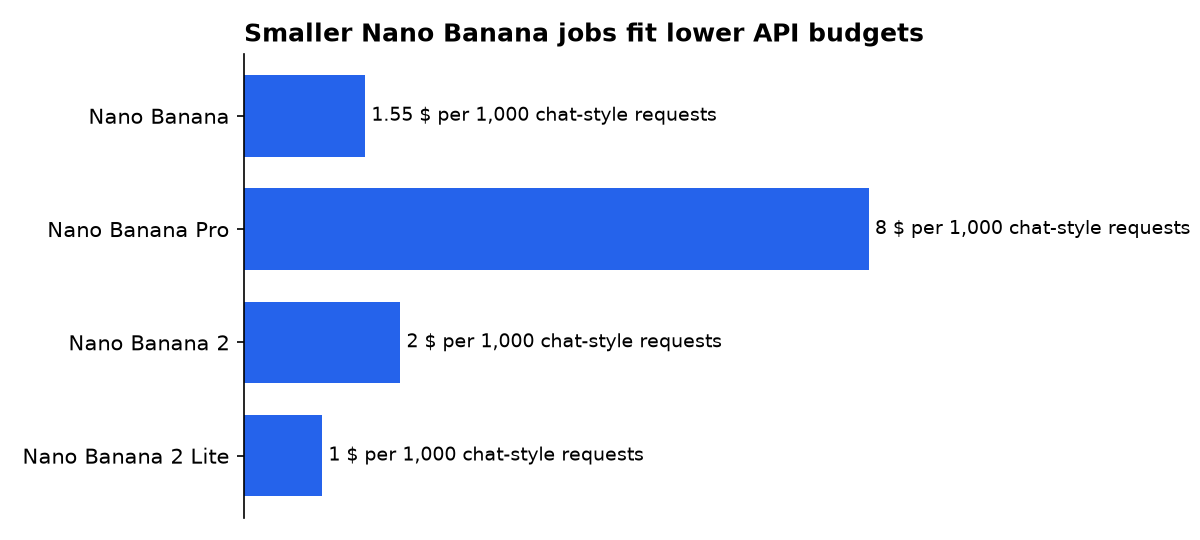
The result is a naming reality that differs from the meme. Nano Banana was born from a personal joke. The current family contains products for different speed, quality and cost choices.
What misconceptions should readers avoid?
First, Nano Banana was not Google’s original technical product name. Gemini 2.5 Flash Image was the original technical name, and Nano Banana was the public codename that became a brand.
Second, “Nano” does not prove the model was physically small or low capability. Google’s explanation traces it to Raisinghani’s nickname, while the original model was marketed for image generation, editing and image-plus-text work.
Third, Nano Banana is not automatically a reference to Nano Banana Pro or Nano Banana 2. Those are later products with different underlying Gemini model names. Calling all of them “Nano Banana” can hide important differences in availability, features and pricing.
Finally, the word “Flash” does not explain “Banana.” Google says the combined nickname felt appropriate because the original was a Flash model. It was a fit after the fact, not the origin of the banana half of the name.
What we could not verify?
Google has not published a record of every person involved in the final naming decision, the exact internal message thread, or the full set of candidate codenames rejected before Nano Banana. Naina Raisinghani and the Google DeepMind product team could settle those details.
Google also has not published a technical rule defining when future image models may use the Nano Banana label. The company could clarify whether the name will remain a permanent family brand or change again with later Gemini image releases.
Sources
- Google: How Nano Banana got its name
- Google Developers: Introducing Gemini 2.5 Flash Image
- Google AI for Developers: Gemini 2.5 Flash Image model page
- Google DeepMind Nano Banana Hackathon starter kit
- Google: Introducing Nano Banana Pro
- Google Gemini Developer API pricing
- OpenRouter models and list prices

