
FuturPulse analysis
Qwen-Image-2.1 has a 7B-parameter visual generator, but neither its official model card nor a community GGUF download demonstrates that it will accept every prompt. “Uncensored” is usually a description of where a tool runs and how much of its workflow you control, not a verifiable promise of unlimited output.
At a glance
- Qwen-Image-2.1 is an open image-generation and editing model that can generate transparent images and use reference images.
- The community GGUF package offers smaller weight files for local use, but its “Uncensored” label is not accompanied by a public safety evaluation or change log.
- File size is not a reliable memory requirement. Image generation also depends on resolution, image encoders, decoders, workflow settings, software and whether work is moved between system memory and a GPU.
- Hosted tools marketed as unfiltered still publish boundaries, account rules, feature limits or paid plans.
- No provider in this comparison publishes an independent, like-for-like refusal-rate test for lawful creative prompts.
What does “no censorship” mean in an image generator?
“No censorship” has no standard technical meaning. A provider can use it to mean fewer prompt blocks, private generation, a wider range of adult-themed material, local execution, or simply an absence of a visible warning screen. Those are different claims, and they should not be treated as interchangeable.
A local workflow gives the user more control over the software stack. The model files, prompts and outputs can remain on the user’s machine if the chosen workflow does not call external services. That removes some hosted-service controls, but it does not prove that a model has no learned refusals, no embedded preferences or no licence conditions.
A hosted service controls more of the process. It can choose the underlying model, change the prompt handling, limit plans, review accounts or alter its policy without the user changing any local files. That is why a product’s content policy matters as much as the marketing label on its landing page.
For readers seeking fewer false refusals on lawful prompts, the useful question is narrower: does this tool offer a documented workflow for the type of image you need, and does its publisher clearly explain its boundaries? A claim of “unrestricted” is not evidence on its own.
What did Qwen-Image-2.1 actually release?
Qwen describes Qwen-Image-2.1 as a unified text-to-image and image-editing model. Its official documentation says it can create regular images and transparent RGBA images, edit transparent layers, and use reference images for composition and editing. RGBA is an image format that includes an alpha channel, which records transparency.
The official workflow uses the Diffusers software library and sends the model to a CUDA device. CUDA is Nvidia’s software platform for running compute work on compatible graphics processors. Qwen also documents a CPU-offloading option, which moves model components through system memory when graphics memory is limited.
That option is useful, but it is not a simple hardware guarantee. Offloading can change speed and memory behaviour because components do not all remain on the graphics card. Output size, reference images, batch size, model precision and the surrounding software can also change the amount of memory a run needs.
Qwen’s documentation includes prompt rewriting models for text-to-image and image-editing workflows. These optional models expand a short request into a longer prompt before image generation. That can improve the workflow for some users, but it also means the final prompt may not be identical to the words originally typed.
The official package is licensed under the Qwen Research License Agreement. The published model card identifies that licence, but the material reviewed here does not establish the full commercial-use terms for every community conversion or derivative. A local download should therefore not be assumed to carry unrestricted commercial rights.
What is the community “Uncensored” GGUF package?
The Qwen-Image-2.1-Uncensored-GGUF page distributes quantized GGUF files. Quantization stores model values with less precision, reducing the size of a file and sometimes making local use more practical. It does not, by itself, establish that the model’s behavioural limits were removed.
The package page provides published file sizes, but no public test set, refusal-rate report, fine-tuning description or technical account of changes behind the “Uncensored” label is available in the public record. It is therefore not possible to verify whether the label refers to changed weights, a local workflow, a packaging decision or a combination of those things.
This distinction matters for buyers and creators. A model can run locally while still producing poor results for a request, following tendencies present in its training, or being subject to a separate licence. Conversely, a hosted tool may permit a wider set of lawful creative requests while retaining account and content rules.
The GGUF package should be understood as a local-format option, not as proof of universal prompt acceptance. Anyone evaluating it should record the exact file, software version, resolution, seed, prompt and workflow settings. Those details make results repeatable and make it easier to distinguish a model limitation from a setup problem.
How should readers compare local and hosted options?
The table compares the parts a reader can verify from each publisher’s public material: where the product runs, what workflow it offers, what is known about limits, and which important facts remain undocumented. It does not rank image quality or claim that one service accepts more prompts than another.
| Tool or workflow | Where it runs | Workflow and companion requirements | Licence or commercial-use position | Policy, free access and evidence on refusals |
|---|---|---|---|---|
| Qwen-Image-2.1 | Local software workflow | Qwen documents Diffusers, PyTorch, Transformers, Accelerate and Pillow for its local examples. Its example workflow uses a CUDA device, while CPU offloading is documented for constrained graphics memory. | The model card identifies the Qwen Research License Agreement. The public record does not establish full terms for all commercial uses or derivative packages. | Qwen’s model card describes generation, editing and transparency features. It does not publish a content-policy page or a refusal-rate evaluation for this model. |
| Qwen-Image-2.1-Uncensored-GGUF | Local GGUF weights | The download offers several quantized files. The public record does not verify every companion file, interface, operating-system requirement or compatible hardware configuration for this community package. | No separate licence terms for the community conversion are established here. Users should check the upstream licence and the package page before relying on commercial use. | The package is labelled “Uncensored,” but no supplied public refusal test, safety evaluation or documented list of model changes verifies that claim. |
| Mage | Hosted browser service | Mage says it supports image and video generation, reference-image character workflows, inpainting and a range of named models. Users do not need to install a local model stack. | Mage says users can use creations commercially, with attribution appreciated but not required. | Mage’s public policy and membership page says illegal and prohibited material is not allowed. It offers a free starting tier, while paid memberships and Gems govern access to some models and features. No independent refusal-rate evidence is published there. |
| ZenCreator | Hosted browser service | ZenCreator advertises text-to-image, image-to-image, editing, inpainting and outpainting. It does not disclose a named underlying model in the public record. | ZenCreator advertises commercial rights for paid plans. The public record should not be read as an independent legal assessment of those rights. | ZenCreator’s content-policy section says users must be adults and prohibits minors and illegal content. That published restriction conflicts with any literal reading of “no restrictions.” Its performance and acceptance claims are provider claims, not independent testing. |
| Senzia | Hosted browser service | Senzia describes text-to-image and image-to-image still generation from prompts or reference photos. It says no software installation is required. | The page says users retain ownership of exported files, but the public record does not provide a separate licence document for closer interpretation. | Senzia’s product page says the service is free to start and presents private processing claims. It does not publish a detailed content-policy link or independent evidence of how often lawful prompts are refused. |
The comparison uses publishers’ public descriptions of their products, policies and plans. Claims about privacy, speed, ownership, model behaviour and “unfiltered” output remain provider claims unless supported by a reproducible external evaluation.
What do the GGUF file sizes tell you?
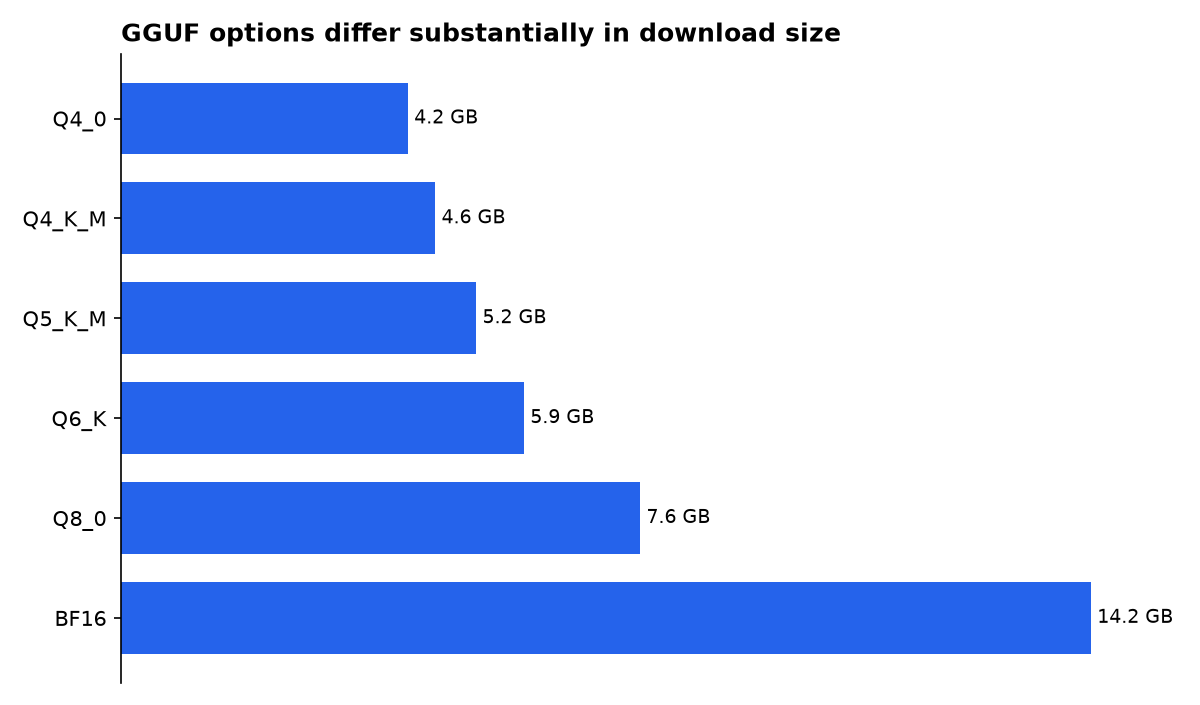
The listed GGUF files differ significantly in download size. Smaller quantized files can be easier to store and may be more practical for some local setups. They are not, however, reproducible statements of total RAM or VRAM requirements.
| GGUF option | Published file size | Practical meaning |
|---|---|---|
| Q4_0 | 4.2 GB | Smallest listed GGUF download |
| Q4_K_M | 4.6 GB | Slightly larger quantized download |
| Q5_K_M | 5.2 GB | Mid-sized listed quantized download |
| Q6_K | 5.9 GB | Larger listed quantized download |
| Q8_0 | 7.6 GB | Largest listed integer-format GGUF download |
| BF16 | 14.2 GB | Largest listed GGUF download |
Source: published sizes on the Qwen-Image-2.1-Uncensored-GGUF package page.
A download size is only one part of capacity planning. The image model must coexist with its text-processing and image-decoding components, temporary tensors, the selected image dimensions and the software runtime. A workflow using reference images or image editing can also behave differently from a simple text-to-image run.
For that reason, readers should treat a GGUF file size as a storage requirement rather than a promise that a machine with matching memory can generate an image. The useful test is a small, documented run on the intended hardware and workflow. Record the output resolution and settings before deciding whether a larger file is worthwhile.
Can a hosted “uncensored” generator have rules?
Yes. ZenCreator illustrates the contradiction clearly. Its marketing promotes no-filter generation and adult-oriented creation, while its own content-policy section requires adult users and excludes minors and illegal content. Those limits are important, and they are more informative than a slogan about total freedom.
Mage also describes boundaries. It promotes creative freedom and private-by-default creations, but says illegal and prohibited material is not allowed. Its free tier is a way to try the service, not evidence that every model, feature or request is available without restriction.
Senzia markets a browser-based unfiltered workflow and says it is free to start. Its page describes text-to-image and image-to-image generation, private processing and downloadable still images. The material reviewed here does not provide enough evidence to establish a detailed moderation policy or a measured refusal rate.
These examples show why “hosted and uncensored” should be read cautiously. A hosted service can be convenient and require no local setup, but the provider retains control over the service. Policies, prices, models and moderation can change independently of the user’s workflow.
Which option suits a lawful creative workflow?
Choose a local workflow when control, repeatability and the ability to inspect the software setup matter most. It is best suited to readers prepared to manage downloads, dependencies, storage and troubleshooting. Local execution is not automatically simpler, cheaper or unrestricted by licence.
Choose a hosted tool when fast access matters more than control over the full stack. Browser tools can offer image generation without installing software, and some provide editing or reference-image features. The trade-off is that the provider controls the account, plans, service rules and available models.
For either route, test ordinary lawful requests first. Try the same non-graphic fantasy, historical, product-design or editorial concept prompt across the tools you are considering. Keep the prompt, settings and result, then judge whether the workflow meets your needs without relying on marketing language.
Do not use image-generation tools to create sexual content involving minors, non-consensual intimate imagery, deceptive impersonation or other unlawful material. Privacy claims and local execution do not remove legal duties, consent requirements or the terms attached to software and services.
What can we verify about refusal behaviour?
We cannot verify that any tool in this comparison accepts every prompt. The publishers describe product features and, in some cases, broad creative latitude. That is not the same as a controlled evaluation showing how a tool responds to a consistent set of lawful prompts.
We also cannot verify the precise changes behind the community GGUF package’s “Uncensored” name. The public record does not include training lineage, a fine-tuning report, removed-filter source code, a versioned change log or side-by-side behavioural tests against the upstream model.
Nor can we verify a universal hardware requirement for the GGUF files. The published file sizes are useful for download and storage planning, but total generation memory depends on the complete workflow. The strongest next step would be a reproducible benchmark that names the hardware, software, model files, resolution and output settings.
What should readers check before choosing a tool?
- Read the licence for the exact model or service you intend to use.
- Check whether the workflow is local, hosted or partly dependent on online components.
- Identify companion software and files before downloading large model packages.
- Read the provider’s content-policy wording rather than relying on “no filter” marketing.
- Confirm the free-tier limits, paid features and any credit system.
- Test lawful prompts with saved settings before committing a production workflow.
The next useful evidence would be transparent evaluations: a documented lawful-prompt suite, versioned model files, repeatable workflows and a published account of refusals. Until publishers provide that evidence, “uncensored” should be treated as a marketing term that requires qualification.

