

OpenRouter lists GLM Flash Latest at about $0.05 per million input tokens and $0.07 per million output tokens, while Z.ai lists GLM-5.3-Flash at $0.15 and $0.50. OpenRouter’s GLM Flash Latest page is the direct place to check the alias, provider route and live price before deployment. Z.ai’s named-model prices appear on its official pricing page.
At a glance
- Z.ai lists GLM-5.3-Flash at $0.15 per million fresh input tokens, $0.03 cached input tokens and $0.50 output tokens. (docs.z.ai)
- OpenRouter’s catalogue lists GLM Flash Latest at about $0.05 per million input tokens and $0.07 per million output tokens. Its alias price is not a permanent Z.ai rate. (openrouter.ai)
- GLM-5.3-Flash supports a 1M-token context window and can return up to 128K tokens. (docs.z.ai)
- Z.ai lists GLM-5.3 at $1.40 per million input tokens and $4.40 per million output tokens. (docs.z.ai)
How much does GLM Flash Latest cost today?
OpenRouter’s model catalogue lists GLM Flash Latest at about $0.05 per million input tokens and $0.07 per million output tokens. The dedicated alias page is the relevant live reference because an alias can point to a changing model or provider route.
The catalogue identifies the alias as a 1,048,576-token-context option. It also lists GLM 5.3 Flash at $0.15 per million input tokens and $0.50 per million output tokens through the named marketplace entry. (openrouter.ai)
Z.ai’s named GLM-5.3-Flash API price is $0.15 per million fresh input tokens and $0.50 per million output tokens. Cached input is $0.03 per million tokens. (docs.z.ai)
That distinction matters for a production budget. The OpenRouter alias is a marketplace route with a live listing. The Z.ai model identifier is a clearer purchasing reference when a team needs to record a specific model and vendor rate.
Tokens are the text, images, files or generated words that a model processes and bills. Input tokens describe what the model receives. Output tokens describe what it generates.
Which route produces the lowest bill?
The cheapest listed route depends on the traffic pattern and the price available when the request runs. The table separates Z.ai’s direct rates from OpenRouter’s marketplace listings. Its agent calculation uses 1,000 agent steps, with 30,000 input tokens and 2,000 output tokens in each step.
This is a long-context agent profile, not a benchmark. It shows how token prices translate into one defined workload. Real bills will change with prompt length, retries, tool results, cache treatment and generated output.
| Concrete option | Input / cached input / output per 1M tokens | Context | Our calculated cost per 1,000 agent steps | Evidence tier | Best fit |
|---|---|---|---|---|---|
| Z.ai GLM-5.3-Flash API | $0.15 / $0.03 / $0.50 | 1M tokens | $5.50 | Vendor-page price | Stable direct API budgeting |
| OpenRouter GLM Flash Latest | about $0.05 / not published / about $0.07 | 1,048,576 tokens | $1.67 | Marketplace list price | Flexible routing with alias risk |
| OpenRouter GLM-5.3-Flash batch | $0.05 / not published / $0.18 | 1,048,576 tokens | $1.86 | Marketplace list price | Work that can wait for batch processing |
| OpenRouter GLM-4.7-Flash | $0.06 / not published / $0.40 | 200,000 tokens | $2.62 | Marketplace list price | Older Flash integrations with shorter context |
| Z.ai GLM-5.3-FlashX API | $0.37 / $0.075 / $1.25 | 1M tokens | $13.60 | Vendor-page price | When faster responses justify the premium |
| Z.ai GLM-5.3 API | $1.40 / $0.26 / $4.40 | 1M tokens | $50.80 | Vendor-page price | Escalation path for demanding tasks |
The calculation uses the public prices in OpenRouter’s model catalogue and Z.ai’s published schedule. It assumes 30,000 fresh input tokens and 2,000 output tokens per agent step. It does not assume cache hits unless a cached-input price appears in the row.
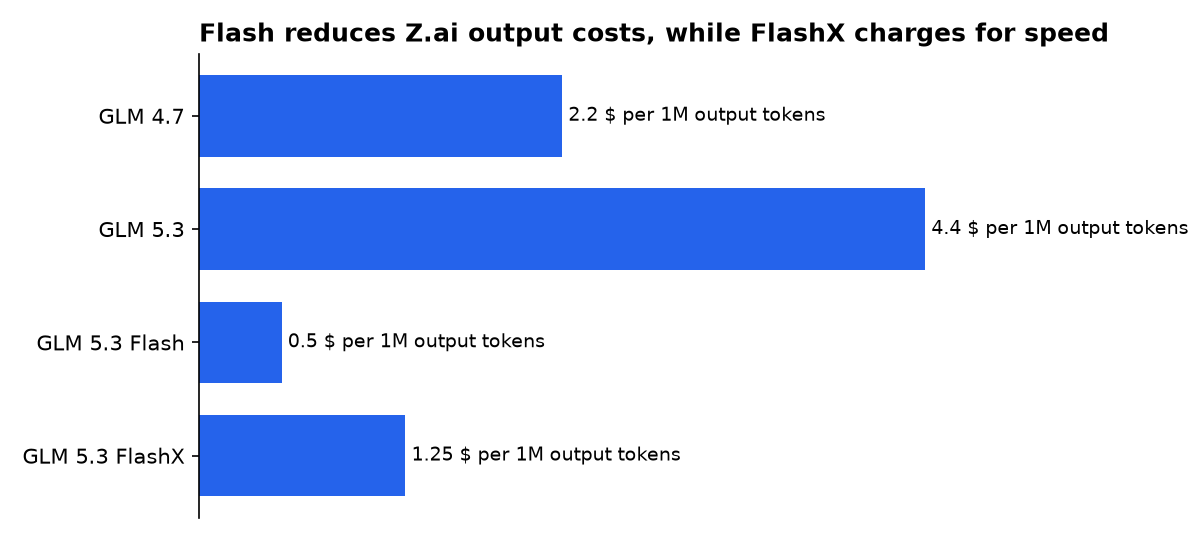
The table highlights an output-heavy result. GLM Flash Latest has the lowest listed agent cost in this comparison because its OpenRouter output listing is about $0.07 per million tokens. That result belongs to the observed marketplace listing, not to every GLM Flash deployment.
Teams should save the model name, provider route, displayed prices and the time of the check with each deployment. The OpenRouter alias page provides the direct page to inspect for that record.
Which is better, a GLM 5.3 or a GLM 5.3 Flash?
GLM-5.3-Flash costs less than GLM-5.3 on Z.ai’s direct schedule. Z.ai lists Flash at $0.15 per million input tokens and $0.50 per million output tokens, compared with $1.40 and $4.40 for GLM-5.3. (docs.z.ai)
The price gap is large enough to shape model selection. One million input tokens and one million output tokens cost $0.65 on standard GLM-5.3-Flash before cache use. The same volumes cost $5.80 on GLM-5.3. (docs.z.ai)
GLM-5.3-Flash is a native multimodal model. Z.ai lists video, image, text and file input, with text output, a 1M-token context and a 128K maximum output. (docs.z.ai)
That specification suits coding, document processing and visual workflows. It does not prove that Flash will produce acceptable results for every codebase or business task.
A two-tier policy limits risk. Start with Flash for routine extraction, drafts, classification and first-pass coding. Escalate failed checks or high-impact work to GLM-5.3 after testing the acceptance criteria for the task.
What is the latest version of GLM?
The named Flash model in the current comparison is GLM-5.3-Flash. OpenRouter’s model catalogue also lists GLM Flash Latest as a separate alias with a 1,048,576-token context. (openrouter.ai)
Z.ai groups GLM-5.3, GLM-5.3-Flash and GLM-5.3-FlashX under its latest models. The pricing page therefore presents several current variants rather than one model for every workload. (docs.z.ai)
GLM-5.3-FlashX is a faster variant with different pricing. Z.ai’s model guide says it can reach 200 tokens per second. (docs.z.ai) Z.ai lists FlashX at $0.37 per million input tokens, $0.075 cached input tokens and $1.25 output tokens. (docs.z.ai)
The explicit API identifier is glm-5.3-flash. (docs.z.ai) The alias glm-flash-latest is more convenient for experiments, but its destination can change. Production systems should record the resolved model alongside evaluation results.
What is the cost of GLM?
Z.ai lists GLM-5.3-Flash at $0.15 per million input tokens and $0.50 per million output tokens. FlashX costs $0.37 input and $1.25 output. GLM-5.3 costs $1.40 input and $4.40 output. (docs.z.ai)
Cached input changes the Flash rates. Z.ai lists $0.03 per million cached input tokens for Flash and $0.075 for FlashX. (docs.z.ai)
Third-party tracking agrees with the direct FlashX rate. UsagePricing lists $0.37 per million input tokens and $1.25 per million output tokens, with a 1,048,576-token context. (UsagePricing)
For an older comparison, UsagePricing lists GLM-4.7 at $0.60 per million input tokens and $2.20 per million output tokens. It lists GLM-5.3-Flash at $0.15 and $0.50, with context windows of 204,800 and 1,000,000 tokens respectively. (UsagePricing)
How much does prompt caching change the bill?
Z.ai lists cached GLM-5.3-Flash input at $0.03 per million tokens, compared with $0.15 for fresh input. The cached rate is one-fifth of the fresh rate. (docs.z.ai)
For one million input tokens and one million output tokens, all-fresh usage costs $0.65 at Z.ai’s listed Flash rates. If the input qualifies for the listed cached rate, the result depends on how many input tokens are recognized as cached. (docs.z.ai)
That qualification is the important unknown. The public record does not establish Z.ai’s complete cache-recognition rules, including the exact eligibility conditions for request order, byte identity or prefix length.
Do not build a production forecast on an assumed cache hit. Measure the billed input categories through the account and API documentation available to your team. The public pricing page establishes the rates, but not every condition that determines recognition.
What should buyers actually do?
Choose the direct Z.ai GLM-5.3-Flash API when you need a named model and a published baseline price. Its listed cached-input rate can reduce the cost of eligible repeated input. (docs.z.ai)
- Use GLM Flash Latest for flexible traffic: OpenRouter currently lists about $0.05 input and $0.07 output per million tokens. Check the alias page before deployment and record its resolved model, provider, prices and check time.
- Use GLM-5.3-Flash batch for delayed jobs: OpenRouter lists $0.05 input and $0.18 output per million tokens. (openrouter.ai) Confirm the service’s turnaround terms before treating it as a batch workflow.
- Use GLM-5.3-FlashX when speed has a measured value: Z.ai lists $0.37 input and $1.25 output per million tokens. Its guide lists up to 200 tokens per second. (docs.z.ai)
- Use GLM-5.3 as an escalation model: its direct rate is $1.40 input and $4.40 output per million tokens. (docs.z.ai)
ModelCosts lists GLM-5.3-Flash as released on 26 August 2026, with a 1,000,000-token context and 128,000-token maximum output. Those specifications describe the named model. They do not guarantee a fixed alias price or a particular result on a task.
What we could not verify?
The public record does not establish a permanent price for the OpenRouter GLM Flash Latest alias. OpenRouter’s alias page is the direct place to inspect its current resolved model, provider route and price. The catalogue lists about $0.05 input and $0.07 output per million tokens, but those figures should be treated as a live marketplace listing rather than a procurement promise. (openrouter.ai)
The public record also does not provide a timestamped OpenRouter API response for the alias. Buyers should record the timestamp shown or available through the live OpenRouter page or API when they make a deployment decision.
Z.ai’s pricing page confirms cached-input prices, but the material reviewed here does not supply complete official documentation for cache eligibility. It does not prove that a repeated prompt will receive the cached rate.
The public record also does not establish official batch turnaround terms. OpenRouter lists a GLM-5.3-Flash batch price, but buyers need the current service documentation or account terms for processing time, availability and operational limits.
No public product specification establishes a universal quality winner between GLM-5.3 and GLM-5.3-Flash. Z.ai provides model specifications and prices, while teams still need task-specific acceptance checks before choosing an escalation policy.
Sources

