
AI Pose Gallery Chinese Edition is useful as a searchable visual reference library, not as a ready-made AI training dataset or a direct pose-control file. As of 28 October 2026, it contains 1,439 reference records across 288 pose groups; the often repeated 2,878 figure is the combined count of thumbnails and original-image files.
At a glance
- The repository mirrors 1,439 pose references, each represented by a thumbnail and a full-size image file.
- The Chinese gallery exposes 288 pose groups and five selectable viewing angles for browsing and downloading.
- The repository says its image archive occupies 659.5 MB, with PNG originals at 900 × 1,200 pixels.
- The library is better for choosing a composition than for producing OpenPose skeleton data, because its JSON records store labels and image paths rather than body-joint coordinates.
- The mirror’s source-code licence does not automatically cover the images, whose use terms need separate checking before commercial deployment.
What is AI Pose Gallery Chinese Edition?
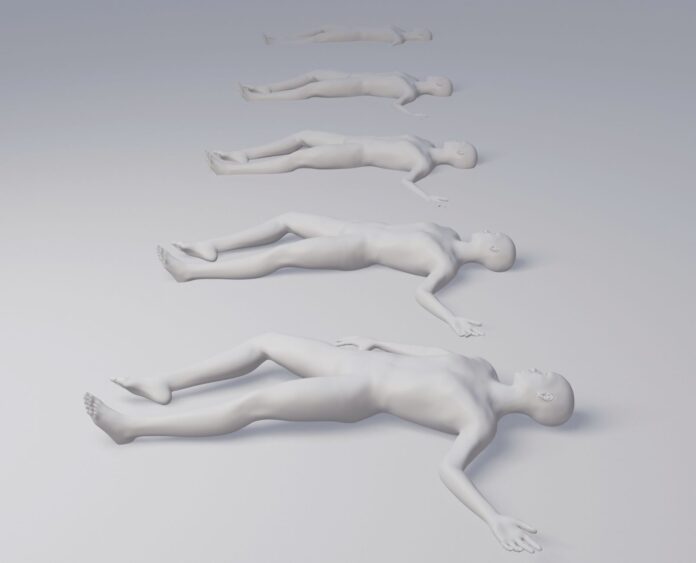
AI Pose Gallery Chinese Edition is a static, Chinese-language browser for a Japanese pose-reference collection. It provides grey, faceless mannequin line drawings intended for AI art, photography and composition reference. The live Chinese site describes the collection as a multi-angle library, while the original site says users can load its images into AI tools that accept pose or composition references.
The important distinction is between a reference image and a pose map. A reference image gives a generator visible guidance about a body, camera angle and framing. A pose map is machine-readable joint information, often a stick figure or a list of body coordinates. This gallery ships the former, not the latter.
The library is organised for a human selecting an image before generation. The translated records include an ID, category, pose number, pose name, viewing angle, thumbnail path and original-image path. The published JSON also includes a combined search field, which makes the collection easier to search by Chinese pose and category terms.
Is the 2,878-image claim accurate?
No: the useful number for a creator choosing a pose is 1,439 reference images, not 2,878 distinct poses. The repository describes 1,439 JPG thumbnails at 300 × 400 pixels and 1,439 PNG originals at 900 × 1,200 pixels. Those paired files total 2,878 assets, so they should not be treated as 2,878 independently composed poses.
This matters when judging variety. A five-angle set can make one pose more useful for a camera-sensitive prompt, but it does not create five different actions. The Chinese interface advertises five viewpoints: front, high angle, low angle, side and diagonal. The raw records show that a pose ID can recur across those view labels, such as the first standing pose appearing in five orientations.
| Gallery section | Reference records | What a creator gets |
|---|---|---|
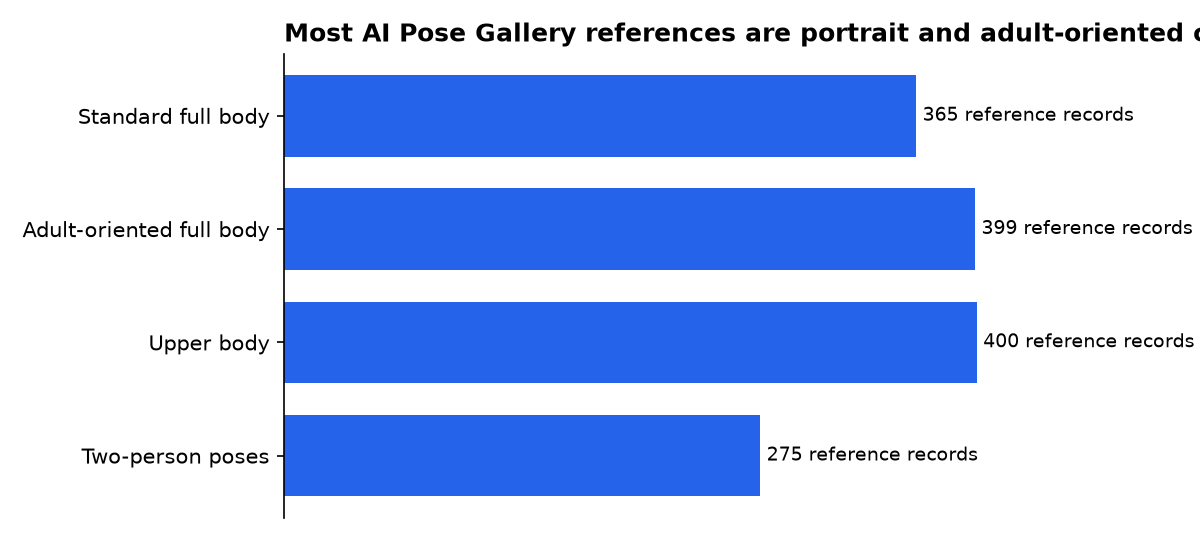
| Full-body single person, standard | 365 | General standing and action references |
| Full-body single person, adult-themed | 399 | Adult-oriented pose references requiring content review |
| Upper-body single person | 400 | Closer framing for portraits and character shots |
| Two-person intimate poses | 275 | Paired-body composition references requiring extra caution |
The category split shows that the collection is not a broad sample of everyday movement. It is a curated image-reference set with a large adult-oriented component. The repository’s own breakdown lists 365 standard full-body records, 399 adult-themed full-body records, 400 upper-body records and 275 paired records.
What did it promise, and what shipped?
The practical story is not a model launch. It is a repackaging project: a Japanese pose browser was mirrored, translated and turned into a downloadable static gallery. The result appears complete enough for browsing and self-hosting, but it does not turn the original images into newly licensed training material.
-
2026, exact launch date not publicly stated
The original Japanese site presents faceless mannequin drawings in a 3:4 format and says they can be loaded as pose or composition references in AI tools. It also promises full-resolution PNG downloads and multi-angle comparison. The live original gallery shows those intended uses and its five-angle interface. -
2026, exact mirror publication date not publicly stated
The Chinese repository promises a full mirror, complete Chinese translation and a zero-dependency responsive gallery. It ships 1,439 thumbnails, 1,439 originals, translated metadata, filtering, grouped browsing, a lightbox and image downloads. The repository’s feature list and file structure describe the delivered archive. -
28 October 2026
The deployed Chinese edition exposes the claimed user-facing counts, search box, grouped or single-image modes and download option. The public site displays 288 groups, 1,439 reference images and five views.
There is one gap between the marketing shorthand and the actual archive. The repository’s headline calls the material “2,878 images,” while its detailed inventory correctly identifies paired thumbnail and original files. For workflow planning, treat the archive as 1,439 selectable references with duplicate-resolution delivery.
How does it fit an AI image workflow?
AI Pose Gallery works best at the planning stage. Search for a pose, choose an angle, download the 900 × 1,200 PNG, then use it as an image reference in a generator that accepts reference images. Add a text prompt for identity, clothes, lighting and scene because the gallery’s drawings deliberately omit faces, costumes and backgrounds.
For a diffusion workflow, the safest sequence is simple:
- Choose a composition from the gallery rather than describing a difficult body position in text alone.
- Use the full-size PNG as a reference image, then write the details that the mannequin does not contain.
- Generate several variations before changing pose, subject or camera position.
- If your tool supports pose conditioning, first convert the reference through a pose detector or editor.
That last step is essential. ControlNet is a neural-network structure that guides a diffusion model with an added condition, such as a pose image. Its official implementation includes pose-to-image examples and describes the method as control through extra conditions. ControlNet does not make this gallery’s metadata into a joint-coordinate dataset by itself.
In practice, use the gallery for selection and use an OpenPose-style detector or pose editor for formal skeletal control. OpenPose is designed to detect body, face, hand and foot keypoints; its project describes a total of 135 detectable keypoints. That is a different output from the gallery’s labelled image paths.
How does it compare with pose datasets?
AI Pose Gallery is smaller and narrower than research datasets, but it is immediately readable by artists. Its advantage is editorial convenience: named poses, fixed multi-angle drawings and a lightweight browser. Its drawback is that it lacks the annotated joints and real-world variation needed to train or evaluate pose-estimation systems.
| Resource | Primary purpose | Best use in an image workflow | Not suitable for |
|---|---|---|---|
| AI Pose Gallery Chinese Edition | Curated mannequin references | Selecting an action, framing and camera angle | Pose-model training or benchmark evaluation |
| MPII Human Pose Dataset | Human-pose estimation benchmark | Research and detector development | Quick, clean art-direction browsing |
| COCO Keypoints | Keypoint detection and evaluation | Training or assessing detection systems | Hand-picked pose reference boards |
| OpenPose or a pose editor | Extracting or constructing skeleton controls | Producing a control image for a compatible generator | Supplying visual style or a finished reference library |
MPII illustrates the difference in scale and purpose. The Max Planck Institute describes its dataset as roughly 25,000 images containing more than 40,000 annotated people across 410 activities. Those images are useful because they include body-joint annotations and activity labels, not because they are polished pose cards.
COCO also treats pose as an evaluation and annotation problem. Its official site separates Keypoints from detection, captions, segmentation and DensePose tasks. COCO’s keypoint section is a benchmark resource, whereas AI Pose Gallery is a browsing and inspiration resource. They are complementary only if you keep those jobs separate.
What does the licence allow?
The licensing picture is the main reason not to treat this as a plug-and-play commercial dataset. The original Japanese gallery says its images may be used without charge for commercial creative work and editing, but it prohibits redistributing, reposting or reselling the image data itself. That is permission for use, not a blanket open-data licence.
The Chinese mirror is more restrictive in its repository licence notice. It applies MIT terms to its HTML and scripts, but says the images and source data belong to the original author and are outside that MIT licence. The mirror’s licence text also says those materials must not be used commercially.
The content itself also needs review. The repository flags adult-oriented reference material, including categories with sexual terminology. Teams should keep such files out of general asset libraries, use age-appropriate access controls and ensure their model provider’s content policy permits the planned workflow.
Can you deploy the gallery yourself?
Yes, technically. The project is a static site with no framework dependency. Its instructions say local viewing needs an HTTP server because the page fetches JSON, and its build script copies the HTML, data and image folders into a deployment directory.
The deployable payload is not small for a simple reference browser. The repository lists a 637 MB originals folder and a 22 MB thumbnail folder. That makes the thumbnail-first design sensible: users can browse smaller JPGs, then load a PNG only after opening an item.
The project also configures long-lived cache headers for images and shorter caching for data. That can keep repeat browsing responsive, but it creates another maintenance duty: if imagery or permissions change, a fork operator must remove the files and purge cached copies rather than assuming a code update is enough.
What we could not verify?
No public release date, versioned release package or changelog establishes when the Chinese mirror first went live. The repository has no public statement from the original artist approving this specific mirror, its translation or its bulk-download archive. The original creator could settle the reuse question by publishing a clear licence covering mirrors, redistribution, commercial reference use and model training.
There is also no public evidence that the 1,439 references were labelled with OpenPose joints, quality-checked for anatomical accuracy or tested against a particular image generator. A maintainer could settle that by publishing pose annotations, a provenance manifest and a workflow test set. Until then, AI Pose Gallery should be treated as a useful visual lookup tool, not a validated technical dataset.
Sources

