

FuturPulse analysis · 1 October 2026
AIHOT’s GitHub framework is a self-hosted publishing system for industry briefings. It includes a website, administration tools, a selection pipeline, event clustering and scheduled reports. The repository ships with 18 demonstration AI-news sources, but says operators must replace them with sources for their own field.
At a glance
- GitNova dates the public repository to 28 September 2026.
- The included starter configuration has 18 public overseas AI-news sources, not AIHOT’s production source list.
- The selection process scores potentially relevant material twice against the same standard before it enters the selected feed.
- AIHOT requires Docker and an OpenAI-compatible model API key for its basic deployment path.
- The project exposes content through web pages, RSS, an API, MCP and agent-readable formats.
What is AIHOT GitHub, exactly?
AIHOT is a framework for operating a specialised news or intelligence site. It collects material from configured sources, filters possible items with a language model, creates Chinese headlines and summaries, groups related coverage into events, then publishes reports. The repository presents this as a way to create a site for a field such as law, HR, finance or precious metals. The project’s README describes the full workflow and its intended use.
The important distinction is between the framework and the AIHOT news service. The framework gives an operator code and configuration to run a separate site. The service gives readers or agents access to AIHOT’s existing AI-news output. Khazix Skills describes its aihot skill as a way to retrieve AIHOT daily reports and AI updates.
That distinction matters for anyone searching GitHub for “aihot.” Installing a skill does not create a new publication or provide control over its source list. Running the framework can provide that control, but it also makes the operator responsible for editorial rules, licences, infrastructure and error handling. XinAloha’s skill documentation says its product is anonymous and read-only.
AIHOT’s central proposition is not that language models can replace an editor. It is that editorial choices can be put into visible configuration. Its prompts and selection thresholds are included in the repository, so an operator can inspect and change the criteria that decide what counts as significant. The README says every prompt and selection threshold is included.
What was promised, and what has shipped?
AIHOT has developed along two paths: a public AI-news service and a later open-source framework. The service made AIHOT’s existing output available to readers and agents. The framework exposes the system’s structure for people who want to create a different industry publication.
| Date | Promise or claim | What was available or later shipped |
|---|---|---|
| 8 May 2026 | The AIHOT operator said the service would offer Skill, RSS and API access for agents, readers and integrations. | The launch account described daily reports, selected items, category queries and keyword search. |
| 21 September 2026 | A community listing described the aihot skill as a read-only client for current Chinese AI news and daily briefings. | The listing identifies the product as a consumer of AIHOT’s public v1 API. |
| 28 September 2026 | The separate AIHOT repository appeared as a framework for replacing sources and curation rules. | GitNova records its creation date and describes source replacement, LLM scoring and event clustering. |
| 1 October 2026 | The framework offered a route to a branded niche site rather than access to AIHOT’s own operating system. | Its README documents source configuration, prompts, deployment and public outputs. |
The project itself gives an important warning. It calls the release a snapshot of code running for AIHOT, rather than a polished general-purpose platform. The maintainer says future updates will be synchronised where possible, but does not promise that every production change will reach the public repository. That limitation appears in the repository’s “before you start” section.
This is a useful warning for founders assessing the project. A snapshot can still be valuable, especially when it contains the working editorial model. It also means a deployment needs a plan for upstream changes, security updates and local modifications rather than an assumption that GitHub will always match the live service.
How does AIHOT decide what readers see?
AIHOT treats “hot” as an event rather than a pile of links. A company announcement, several media reports and a discussion thread may all concern the same development. The system aims to group those items into one reader-facing event. The repository says it finds candidates with title-and-summary vectors, then asks models to classify the relationship.
The selection path starts with duplicate checking and pre-screening. Material that might matter is independently scored twice against the same standard. Only items that pass the configured threshold enter the selected feed. AIHOT describes duplicate checks, pre-screening and two independent scoring passes.
A score is not a verified measure of truth. It is a model’s judgment against an operator’s prompt and threshold. That makes the selection configuration editorial policy, not a neutral fact detector, and it should be treated with the same scrutiny as any other publication rule.
AIHOT separates sources into tiers, including official first-party sources and media or personal sources. It applies selection thresholds according to those tiers. The project describes source grading and thresholds that vary by source type.
For a legal, healthcare or financial briefing, that can be a sensible starting point. A regulator’s notice and an analyst’s interpretation do not carry the same evidential weight. Yet tiering is not enough on its own: an official statement can be incomplete, while good reporting can supply context that the original announcement omits.
After an item is selected, AIHOT writes a Chinese title, an answer-first summary, a recommendation reason and tags. It also creates topic structures around companies, areas and content types. The project lists titles, summaries, recommendation reasons, tags and topic pages among its outputs.
This shared workflow matters because one early choice affects later products. A poor source rule can influence the homepage, search results, event pages and reports. A careful rule can make those outputs more consistent, but it cannot guarantee that a model summary will preserve every qualification in the source material.
Why is event-based heat more trustworthy?
AIHOT ranks events by independent discussion, not raw article volume. Within a 48-hour period, each independent source counts once, and its contribution falls by half after 24 hours. Repeated crawling does not raise the score, and multiple posts from one outlet count once.
That approach addresses a familiar aggregation failure. Syndication can make one announcement appear to be many separate confirmations. Treating a source as one contribution makes a ranking less vulnerable to a single publisher repeating the same story, although it does not solve the problem of several outlets relying on the same original claim.
Heat is therefore a measure of attention, not proof. A highly ranked event can mean that many independent sources discussed it. Readers still need the original source to judge the underlying claim, the evidence and the language used.
AIHOT says it provides the same content through the website, RSS, a public API, MCP and agent-readable pages. It also says those outputs share article withdrawal and full-text permission rules. The README describes these shared publication channels and policies.
That architecture is more manageable than maintaining separate copies for every channel. If an operator removes a withdrawn item or changes permissions, the rule can apply across the site and machine-facing feeds. The value depends on whether the operator actually maintains those rules and checks exceptions.
The framework says it links selected material back to the original publication. It says full text appears only where the source configuration permits it. Its source and agent-output documentation describes original links and full-text permissions.
That is a useful default, not a complete copyright policy. A publisher using the framework must still decide which material it can store, translate, quote or redistribute. The public AIHOT skill documentation makes the same point: third-party copyright remains with the original author. XinAloha’s documentation says third-party rights do not change because content passes through AIHOT.
What do you need to run AIHOT?
AIHOT’s basic setup requires Docker and an OpenAI-compatible model API key. Docker is software for separating applications from underlying infrastructure, rather than a hosted service that removes operational work. Docker describes its platform as a way to develop, ship and run applications separately from infrastructure.
The repository’s quick-start path is to clone the project, initialise environment settings with a model key and start Docker Compose. It says content begins appearing after one or two minutes, while the first imported material takes roughly half an hour to process. Those timings are a project estimate, not a service-level guarantee.
The underlying stack includes Node.js, TypeScript, React Router, Fastify, PostgreSQL, pg-boss, Tailwind CSS and Docker Compose. AIHOT publishes that technology list in its README. That is enough moving parts to justify testing on a non-production machine before pointing a public domain at it.
The operator must also manage model credentials and external services. AIHOT says its administration tools include budget circuit breakers for paid providers, run records and alerts. Those controls are listed among the framework’s back-office features.
Budget controls do not establish a fixed operating price. Model calls vary with the volume of incoming material, prompts, retries and selected output. Hosting, extraction services and social-network access can also vary by deployment, so the repository does not support a single monthly-cost estimate.
Docker itself also has its own commercial terms in some circumstances. Docker says commercial use of Docker Desktop in organisations with more than 250 employees or more than $10 million in annual revenue requires a paid subscription. That rule concerns Docker Desktop, not AIHOT’s MIT code licence.
What should a niche publisher customise?
Most of the editorial customisation sits in the industry/ directory. AIHOT identifies settings for site copy, taxonomy, topics, initial sources, prompts, selection thresholds, optional features, brand assets and policy pages. The README lists these files and their roles.
Start with sources rather than branding. AIHOT supports RSS, web-page lists, JSON feeds, X accounts, WeChat accounts and material pushed by an operator’s own scripts. The project lists six source types.
A legal briefing could begin with regulators, courts and professional bodies. A company-intelligence briefing might give more weight to filings, company announcements and specialist reporting. Those are editorial choices, and the framework cannot determine them without someone who understands the audience and the field.
Next, define significance in language your intended reader would recognise. A compliance team may prioritise new duties, deadlines and enforcement. A recruiting team may care more about workforce reductions, compensation data and employment-law changes.
AIHOT provides a way to calibrate that judgment. The repository recommends using one or two hundred operator-labelled examples with its selection evaluation script, then adjusting prompts and thresholds. It also says the examples should reflect the operator’s own understanding of what belongs in the selected feed.
That process is closer to editorial testing than to automation theatre. A labelled example set can show where a rule selects irrelevant material or misses important items. It cannot prove that the system will perform well on future stories, especially when the source mix or the news cycle changes.
AIHOT also includes optional AI-specific modules, including a model ranking feature and Codex reset monitoring. The framework says operators can switch those features off for other industries. The project identifies those modules as configurable AI-specific features.
How does it compare with simpler aggregators?
AIHOT is more involved than a static feed collector because it combines storage, model calls, editorial selection, event grouping and multiple publication outputs. That work buys a configurable workflow. A simpler system can be the better choice when the requirement is to display incoming links with minimal transformation.
| Decision point | AIHOT framework | Typical feed-style aggregator |
|---|---|---|
| Editorial rule | Prompts and thresholds are designed to be changed by the operator. | Usually filters by topic, keywords or source lists. |
| Repeated coverage | Groups related reports into a single event before ranking. | Often displays separate posts as separate items. |
| Public outputs | One publication layer supports web pages, RSS, API, MCP and agent formats. | Usually focuses on a web page, feed or export file. |
| Quality tuning | Supports labelled examples and selection calibration. | Often relies on manual filter changes. |
The comparison is clearest in the number and type of inputs each project documents. AIHOT supports 6 source types, while SuYxh’s AI News Aggregator documents 11 aggregation platforms and more than 70 RSS feeds. Those figures describe intake, not editorial quality.
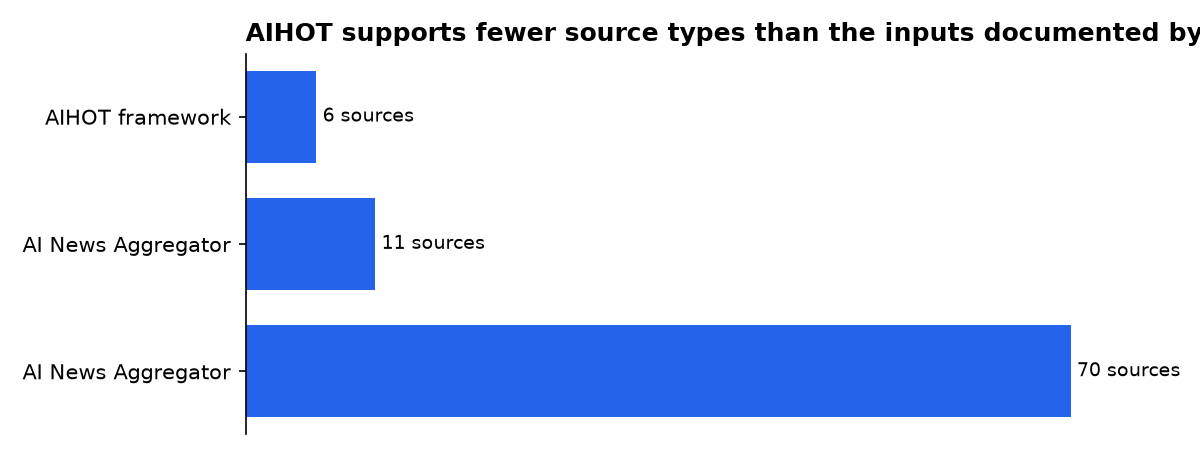
SuYxh’s project is a collection-first design. Its technical specification describes automated collection, AI-related filtering, duplicate removal, English-to-Chinese title translation and publication through a React application. It schedules updates every two hours. The specification documents that architecture and update schedule.
AIHOT’s emphasis is different. It focuses on replaceable editorial prompts, source tiers, event grouping and report production. Neither approach automatically makes a briefing reliable: a broad collector can ingest poor sources, while an editorial framework can encode poor judgment in a sophisticated-looking prompt.
Do not confuse either codebase with an AIHOT agent skill. The community listing for Khazix’s aihot skill says it uses anonymous, read-only requests to the AIHOT v1 API. It does not provide the user with AIHOT’s database, selection settings or source-management controls. Sofarbot describes the skill’s read-only scope and API role.
What makes a briefing credible in practice?
A credible deployment should explain what it watches, how it chooses items and where each claim began. AIHOT gives an operator places to express those choices through source configuration, prompts, policy pages and original links. It does not evaluate whether those choices are responsible.
Use primary material for claims that can change obligations or money. Link to the original item wherever possible. Treat a model-written summary as an editorial aid, not as proof that the underlying claim is accurate.
Editors should also inspect event matches. AIHOT says uncertain relationships are merged and checked again with another model. The project describes a second-model confirmation step for uncertain event relationships. That may reduce obvious duplication, but it can still merge separate developments or separate events that later prove unrelated.
Reporting cadence should match the team’s ability to review output. AIHOT schedules its daily report for 08:00, a weekly report on Monday and a monthly report on the first day of each month. A small publisher can use those outputs as review material rather than treating an automatic schedule as a reason to publish unchecked prose.
For external commercial use, licensing needs separate attention. XinAloha’s AIHOT skill documentation says personal non-commercial use, public-interest non-commercial use and internal organisational use are free under its public rules. It says external commercial products, paid services, client delivery, resale and public redistribution require written permission. The skill documentation sets out those usage boundaries.
Those rules concern AIHOT service output and the skill package, not a blanket licence for third-party source material. AIHOT’s code is MIT-licensed, while its name and logo are excluded from that licence. The repository states that the code uses MIT but the AIHOT name and logo are outside the licence.
What could we not verify?
AIHOT does not publish its complete production source list or operating data in the repository. It says the framework includes 18 demonstration sources and excludes the live service’s source list and operational data. That means outsiders cannot compare the production service’s rankings with a self-hosted installation using the sample setup.
We could not verify a typical monthly operating cost. The framework documents model-key requirements and budget controls, but it does not publish a standard workload, model bill, hosting price or extraction-service bill. Actual cost depends on the operator’s sources, settings, traffic and provider contracts.
We could not verify that every feature in the live AIHOT service is present in the repository. The maintainer explicitly calls the project a snapshot and says future synchronisation is not guaranteed. That limitation is stated in the repository itself.
The most useful next step is practical: build a small source list, label a set of examples and test the selection rules before publishing to a real audience. AIHOT’s evaluation tooling is designed for that calibration work, and the framework’s prompts and thresholds can then be changed to reflect the result. The repository points operators to its selection and calibration workflow.

