
FuturPulse analysis · 21 October 2026
New-term-radar is an open-source daily scanner for names that are beginning to surge in AI. It watches X, Hugging Face, GitHub, sitemaps, new sites and search data before turning candidates into a keyword table. Its published example configuration costs about $15 a month. The repository says the tool runs with Python 3.10 or later.
At a glance
- New-term-radar reads early signals, then uses Google Trends and keyword data as checks rather than as its first discovery source.
- Its GitHub breakout rule covers repositories under 14 days old that average 200 or more stars a day, or gain 400 or more stars since the previous day.
- The example configuration reads 35 X accounts three times a day and creates a keyword table for five names each day.
- The project publishes a sample table, but not the historical dataset needed to test precision, false positives or lead time across candidates.
What is a new AI term radar?
A new AI term radar is a watchlist for names before they become mature keywords. It looks for a model, product, tool or repository while the name is still forming. The useful output is not simply an alert. It is a candidate with evidence, a possible user task and a decision about what to do next.
New-term-radar describes its job in those terms. Its repository says a new name can first appear in an X post or in Hugging Face’s trending list. It may then surface through a fast-growing GitHub repository, directory pages, new sites or a site’s own search impressions. Google Trends and keyword tools arrive later in that sequence, according to the project.
That sequence is a discovery workflow, not proof of future demand. A name can be visible before people search for it at scale. The radar therefore needs to separate an observable emergence event from a prediction about traffic, revenue or editorial value.
DeepSeek-V4.1-Flash-1017 shows why that distinction matters. The Hugging Face page recorded the model as created on 17 October 2026, with a trending score of 1,304, 1,410 likes and 10,233 downloads when the signal was collected on 19 October 2026. Hugging Face also lists image-text-to-text as its task and MIT as its licence.
Those observations establish that the model had appeared and attracted activity on Hugging Face. They do not establish that a large audience would search for the exact model name later. A responsible radar records both facts separately.
How is this different from AI term tracking?
Most AI term tools answer a later question. A glossary explains an existing term. A model directory records established launches. An AI search tracker measures whether a known company appears in generated answers. A term radar asks which unfamiliar name deserves investigation now.
Tech Jacks Solutions’ AI Glossary describes a collection of 438 terms across machine learning, governance, security and agentic AI. That makes it a reference resource. It does not present itself as a day-by-day detector for names on their first appearance.
Snoika’s AI search glossary displays 24 terms grouped under AI search, measurement, technical subjects, content and links, AI models and SEO basics. Its entries define concepts such as AI visibility, AI citation, grounding and prompt tracking. The glossary helps a team use established measurement language after it has chosen a programme.
Rapidops’ AI Tracker presents models, products and use cases in a catalogue. Its visible entries include Grok, Defog SQLCoder and Codey, each with a launch date. That is useful for browsing known releases. It is not evidence of a continuously reproducible alert stream for names still forming.
Am I Cited describes AI search visibility tools as systems that measure brand appearances in AI-generated answers, citations, sentiment and competitive benchmarks. This is downstream measurement. It starts with a known brand or topic and asks how often answer systems mention it.
Citelligence describes the same category as repeated prompt sweeps. Its guide says trackers commonly run 30 to 200 buyer-intent queries through several AI platforms, extract brand mentions and calculate share of voice. Citelligence’s guide is therefore useful for understanding visibility tracking, but it does not turn that tracking loop into a new-term discovery system.
What does the project actually monitor?
The repository lists eight broad signal groups, although not every signal is equally independent. X and Hugging Face provide early discovery. GitHub measures public repository activity. Sitemaps and new-site checks look for pages and domains. Sellers and revenue provide commercial clues. Search Console and later trend checks provide evidence about what happens after discovery.
| Signal | What it records | Cost or requirement | Editorial use |
|---|---|---|---|
| X | Names used for the first time in 60 days | $0.003 per account per run; AIsa key | Find names in selected accounts |
| Hugging Face | Models and Spaces entering the trending top 50 | Free | Find models and demos attracting attention |
| GitHub breakout | Repositories under 14 days old with rapid star growth | Free; token optional for rate limits | Find projects gaining developer attention |
| Sitemaps | Words shared by several new URLs | Free; listed sitemaps required | Find names appearing across directories |
| New sites | Domains registered and first indexed within 90 days that rank for 20 or more keywords | About $0.13 per query weekly; AIsa key | Find new commercial activity |
| Sellers | Sites linking to payment platforms for the first time | About $0.40 a week; AIsa key | Find products beginning to sell |
| Search Console | Queries receiving impressions for the first time | Free; site owner’s Google token | Find demand already reaching your site |
| Review | Later Google Trends movement against a baseline | $0.0012 per search variant; AIsa key | Check what happened after discovery |
Signal descriptions and prices: New-term-radar repository.
The GitHub rule is more specific than a general “trending repository” label. The project watches a repository under 14 days old when it averages at least 200 stars a day or adds at least 400 stars since the previous day. Hugging Face candidates enter when Models or Spaces appear in the trending top 50.
These are public activity measures. A star is not a purchase, a download is not sustained use and a trending position is not search demand. The tool’s value depends on whether several signals converge and whether a human can explain the resulting name to a reader.
What does the keyword table show?
The project’s keyword table tries to connect a name with the job behind it. A name can be short-lived, while a generic task may remain useful. The table therefore records the candidate, its type, estimated searches per day, trend movement, a comparison with “gpts”, the recent direction and a decision.
| Candidate | Type | First-seen signal | Estimated searches/day | Trend evidence | False positive or limitation | Decision |
|---|---|---|---|---|---|---|
| photocraft | Name | Not published in the sample | 12,747 | Started rising 5 October 2026; 97 vs 3.1 benchmark; still rising | Page-one result not recorded in the shortened table | Prioritize |
| claude haiku 5.5 | Name | Not published in the sample | 1,863 | Started rising 7 October 2026; 100 vs 23.7 benchmark; sixfold recent increase | Not a false positive in the sample; candidate date is absent | Prioritize |
| ai image detector | Generic phrase | Derived from SynthID Detector | 2,537 | 87 vs 31.6 benchmark; flat; 1.2 times the previous seven-day period | Source name is another product; exact first-seen date is absent | Watch |
| photoshop alternative | Generic phrase | Derived from photocraft | 244 | Started rising 8 October 2026; 61 vs 61.7 benchmark; flat; 1.8 times the previous period | Brand-dependent phrase marked as a risk | Skip |
Shortened real run dated 12 October 2026: New-term-radar repository. The project says the sample’s page-one column was added later.
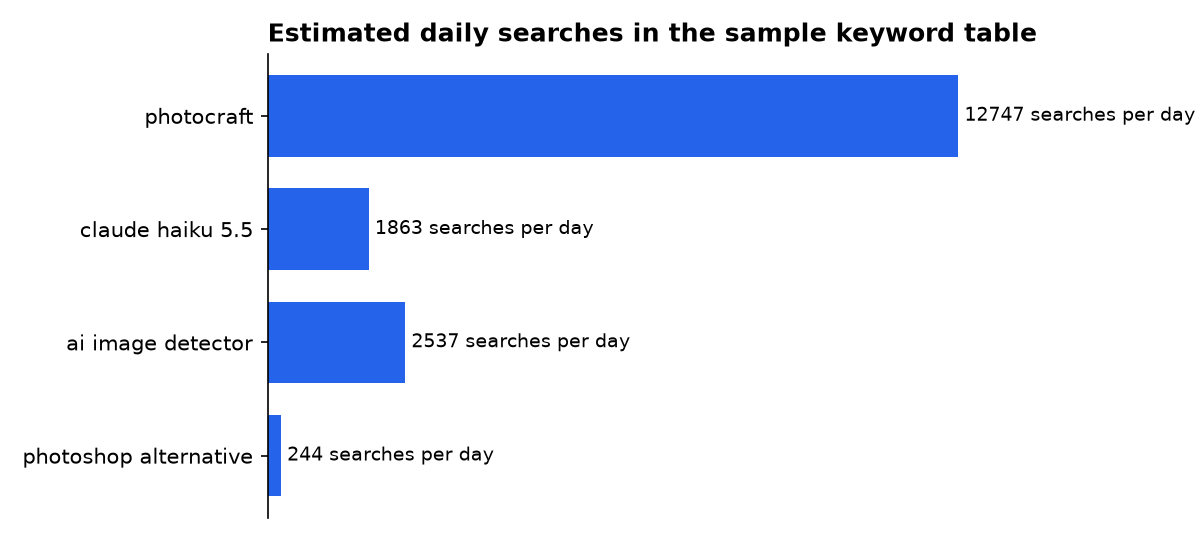
The table is useful because it exposes the difference between a proper name and a user task. “AI image detector” is attached to SynthID Detector, while “photoshop alternative” is attached to photocraft. The project marks the latter as a risk because demand may remain tied to the incumbent brand rather than the new product.
The project says its phrase generation starts with evidence from the most-liked X posts that mention a name and, for repositories, the README. A model then writes the ordinary-language phrase associated with each job. A second call scores how well the name answers each phrase and drops loosely related suggestions.
Google Ads supplies monthly search estimates for phrases that survive the minimum-volume filter. Google Trends supplies the curve, the starting date, the peak and the recent comparison. A name without volume data is sized against a benchmark phrase. The repository explicitly describes these figures as estimates.
The table is not yet a reproducible historical benchmark. It gives four rows from one shortened run, but it does not publish candidate-level first-seen dates for every signal, every rejected candidate, or the exact later demand record needed to calculate precision.
What did the project promise versus demonstrate?
The strongest public example is Niko1221/Strata. The project says the repository was created on 24 September 2026 and had 7,700 stars nine days later. It also says people searched for “niko strata” from 26 September, while no second repository carried the name and no keyword tool listed it.
This is a useful illustration of the intended lead. It is not a performance rate. The project does not publish a candidate-level file showing all alerts, the alerts later rejected, the first date each external tool registered them or the median lead time across a defined test period.
The seller signal needs the same caution. The repository says it detects sites linking to payment platforms such as Stripe Payment Links, Polar, Lemon Squeezy, Gumroad and Creem. It records the first day each site linked to a platform and excludes new pages from old sellers, platform pages and forum threads.
The project also describes a correction to its earlier logic. A fresh payment link could be mistaken for a fresh seller when the seller’s site was older. The notes say the revised check found 17 of 60 Stripe sellers in one day’s list had actually just started. That figure is reported by the project, and the repository does not publish the underlying candidate dataset or independent validation.
How can a reader reproduce the results?
A credible evaluation needs more than a screenshot of a keyword table. It needs the candidate list, the signal that first detected each candidate, the first-seen date for every signal, the later search record, the false-positive result and the comparison date for Google Trends and keyword tools.
The following is the minimum useful schema:
- Candidate: exact spelling, aliases, product or model relationship and source URL.
- First-seen dates: separate dates for X, Hugging Face, GitHub, sitemaps, new sites, sellers, Search Console and review.
- Demand: later Google Trends movement, benchmark value, estimated daily searches and the date of each reading.
- Outcome: relevant or irrelevant, sustained or fading, and the reason for rejection.
- Lead time: hours or days between the first radar signal and each later Google Trends or keyword-tool observation.
- False positive: a detected candidate that fails the stated relevance or persistence test.
Using the published material, only a partial table can be reconstructed. The project supplies a first-seen date for Strata’s repository and a later search date. It supplies creation and collection dates for DeepSeek-V4.1-Flash-1017. It supplies demand fields for four keyword-table rows, but not their signal dates or false-positive outcomes.
| Candidate | First-seen date by signal | Subsequent demand | False positives | Lead time versus Trends or keyword tools |
|---|---|---|---|---|
| Niko1221/Strata | GitHub: 24 September 2026; search: 26 September 2026 | 7,700 GitHub stars nine days after creation | Not published | Not fully published; the project says no keyword tool listed it in the example |
| DeepSeek-V4.1-Flash-1017 | Hugging Face creation: 17 October 2026; measured: 19 October 2026 | 1,304 trending score; 1,410 likes; 10,233 downloads | Not published | Not published against Google Trends or a keyword tool |
| photocraft | Not published by signal | 12,747 estimated searches/day; rising from 5 October 2026 | Not published | Not published |
| claude haiku 5.5 | Not published by signal | 1,863 estimated searches/day; rising from 7 October 2026 | Not published | Not published |
| ai image detector | Derived from SynthID Detector; date not published | 2,537 estimated searches/day; flat; 1.2 times the prior period | Not published | Not published |
| photoshop alternative | Derived from photocraft; date not published | 244 estimated searches/day; flat; 1.8 times the prior period | Brand-dependent phrase marked as a risk | Not published |
Reconstructed only from the project’s published example, measured Hugging Face record and shortened keyword table: New-term-radar repository and Hugging Face.
This table shows the central evidence gap. A reader can reproduce the arithmetic for the displayed demand figures only if the underlying tool outputs are preserved. A reader cannot calculate precision, recall, median lead time or a false-positive rate from the published sample alone.
Which signals deserve the most trust?
No early signal proves demand. A model can attract downloads without becoming a durable search term. A repository can gain stars because developers are curious. A payment link can indicate a new offer without showing that the offer has customers.
Trust should increase when separate signals describe the same candidate. A model entering Hugging Face’s top 50, a repository gaining stars and new directory pages using the same name provide a stronger editorial lead than any one event. That remains a prioritisation rule, not a statistical validation.
The radar’s own review stage is designed to test candidates later. The project says it checks each lead in Google Trends 14 days later against its own baseline, then records hit rate and days ahead by signal. The public notes describe the intended measurement, but do not provide the historical results needed to verify it.
For model context, Artificial Analysis tracks model intelligence, efficiency, architecture, inference speed, cost and release timing. Its page says the Intelligence Index uses 10 evaluations. That information can help a reviewer judge whether a newly surfaced model represents a meaningful technical change, but it does not measure term demand.
How much does a small radar cost?
New-term-radar’s published example reads 35 X accounts three times a day and creates a keyword table for five names each day. The project estimates about $10 a month for X reads and about $5 for the keyword table, or roughly $15 in total. These are service costs, not a software licence fee.
The same repository says an X read costs $0.003 per account per run. It estimates the five-name keyword table at about $0.18 a day, or about $5 a month. The actual bill depends on the account list, scan frequency and optional services.
| Radar plan | X account reads | Estimated monthly cost | What it means |
|---|---|---|---|
| No X monitoring | 0 per day | $5.00 | Use the project’s free repository, model and sitemap signals, while retaining the sample keyword-table cost. |
| Lean daily scan | 35 per day | $8.15 | Read the example account list once daily, then add the estimated keyword-table cost. |
| Published sample pattern | 105 per day | $14.45 | Read 35 accounts three times daily, close to the project’s roughly $15 example. |
FuturPulse calculation using 30 days, the repository’s $0.003 account-read price and its estimated $0.18 daily keyword-table cost: New-term-radar repository.
The table leaves out staff time. Every candidate still needs a human check of the source, spelling, licence, capability and likely user task. A low service bill does not make an alert useful by itself.
Should you use a radar or an AI visibility tracker?
Use a radar to decide what to investigate. Use a visibility tracker to measure whether an established brand appears in generated answers. The tools address different points in the publishing cycle.
Citelligence says AI search trackers run fixed prompt sets, capture answers from platforms such as ChatGPT, Claude, Gemini, Perplexity, Google AI Overviews and DeepSeek, then extract mentions and calculate share of voice. Its guide describes a measurement loop for known buyer questions.
A practical sequence is straightforward. First, the radar identifies an unfamiliar name. Second, an editor checks the primary model or product page. Third, the team maps the name to a stable user task. Finally, prompt tracking checks whether answer systems cite or mention the resulting work.
Keep technical emergence separate from commercial verification. OpenRouter’s model catalogue lists model prices by input and output tokens. Its published rates can support an API cost comparison, but a price list cannot show whether a newly detected name will remain relevant.
What should a weekly review contain?
Run collection daily if the candidates change quickly, but review editorial decisions on a fixed schedule. A regular review makes it easier to distinguish a durable lead from a short launch spike.
- Candidate: exact name, spelling variants and relationship to any parent product.
- Evidence: original post, model page, repository, sitemap or payment link.
- First-seen record: one date per signal, not one blended date.
- User job: the task a reader might type in ordinary language.
- Demand record: later Trends movement, estimated searches and benchmark.
- Competition: page-one conditions when the team considers publishing.
- Outcome: publish, update an existing guide, watch or discard.
- False-positive reason: irrelevant, duplicate, temporary, brand-dependent or unsupported.
The project’s own table provides a useful starting structure because it records names, generic phrases, demand estimates, trend direction and decisions together. It needs a historical export around that table. Without the rejected candidates and their dates, readers cannot tell how often the system produces useful leads.
For a scheduled Python workflow, Astral’s uv documentation describes a package and project manager that can create environments, manage dependencies, run scripts and install Python versions. The documentation also describes lockfiles for reproducible resolutions. That can make the execution environment easier to reproduce, but it does not validate the radar’s data or conclusions.
What we could not verify?
New-term-radar does not publish an independently audited hit rate, a median lead time over Google Trends or keyword tools, or a false-positive rate across all signals. Its public examples show how the workflow works, but they do not establish how consistently it gets ahead.
The project also does not publish the candidate-level dataset needed to reproduce the seller result. The claim that 17 of 60 Stripe sellers had just started comes from the project’s own notes. The notes do not provide the underlying sites, first-link dates, exclusion decisions or independent validation.
We could not verify whether a detected name produces durable traffic, revenue or citations in AI answers. The published keyword table estimates demand for four rows, but it does not provide the complete first-seen history, all rejected candidates or later outcomes.
A versioned benchmark could resolve the gap. It should include every alert, each signal’s first-seen date, the later Trends and keyword-tool readings, the editorial relevance decision and the false-positive reason. Until then, the radar is best treated as a transparent triage tool rather than a proven forecasting system.

