
FuturPulse analysis · 2 November 2026
Gemma 4 26B A4B costs $0.03 per million input tokens and $0.089 per million output tokens on OpenRouter as of 2 November 2026. The model has 25.2B parameters in total, but activates 3.8B for each token. That smaller working set helps explain its low serving cost, though no provider publishes a complete cost formula.
At a glance
- Google DeepMind’s Gemma 4 26B A4B has 25.2B total parameters and 3.8B active parameters per token.
- OpenRouter lists Gemma 4 26B A4B at $0.03 per million input tokens and $0.089 per million output tokens.
- A thousand chat turns using 1,000 input and 500 output tokens cost $0.0745 by our calculation.
- Gemma 4 26B A4B has a 262,144-token context window, twice the 131,072-token window listed for OpenAI’s gpt-oss-20b.
- Google’s official Gemini API model list does not list Gemma 4 26B A4B as a Gemini Developer API endpoint.
What is the Gemma 4 26B API price?
For a hosted API route with a published current list price, the confirmed answer is OpenRouter’s rate: $0.03 per million input tokens and $0.089 per million output tokens. Tokens are the chunks of text a model reads and bills by. Input is your prompt, attached history and retrieved material; output is the model’s response.
That means output costs almost three times as much as input. A short-answer application therefore stays cheap when prompts are concise, but an agent that produces long plans, code or hidden reasoning can spend more quickly. The published OpenRouter page lists a 262,144-token context limit, or 256K in rounded marketing terms.
Google launched the Gemma 4 family on 2 April 2026 under the Apache 2.0 licence. That licence covers the downloadable model weights. It does not make hosted inference free: a gateway still bills for the accelerators, memory, networking and operations needed to generate each response.
Important distinction: “Gemma 4 26B” is shorthand, not the full performance story. Google’s model card calls it 26B A4B. “A4B” means about 4B parameters are active at inference, the moment the model produces a token.
Why do active parameters matter more?
Gemma 4 26B A4B is a mixture-of-experts, or MoE, model. An MoE contains many specialist subnetworks, called experts, but a router selects only some of them for each token. Google’s model card lists 25.2B total parameters, 3.8B active parameters, 128 experts and eight active experts.
The practical consequence is simple: the model stores a 25.2B-parameter set of learned weights, yet does work closer to a 3.8B-parameter model for the expert layers on each generated token. Google says the architecture activates only that subset during inference and is designed to run much faster than the nominal 26B label suggests.
Active parameters are therefore a better first clue to likely token-generation cost and speed than total parameters. They are not a quote for the provider’s own cost. A hosted API bill also depends on batch size, accelerator type, memory traffic, context length, image processing, traffic volume, reliability targets and margin.
The comparison with the dense Gemma 4 31B makes the point. Google’s model card describes the 31B version as a 30.7B-parameter dense model, meaning most of its model layers participate for every token. Price Per Token currently lists the cheapest observed 31B route at $0.10 input and $0.34 output per million tokens, far above the 26B A4B gateway price.
That is an observed price difference, not proof of a single cause. The 31B service may use different providers, capacity commitments or commercial terms. But the contrast shows why buying by the number on a model label alone is a poor shortcut.
How much will common workloads cost?
For a buyer, per-million-token pricing becomes useful only after it meets a real request pattern. The table below uses published OpenRouter list prices and three fixed request profiles. Our arithmetic assumes 1,000 requests, with no image tokens, cache discounts, taxes, retries or provider-specific surcharges.
| Concrete option | Input / output price | Context | Chat turn | RAG answer | Agent step | Evidence tier |
|---|---|---|---|---|---|---|
| Gemma 4 26B A4B OpenRouter | $0.03 / $0.089 per 1M | 262,144 tokens | $0.0745 | $0.2845 | $1.0780 | A: gateway list price |
| gpt-oss-20b OpenRouter | $0.018 / $0.09 per 1M | 131,072 tokens | $0.0630 | $0.1890 | $0.7200 | A: gateway list price |
| Gemma 3 12B OpenRouter | $0.05 / $0.15 per 1M | 131,072 tokens | $0.1250 | $0.4750 | $1.8000 | A: gateway list price |
| Gemma 3 27B OpenRouter | $0.08 / $0.35 per 1M | 131,072 tokens | $0.2550 | $0.8150 | $3.1000 | A: gateway list price |
| Gemma 2 27B OpenRouter | $0.65 / $0.65 per 1M | 8,192 tokens | $0.9750 | $5.5250 | $20.8000 | A: gateway list price |
Calculation profiles: chat turn = 1,000 input plus 500 output tokens; RAG answer = 8,000 input plus 500 output tokens; agent step = 30,000 input plus 2,000 output tokens. RAG means retrieval-augmented generation: the application adds relevant source text to the prompt.
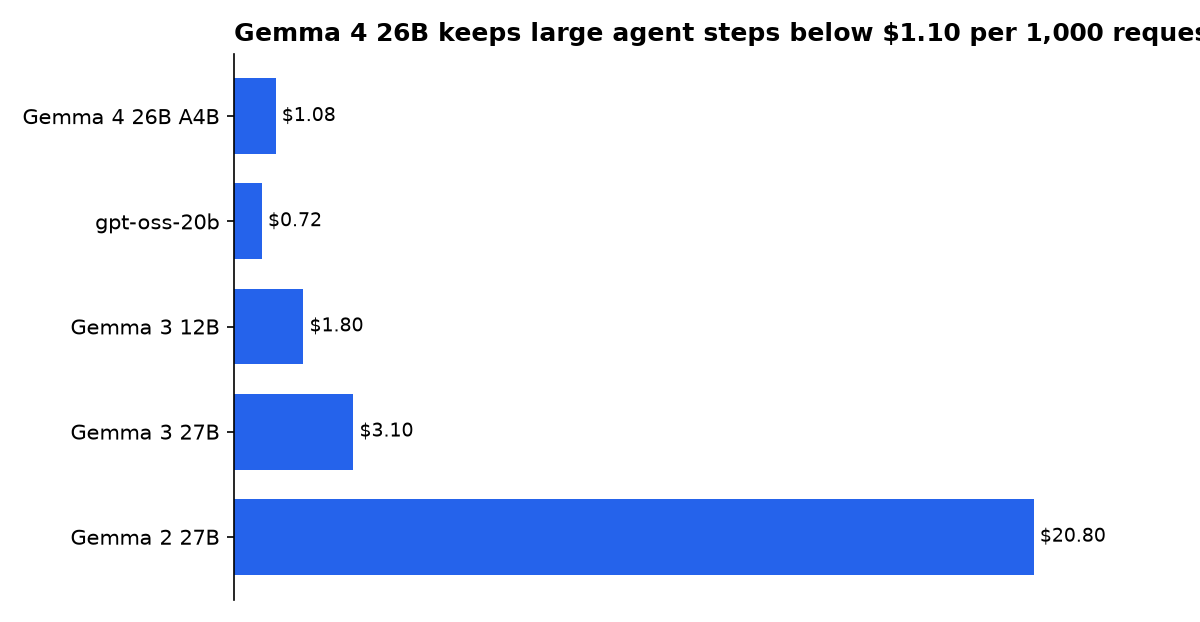
Our calculation uses OpenRouter’s model list prices. It shows the useful buying result: Gemma 4 26B A4B costs about $1.08 for 1,000 large agent steps. That is roughly half the Gemma 3 12B cost and about one-third of Gemma 3 27B, while also offering a longer context window.
Is Gemma 4 26B cheaper than gpt-oss-20b?
No, not on the published OpenRouter list price alone. OpenAI’s gpt-oss-20b costs $0.018 per million input tokens and $0.09 per million output tokens on OpenRouter. Its typical agent-step cost is $0.72 per 1,000 requests, versus $1.078 for Gemma 4 26B A4B.
Gemma 4 26B A4B is still close on output price, at $0.089 against $0.09. It is more expensive mainly because the input price is higher. The trade-off is context: Gemma offers 262,144 tokens, while the gpt-oss-20b page lists 131,072 tokens.
Both models use MoE designs with similar active footprints. OpenRouter describes gpt-oss-20b as a 21B-parameter model with 3.6B active parameters. That supports the broader point: the models’ active counts are close, and their short-output prices are also close, despite different total parameter labels.
Does Gemma 4 26B have a direct Google API?
Google’s public Gemini Developer API catalogue does not list a Gemma 4 26B A4B endpoint. The current model catalogue lists Gemini endpoints, beginning with Gemini 4 Argon, but no Gemma 4 endpoint. Buyers should not assume that downloading Gemma weights and calling a Gemini API are the same product.
Google instead presents Gemma 4 as an open-weight family that developers can download, fine-tune or serve through their chosen infrastructure. The launch announcement names Google AI Studio as a place to experiment with the 26B MoE and 31B models, while also naming hosting and tooling options such as vLLM, Ollama, NVIDIA NIM and Vertex AI.
A gateway is useful when you want a ready API and a per-token bill. Self-hosting is useful when data control, deployment location or sustained volume matters more than operational simplicity. Neither route is automatically cheaper without a measured workload and a hardware plan.
Does the 26B model lose much quality?
Gemma 4 26B A4B is not Google’s highest-scoring Gemma 4 model, but it is close on several published tests. Google reports 82.6% on MMLU-Pro for Gemma 4 26B A4B and 85.2% for Gemma 4 31B. MMLU-Pro is a harder reasoning-focused successor to the older MMLU benchmark.
Google also reports 82.3% on GPQA Diamond for the 26B A4B model and 84.3% for the 31B model. GPQA is deliberately difficult: its creators say subject specialists reached 65% accuracy in the original evaluation, while skilled non-experts reached 34%. The GPQA paper describes the benchmark’s 448 graduate-level science questions.
Those figures are vendor-reported benchmark results, not a promise for a specific application. They do show the decision boundary: use the 26B A4B version when lower API spend and long context matter; test the 31B dense version when a few percentage points on hard reasoning could justify a larger bill.
The MMLU-Pro authors designed their benchmark to reduce easy or noisy questions and increase reasoning difficulty. That makes the reported 2.6-point gap more informative than a generic chatbot demo, but it still cannot replace testing on your own documents, prompts and failure cases.
Which price claims should buyers trust?
Trust a price most when the seller publishes it on the actual purchase page, with a model identifier and unit. OpenRouter’s Gemma 4 26B A4B page clears that standard for its own gateway price. It does not prove that every underlying host charges the same amount, or that the rate will stay unchanged.
Use price aggregators as a market signal, not as a contract. Price Per Token reports a cheapest Gemma 4 31B input rate of $0.10 and output rate of $0.34, and names CoreWeave as the route. That is useful for a directional comparison, but the host’s own order page is the stronger evidence tier.
Reject unexplained claims such as “free unlimited Gemma 4 API” or a bare price without a billing unit, endpoint and update date. Google’s general Gemini pricing page says free access has limited model availability and paid access can include higher rate limits, context caching and batch discounts. Those terms do not establish a paid public price for Gemma 4 26B A4B itself.
What should you actually do?
Start with Gemma 4 26B A4B through OpenRouter if you need a 256K-class context window, text-and-image input, and predictable low token costs. Budget $0.2845 per 1,000 retrieval-heavy answers under the profile above. That gives a practical ceiling before you commit engineering time.
- Choose Gemma 4 26B A4B when long prompts and lower agent costs matter more than maximum benchmark scores.
- Choose gpt-oss-20b when your prompts fit within 131,072 tokens and the lower input rate matters most.
- Test Gemma 4 31B when difficult reasoning is central and you can accept a materially higher token bill.
- Self-host Gemma only after measuring stable volume, privacy needs and the operational cost of serving it.
Before launch, record actual input tokens, output tokens, response length and retry rate for a representative week. Then multiply those figures by the current posted rate. Active parameters tell you why an MoE can be economical; your token mix decides whether it is economical for you.
What we could not verify?
No public direct Google Gemini Developer API price for Gemma 4 26B A4B is listed in Google’s current model catalogue or pricing table. Google could settle that point by publishing an endpoint, a paid token rate and the applicable data-handling terms.
No host has published a complete breakdown showing how much of Gemma 4 26B A4B’s API price comes from active parameters, context memory, accelerators or margin. A provider that disclosed serving configuration and unit economics could settle the causal claim. Until then, active parameters are a strong engineering explanation, not an audited pricing formula.
Sources
- OpenRouter: Google Gemma 4 26B A4B pricing and model page
- OpenRouter: model price list
- Google DeepMind: Gemma 4 model card
- Google: Gemma 4 launch announcement
- Google AI for Developers: Gemini API model catalogue
- Price Per Token: Gemma 4 31B pricing and provider comparison
- arXiv: GPQA benchmark paper
- arXiv: MMLU-Pro benchmark paper

